
Zyphra Zonos
Zyphra · Voice & Language
Zonos is Zyphra's open-weight text-to-speech model for natural voice cloning, emotion control, and multilingual speech, running locally or through the Zyphra API.
About Zyphra Zonos
What Is Zyphra Zonos
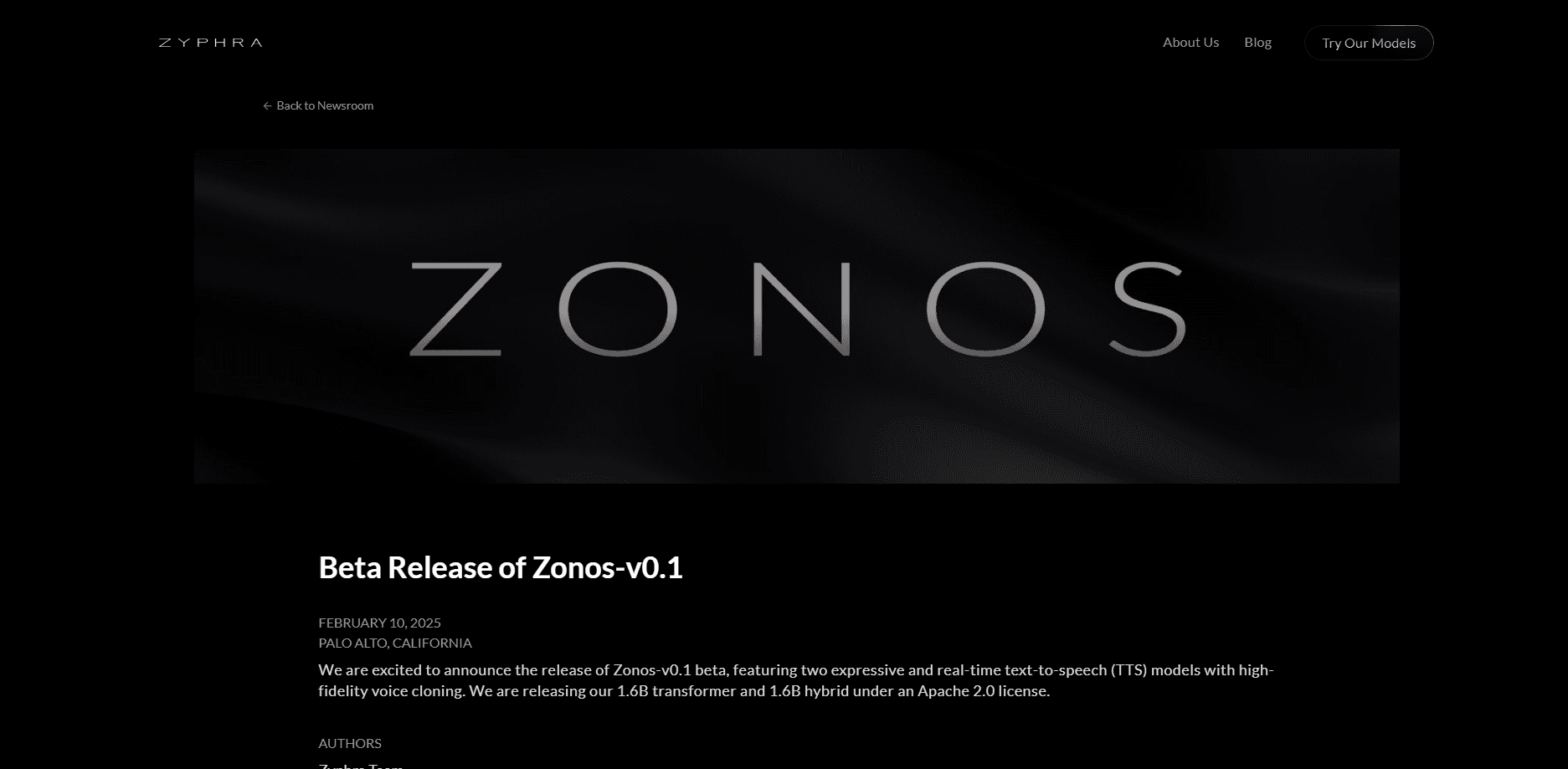
Zonos is a text-to-speech model built by Zyphra, an AI lab focused on open foundation models. This open source text to speech system turns written text into speech and can copy a voice from a short reference clip, usually 10 to 30 seconds of clean audio. The weights ship on Hugging Face under the Apache 2.0 license, so you can run it on your own machine or call it through Zyphra's hosted playground and API.
Zonos v0.1 comes in two flavors: a standard Transformer model and a hybrid that pairs Transformers with a Mamba state space design. Both pack 1.6 billion parameters and were trained on more than 200,000 hours of multilingual speech. Zyphra says the hybrid was the first TTS model to mix these architectures. Speech comes out at 44 kHz, which is higher than the 24 kHz many rivals output.
The catch is that it's a model, not a polished consumer app. You install Python packages, download weights, and manage a GPU if you want speed. The Apache 2.0 license also puts the responsibility for legal, ethical use on you. Cloning someone's voice without consent is illegal in many places, and the license doesn't shield you from that.
Getting Started
- Install the Zonos Python package and PyTorch, then pull the Transformer or hybrid weights from Hugging Face.
- Load a 10 to 30 second reference clip of the speaker you want to clone and let the model build a speaker embedding.
- Write your text and set conditioning options like language, speaking rate, pitch, and emotion.
- Generate the audio and save the WAV, or open the bundled Gradio interface if you'd rather use a browser.
- For a faster start without setup, try the hosted playground at playground.zyphra.com/audio.
Product Information
A quick look at Zyphra Zonos's pricing, supported platforms, and performance.
Best for
The users, tasks, and scenarios where this tool fits best.
Users
- Indie developers
- Podcasters and audiobook creators
- Accessibility and voice-assistant builders
Tasks
- Cloning a specific speaker
- Multilingual narration
- Emotional delivery
Scenarios
- Prototyping a voice product
- Localizing video narration
- Building a private voice pipeline
Key features
Zero-Shot Voice Cloning
Zonos TTS copies a voice from a reference clip of roughly 10 to 30 seconds, with no extra training. Give it clean audio and a text prompt, and it predicts how that speaker would read your script. Zyphra reports that reviewers found short-sample clones convincing on first listen, but pacing can drift on longer passages.
Audio Prefix Inputs
Beyond speaker embeddings, you can feed an audio prefix alongside your text. This nudges the model toward harder-to-copy behaviors such as whispering, which embeddings alone struggle to reproduce. It's a practical tool when the exact delivery matters more than raw similarity.
Emotion and Audio Quality Control
The conditioning setup exposes speaking rate, pitch variation, maximum frequency, and audio quality as adjustable knobs. Emotions including happiness, anger, sadness, and fear are tunable too. For anyone producing character dialogue or dramatic reads, that control is the reason to pick Zonos over a fixed-voice generator.
Multilingual Speech
Zonos v0.1 handles English, Japanese, Chinese, French, and German. English dominates the 200,000-plus hours of training data, so expect the crispest results there, with the other languages solid but less polished. It's enough for multilingual projects that would otherwise need several separate tools.
Two Model Architectures
You choose between a Transformer backbone and a Transformer-Mamba hybrid. Zyphra says the hybrid was the first TTS model to combine these designs. Both use the same weights-per-parameter scale, so the pick comes down to how each behaves on your hardware and content.
Self-Hosted Deployment
The Apache 2.0 weights run fully offline, and a packaged Docker file handles setup. Zyphra says the model hits a real-time factor of about 2x on an RTX 4090, meaning it generates two seconds of audio per second of compute. Running locally keeps audio private and removes ongoing per-use charges.
Pros and cons
Pros
- Open weights under Apache 2.0, so you can run it offline and inspect how it works.
- Strong zero-shot cloning from clips as short as a few seconds.
- Fine control over rate, pitch, and emotion in one place.
- 44 kHz output beats the 24 kHz many competitors ship.
Cons
- Setup needs Python, PyTorch, and a GPU for fast generation, which rules out non-technical users.
- Non-English languages are usable but noticeably weaker than English.
- Cloning carries real legal and ethical risk, and you shoulder that responsibility yourself.
- The hosted API and playground have their own pricing, so free local use means managing your own hardware.
Frequently asked questions
Zonos turns text into speech and clones a target voice from a short clip. People use it for narration, audiobooks, voice assistants, and any project that needs a consistent or custom voice.
Related content
Explore related tools, skills, and articles for Zyphra Zonos.
Zyphra Zonos Alternatives

Foley
Hanamori Labs, LLC · Voice & Language · Productivity · AI AssistantFoley is a voice to-do list that turns a spoken sentence into a filed task, complete with project, date and time, then helps you plan the day around what is already there.
HireKey
HireKey · Voice & Language · Productivity · LeaningHireKey is an AI job search copilot built by a former tech recruiter. It checks role fit, tailors resumes, runs interview practice and tracks every application.
Fluence
Yay Software (Yannick Huchard) · Writing · Voice & Language · ProductivityFluence is an Android app that reads PDFs, EPUBs, Word files and web articles aloud, follows each sentence as it speaks, and answers questions about the text on the phone itself.