
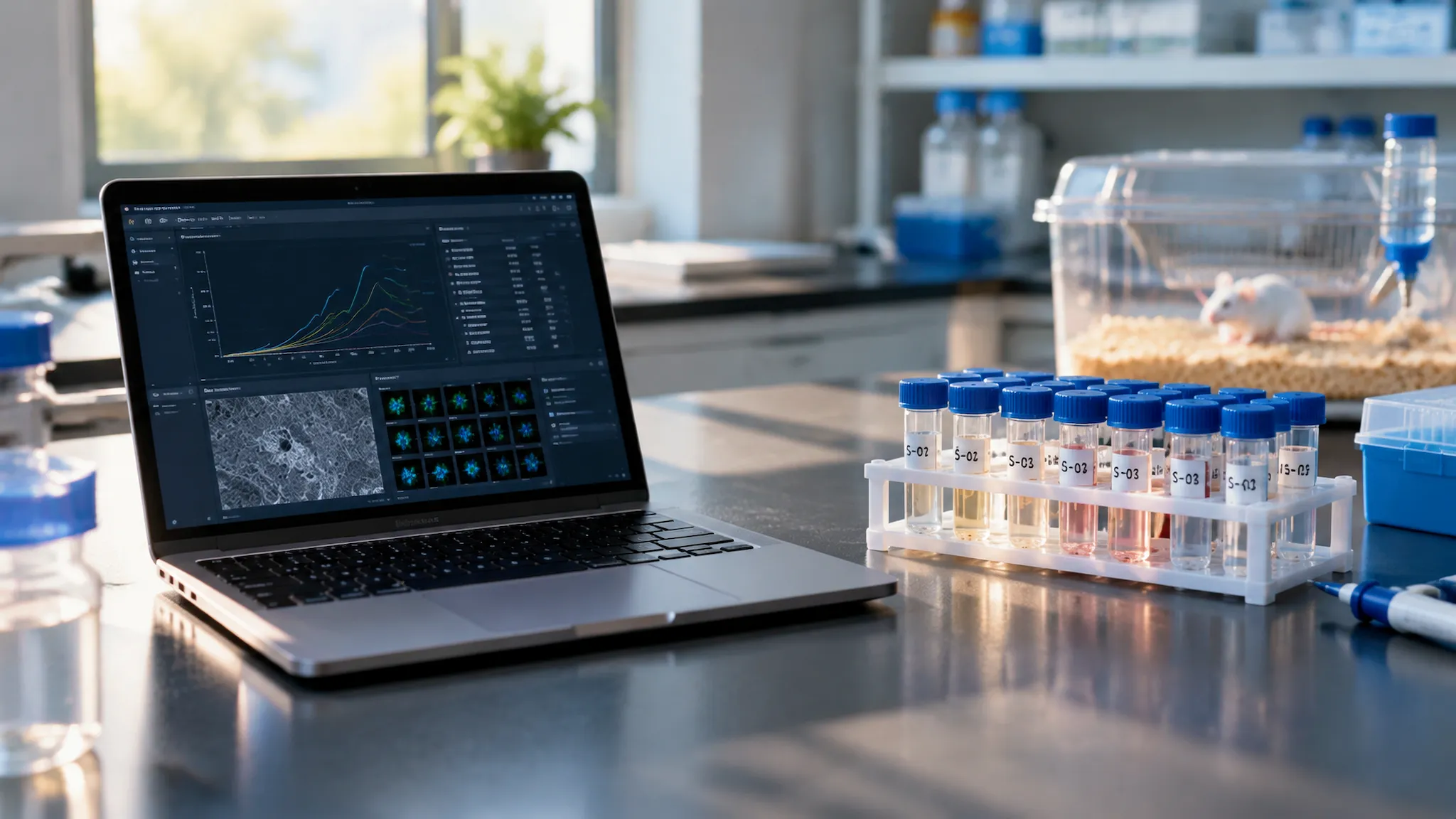
Anthropic acquired Mithril Medicine, a company with one employee, and published early results from six outside drug programs that used Claude. The results are preclinical, which is the part worth holding onto.
Anthropic Acquires Mithril Medicine, a One-Person Biotech
Anthropic said on October 27 that it bought Mithril Medicine, a startup founded by Cody Tranbarger and staffed by nobody else. Mithril has been working on treatments for two rare forms of muscular dystrophy. Tranbarger joins Anthropic and will keep that research going alongside new programs.
A one-person biotech sounds like a punchline until you look at what the job involves. Drug discovery runs on reading, writing protocols, ordering experiments from contract labs, and tracking results across dozens of parallel threads. It's a desk job with a lab bill attached, and it's the kind of desk job a model can sit inside.
Anthropic framed the purchase as a way to learn, not a way to sell medicine. Its life sciences team says running real programs is the only way to find where a model helps and where it quietly gets things wrong.
What Mithril Says Claude Did in 18 Months
According to Anthropic, Tranbarger used Claude to coordinate work with 11 outside labs and moved a candidate therapy for one of the two dystrophies from an idea to positive results in mice in under 18 months.
The company also says Mithril built more than 100 new bispecific antibodies and that those designs are in cell-level testing. A bispecific antibody is a molecule engineered to grab two biological targets at once, which is a useful trick when a disease needs two things blocked together.
Targets are on the record too. Anthropic says the goal is to formally nominate drug candidates for both diseases in 2027, and to reach clinical trials for LAMA2-CMD, one of the two conditions, as early as late 2028. Nomination is the point where a company picks one molecule out of many and commits money to developing it.
Treat every one of those dates as a plan from an interested party. Drug timelines slip, and the company says so itself.
Preclinical Means Mice, Not Patients
The words "promising results in mice" are doing a lot of work in this announcement, and readers should slow down at them.
A mouse result means a molecule did something measurable in an animal model of a disease. It doesn't mean the molecule is safe in humans, that it reaches the right tissue in a person, or that it survives the trial process. Most candidates that look good in mice never become drugs, and that failure rate is the reason a new medicine costs what it costs.
Anthropic's own language keeps to that boundary. Nothing here is in patients. The programs are preclinical, which is the stage before the first human dose.
Generate Biomedicines and the CAR-T Instruction
The partner results are more specific, and one is easy to picture. Generate Biomedicines works on CAR-T therapy, a cancer treatment that reprograms a patient's immune cells to attack tumors.
Six Generate scientists used Claude Code to redesign one segment of the genetic instructions for that therapy. One design came out about 70% shorter than the standard version. In lab tests, immune cells carrying it produced roughly 10 times as many receptors, killed tumor cells more efficiently, and stayed active longer.
Shorter instructions leave room for other genetic payloads, which is the practical reason to care. If a designer can trim one part without losing potency, the rest of the sequence can carry more. The tradeoff is that a compact design only helps if it holds up outside one assay.
Divergence Labs and 35,000 Antibody Designs
Divergence Labs is chasing food allergies with a two-armed drug. One arm binds to IgE, the antibody behind allergic reactions. The other pries IgE off immune cells, which standard drugs don't do.
According to Anthropic, Claude turned the company's goals into a design plan and then generated roughly 35,000 antibody designs in about a month, largely on its own. Early tests found hits on both arms: three designs that bind IgE, and 20 that strip it from immune cells, three of which beat the standard drug in that test.
The next step is joining the two arms into one molecule. That's a hard engineering problem, and a hit in a plate isn't a drug.
Anthropic also cites Enveda cutting document review time for production files by about 89%, and BigHat Biosciences using Claude for lead optimization, the stage where a decent molecule gets tuned into a manufacturable one. Both numbers come from the companies involved and haven't been independently checked.
Which Part of Drug Discovery AI Actually Touches
It helps to separate the stages, because "AI drug discovery" covers everything from a promising target to a filed application.
Target discovery asks which protein to hit. Molecule design asks what shape should hit it. Lead optimization asks whether that shape can be made, stored, and dosed. Manufacturing asks whether you can produce it at scale. Regulatory work asks whether the paperwork proves any of it. Clinical trials ask whether it works in people.
Most of the work in this announcement sits in design, optimization, and documentation. That's real work, and it's where a language model with tool access can compress weeks of reading and drafting. It isn't the same as proving a drug works.
The economics explain the interest. A failed trial costs far more than a failed design, so anything that improves the odds earlier in the chain is worth money. It also explains the caution. A model that produces 35,000 designs has made the testing bottleneck worse, not better, unless the filters around it can sort them.
How to Read Anthropic's Drug Discovery Claims
Three questions are worth keeping in hand.
Did an independent lab reproduce the result? For the Generate and Divergence work, the partners published their own technical reports, which is better than a screenshot and still not a peer-reviewed trial.
Was the comparison fair? A 70% shorter genetic sequence is impressive if it performs as well or better in the same assay, and the assay details decide that.
What happens at the next stage? Mouse data and cell data are cheap compared with a phase one trial. The 2028 target for LAMA2-CMD will be the first real test of whether any of this survives contact with human biology.
Anthropic says it plans to scale the work up, with food allergies, rare childhood diseases, and several cancers on the list. If the company is right, the interesting part won't be this announcement. It will be the first program that fails in a way everyone can see, because that's when the field learns what the model can't do.