
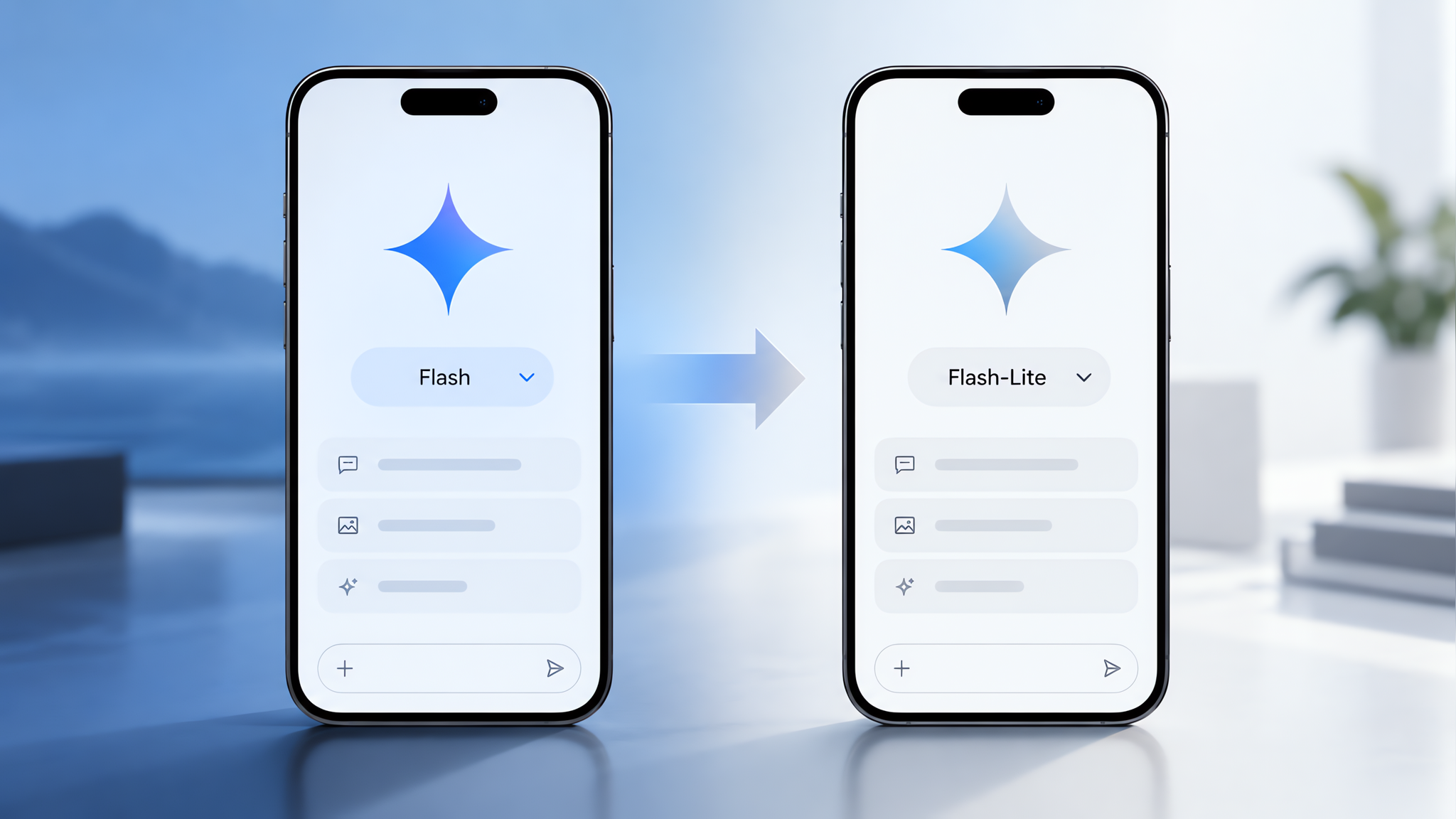
Starting October 9, the free version of the Gemini app stops giving you Flash and Pro by default and hands you Flash-Lite instead. Here's exactly what each tier keeps, and what changes for you if you pay nothing.
Google is moving Gemini's free tier to Flash-Lite
If you use the Gemini app without paying, the model behind it's about to change. Google's support page and the in-app popup now tell free personal-account users that starting October 9, 2026, they'll no longer get default access to the full Flash model or the Pro model. The app drops them to Flash-Lite, the smallest and fastest model in the lineup.
The shift was flagged to users through a popup inside the app and confirmed on Google's support pages. Several tech outlets picked it up on October 3. No ambiguity, no fine print.
What's worth understanding is that this isn't a surprise bug or a temporary limit. It's the end of a long stretch where anyone could use Google's capable models for nothing. From October 9, the models Google has spent months promoting sit behind a subscription, and the free option becomes a lighter one.
What each Gemini plan keeps after October 9
The change hits every tier differently, so the useful part is the breakdown. According to Google, here's where each plan lands:
Google AI plan | Flash-Lite | Flash | Pro |
|---|---|---|---|
No plan (free) | Yes | No | No |
AI Plus | Yes | Yes | No |
AI Pro | Yes | Yes | Yes |
AI Ultra | Yes | Yes | Yes |
Read the middle row again, because it's the one people are missing. AI Plus is a paid plan, and it still loses Pro access. Want all three models? You'll need AI Pro, which becomes the cheapest tier that includes them.
The free change lands October 9. AI Plus subscribers get an email telling them when their own adjustment arrives, which hints their rollout runs on a slightly later schedule.
Inside whichever model you have, you can set an effort level of low, medium, or high, and higher effort produces more thorough answers while burning through your allowance faster. AI Pro and AI Ultra subscribers also get Deep Think, which Google describes as maximum parallel reasoning for hard problems. That's the expensive end.
Why Google is gating its fastest-growing models
The timing is the interesting part. Flash is where Google's momentum has been all year. Gemini 3.8 Flash arrived on September 2, following a run of Flash releases through the summer, and Sundar Pichai called Gemini 3.7 Flash the company's fastest-growing model ever when it launched.
So the model family Google has been pushing hardest is the one now moving behind a paywall for free users. That reads less like trimming a legacy feature and more like Google deciding its best-known models are worth charging for.
The Pro line tells a messier story. Gemini 3.5 Pro was announced at I/O but never shipped, and reports suggest Google shelved it to jump ahead to Gemini 4. Google has been testing a model called Gemini 4 Argon with partners. None of that's confirmed for regular users yet, and free users won't be the first to feel it either way.
What changed before: Gemini's usage limits went compute-based
The model restrictions land on top of an earlier overhaul to how Gemini counts your usage. Since May 17, Gemini runs on compute-based limits instead of a fixed number of daily prompts, so what you spend depends on how complex your request is, which features you use, and how long the chat runs. Limits refresh every five hours until you hit a weekly cap.
Paid plans get a bigger budget: AI Plus gets 2x the standard limit, AI Pro gets 4x, and AI Ultra gets 5x or 20x the Pro limit depending on the subscription.
The catch is that the heavy features burn allowance fastest. That includes image, video, and music generation, Deep Research, the Pro model, and extended thinking. Moving Flash and Pro off the free tier means free users lose access to two of the models that eat the most compute.
Put together, the two changes push in the same direction: free access gets lighter, and the capable stuff costs either money or a bigger share of a capped budget.
What this means if you use Gemini for free
This one's simple.
What this means if you use Gemini for free
For casual use, the shift may not sting much. Flash-Lite is built to be quick, and for everyday questions, drafting, and quick lookups it does the job. If that's all you ever asked of Gemini, you probably won't notice the swap. No big deal.
It bites if you leaned on the free app for the harder work. Long documents, multi-step reasoning, and detailed research are exactly where Flash and Pro made a difference, and those are the tasks that now need a paid plan. Anyone who's been treating free Gemini as a serious work tool has a decision to make before October 9.
If you want to try the other side, Google says you can start, upgrade, change, or cancel a Google AI plan from inside the Gemini app. If you'd rather stay free, it's worth checking which tasks you actually relied on and whether Flash-Lite still covers them.
The next thing to watch is whether AI Plus users grumble loud enough to change Google's plan, and whether the rumored Gemini 4 family lands with anything for the free tier. For now, the safe assumption is simple: the free ride on Flash and Pro ends October 9.