OpenAI split its newest generation into three models instead of one. Astra handles the hard science, Sol handles your day job, and Luna exists because most prompts don't need a frontier model. Here's what each is actually for, and what the half-price API cut means for anyone paying per token.
What OpenAI shipped on September 22
Two new models joined the GPT-6 family: Sol and Luna. Both went live in the ChatGPT API on release day, and OpenAI says the pair is now the default pick for most paid accounts inside ChatGPT Work and Codex.
The GPT-6 name covers three models, and OpenAI introduced them in stages. Astra arrived first, on September 3. Sol and Luna followed this week and take over the middle and budget slots that GPT-5.6 Sol and GPT-5.6 Luna used to fill.
OpenAI calls Astra its most capable model and still points anyone with a hard problem at it. Sol and Luna borrow the training methods behind Astra but run on faster, cheaper infrastructure. In the company's words, the goal is to spread "the benefits of that intelligence" to work that happens at different scales and budgets.
Sol, Luna, and Astra: who each model is built for
The split is about the kind of work you throw at a model, not how recently it shipped. A day-old budget model can beat last year's flagship on the one job it was built for.
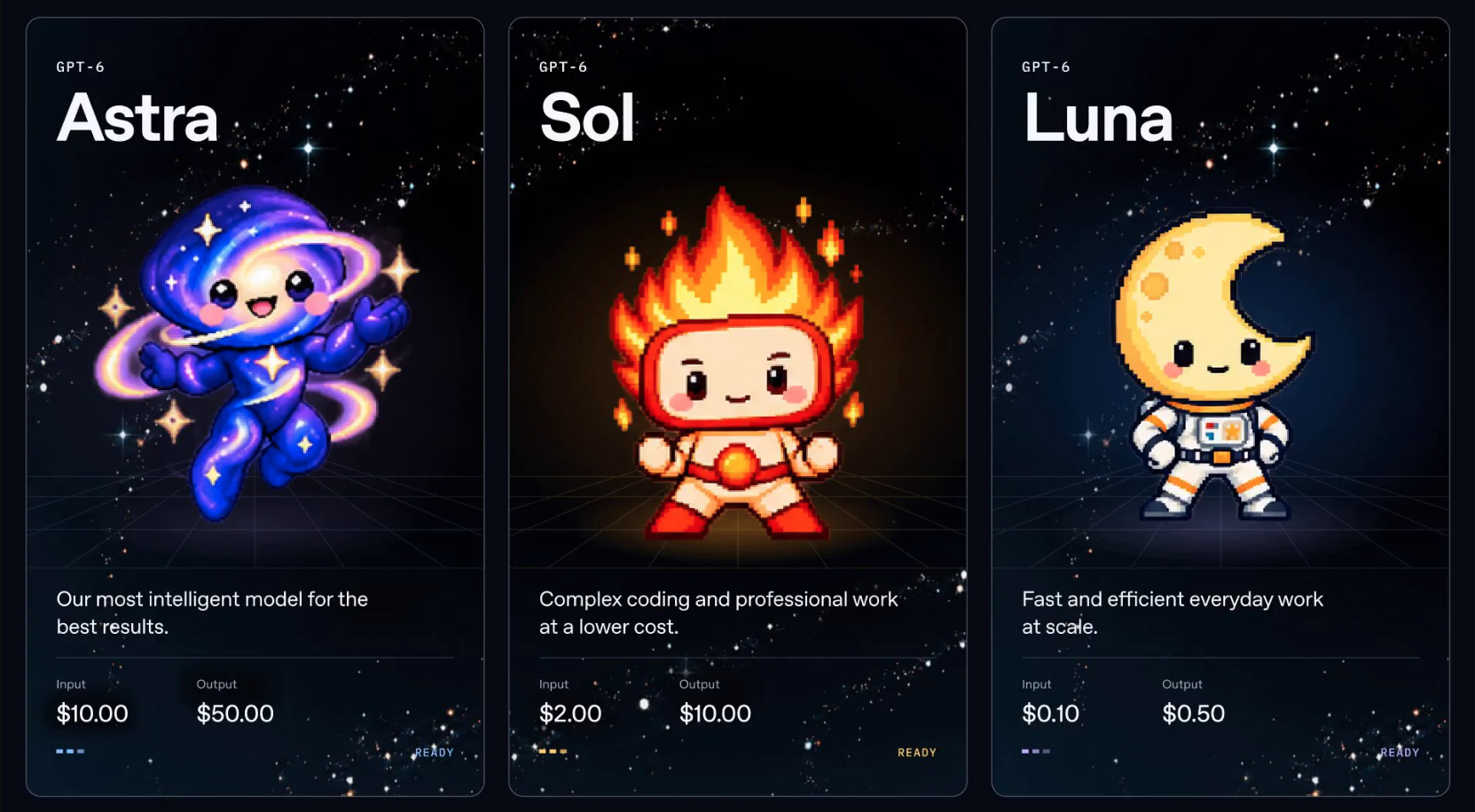
Astra is the one to reach for when a project crosses several media types at once, or when the math and science have to be right the first time. It's the most expensive of the three and the least likely to be your everyday driver.
Sol sits in the middle and targets work you repeat. Feature work, code review, debugging, data analysis. OpenAI built it for developers and knowledge workers who run the same kind of task dozens of times a day, where a slightly worse answer is fine but a runaway bill isn't.
Luna is the volume option. OpenAI describes it as a fit for "high-volume tasks with a clear goal, like summarizing documents, extracting information, or answering quick questions." Think inbox triage, pulling numbers out of PDFs, or a support bot that answers the same question all day. Cheap and fast. That's the entire point.
Model | Position | Typical work | Thinking effort | Input / Output per 1M tokens |
|---|---|---|---|---|
GPT-6 Astra | Flagship | Multi-step research, hard science and math, mixed media | Fixed | Premium tier |
GPT-6 Sol | Mid-tier | Coding, code review, debugging, data analysis | low to max | $2 / $10 |
GPT-6 Luna | Budget | Summarizing, extraction, quick questions | low to high | $0.10 / $0.50 |
The API price cut, in plain numbers
OpenAI halved the rates on both models. Sol now costs $2 per million input tokens and $10 per million output tokens, down from $4 and $20. Luna moved to $0.10 and $0.50, from $0.20 and $1.20. That second cut is steeper than it looks: input dropped 50%, output dropped 58.3%.
A company spokesperson told VentureBeat these are permanent rates rather than a launch promotion. OpenAI credits better caching and inference, meaning it costs the company less to serve the same answer, so it passes the difference on.
So what does that look like on a real invoice? A team running an agent that makes hundreds of model calls per workflow sees the line item drop by more than half. Each call gets cheaper, and the savings stack because the workflow replays context on every step.
At $2 input and $10 output, Sol lands on exactly the same numbers Anthropic charges for Claude Sonnet 5. Luna, meanwhile, undercuts most of the cheap tier from Chinese labs, including some DeepSeek and MiniMax options.
Where GPT-6 Sol and Luna land on benchmarks
Every number below comes from OpenAI's launch post, so treat them as vendor-reported until outside labs run their own tests.
On AutomationBench, which walks an agent through 47 real tools across sales, marketing, operations, support, finance, and HR, GPT-6 Sol at xhigh effort scored 33.2%, ahead of Claude Opus 5 at max effort at 26.9%. OpenAI puts Sol's cost per task at $0.27, roughly a ninth of Opus 5's on the same test.
On DeepSWE v1.1, which measures long-horizon software engineering in real codebases, GPT-6 Sol at max effort reached 68.8%. That's 1.1 points behind Claude Fable 5's top score of 69.9%, at about 80% lower cost per task. Luna at max effort scored 66.6%, which OpenAI compares to Claude Opus 5 and Fable 5 at medium effort while costing 93% less per task than Opus 5.
Factuality got the quieter upgrade. On OpenAI's internal evaluation, built from real conversations where users flagged a model mistake, GPT-6 Sol makes about half as many errors as GPT-5.6 Sol. OpenAI says that puts it near Astra-level reliability at a fraction of the cost.
One caveat worth keeping in mind: that factuality test only counts conversations where a user had already caught an error, so the error rates look far worse than what you'd hit in normal use.
What the price war means if you don't write code
If you pay for ChatGPT rather than pay per token, the release changes less for you than the headlines suggest. Sol and Luna are already the default for most paid accounts in ChatGPT Work and Codex, and Luna is reaching desktop, Free, and Go users as the rollout spreads through the day.
The interesting part is the timing. Anthropic shipped Opus 5.5 about 90 minutes before OpenAI's announcement, which tells you these two labs are now launching against each other's calendars rather than their own roadmaps. For anyone deciding where to spend a monthly AI budget, that competition is the useful signal.
If you build on the API, pull your token logs before the next billing cycle and check which calls actually needed a frontier model. A lot of what teams route to their best model is summarization and extraction that Luna now handles for a tenth of the price.