Same family, wildly different price tags. GPT-6 Sol costs 20 times more per token than GPT-6 Luna, and the scores sit closer than that gap suggests. We pulled apart the benchmark tables and the cost-per-task math to show where the extra money actually buys you something, and where it doesn't.
The one number that drives everything
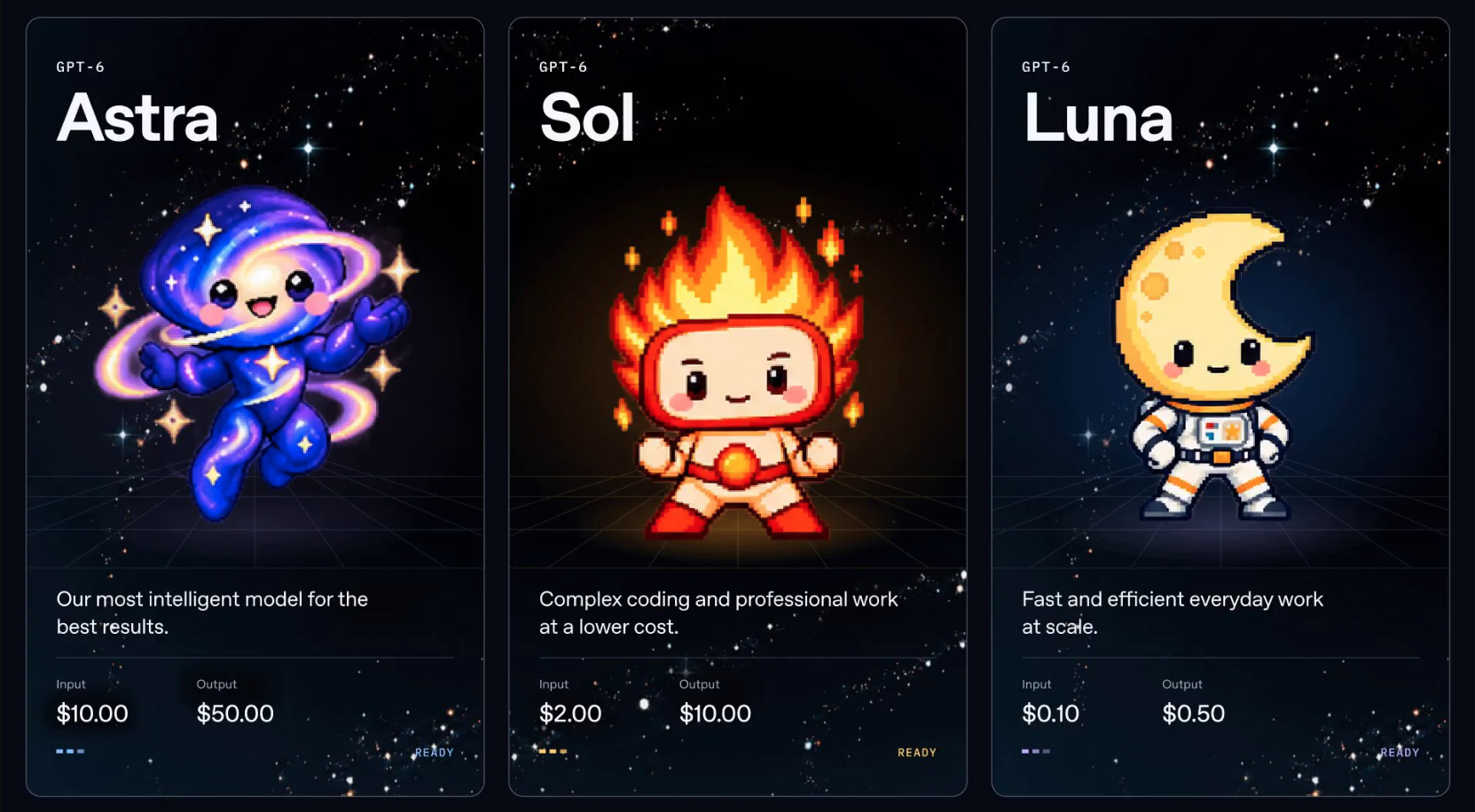
Sol and Luna come from the same generation and the same training recipe. The price is where they part ways. Sol runs $2 per million input tokens and $10 per million output tokens. Luna runs $0.10 and $0.50.
That's a 20x gap on input and a 20x gap on output. If you're the one holding the invoice, that single difference explains why the two models exist as separate products at all.
The short answer most people want: Luna wins on cost per finished task almost every time, Sol wins on the tasks Luna genuinely can't do. Neither one is a bad buy.
GPT-6 Sol | GPT-6 Luna | |
|---|---|---|
Input price per 1M tokens | $2 | $0.10 |
Output price per 1M tokens | $10 | $0.50 |
DeepSWE v1.1 (max effort) | 68.8% | 66.6% |
AutomationBench (xhigh / high) | 33.2% | Improves 5.4 points over GPT-5.6 Luna |
Thinking effort range | low to max | low to high |
Built for | Coding, debugging, data analysis | Summarizing, extraction, quick answers |
Where the two models actually differ
Both were trained with the same methods OpenAI used for Astra, and both are meant to run cheaper than the flagship. The separation is in how much thinking they're allowed to do and what that costs.
Sol gets a wider effort dial, running from low all the way to max. That matters for long agent runs, where the model has to hold a plan, call tools, check its own work, and recover from dead ends. The extra reasoning budget is what keeps a multi-step job on the rails.
Luna caps out at high effort. OpenAI positions it for jobs with a clear finish line, like summarizing a document, pulling structured fields out of an email, or answering a straightforward question.
The scores reflect that division of labor, but not as dramatically as the price gap. On DeepSWE v1.1, a benchmark for long-horizon software engineering in real codebases, Sol at max effort hit 68.8% and Luna at max hit 66.6%. Two points apart.
AutomationBench and DeepSWE: what the numbers say
All scores come from OpenAI's launch post, so they're vendor-reported and not yet replicated by independent labs.
AutomationBench puts an agent through end-to-end business workflows across 47 tools, covering sales, marketing, operations, support, finance, and HR. GPT-6 Sol at xhigh effort scored 33.2% at $0.27 per task. For reference, Claude Opus 5 at max effort scored 26.9%, and OpenAI puts its cost per task at about 11 times Sol's. Low-effort Astra landed at 30.3% while costing 3.9 times Sol.
Luna's row is thinner. OpenAI reports that at high effort it beats GPT-5.6 Luna by 5.4 percentage points while costing 58% less per task. It doesn't post a headline AutomationBench number against the frontier models, which tells you something about who the model is for.
On DeepSWE v1.1, the comparison gets sharper. Sol's 68.8% is 1.1 points behind Claude Fable 5's best of 69.9%, at roughly 80% lower cost per task. Luna's 66.6% matches what the top Anthropic models score at medium effort, but Luna gets there for 93% less per task than Opus 5 and 96% less than Fable 5.
Here's the part worth sitting with. Luna hits the same DeepSWE number as Sol at xhigh effort for $0.22 a task against Sol's $1.00. If your workload looks like that benchmark, the expensive model is buying you almost nothing.
Pick GPT-6 Sol when
- The task runs long and needs a full plan kept in memory
- A wrong answer costs more than the tokens do
- Your agent has to call tools, check itself, and retry
- You need the max reasoning effort tier
Pick GPT-6 Luna when
- The job has a clear finish line, like summary or extraction
- You're running the same prompt thousands of times
- Latency and cost matter more than the last two points of accuracy
- You'd otherwise be paying for intelligence you don't use
The cost-per-task gap is the real story
Sticker price gets all the attention, but cost per finished task is what lands on the invoice. OpenAI's own charts show Luna undercutting the top Anthropic and OpenAI models by 93% to 96% on the DeepSWE workload.
The reason is simple. Luna's most expensive setting is still cheap, and on a lot of benchmarks its best score comes from that top setting. Sol's ceiling is higher, but reaching it means paying max-effort rates on every call.
That flips the usual intuition. The expensive model isn't automatically the wrong choice, but it's the wrong default. Most production pipelines mix both: a cheap model for the 80% of calls that are routine, and the pricier one held back for the steps that genuinely need it.
So which one do you actually need?
The gap between these two isn't quality so much as tolerance for failure and the shape of the task.
Reach for Sol if you're shipping code, chasing a bug through a large repo, or running an agent that has to recover from its own mistakes. The wider effort dial and the higher ceiling show up on exactly those jobs, and the 20x premium pays for itself the first time a bad answer costs you an afternoon.
Reach for Luna if you're doing document work at scale. Summarizing support tickets, extracting line items, answering the same customer question all day. The scores land close enough to the frontier that most users won't notice, and the bill will be a rounding error next to Sol's.
A reasonable setup uses both. Route the easy 80% of calls to Luna, keep Sol for the steps that decide whether the whole job succeeds. Pull your token logs, see which tasks actually need the expensive model, and move the rest down. That single change usually cuts the monthly bill more than any prompt tweaking will.