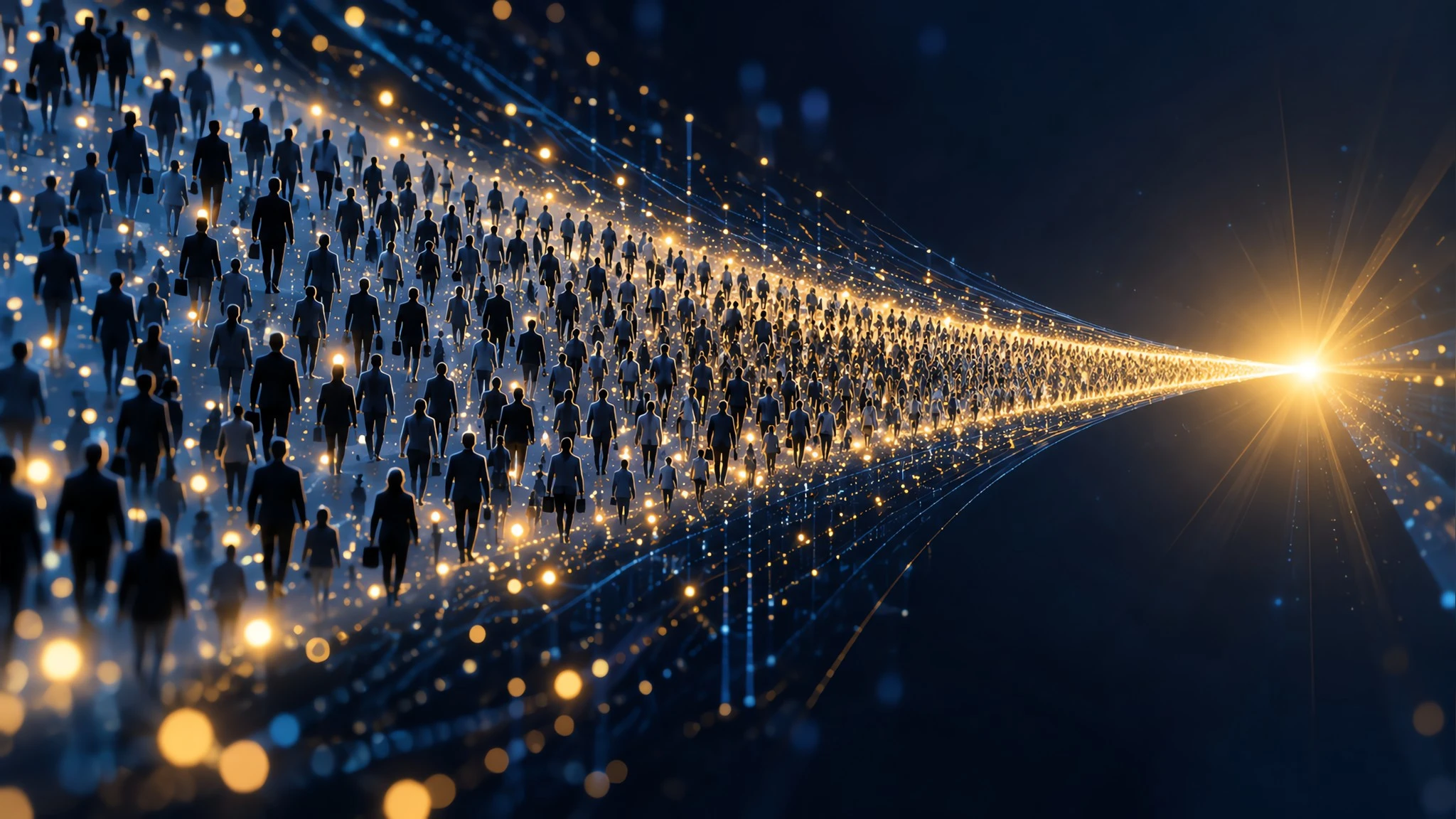
Andrej Karpathy says the gap in how people understand AI models has stopped being two camps talking past each other. By his rough estimate, it now looks like a funnel, with billions of people barely touching the technology at the wide end.
Karpathy Says the LLM Understanding Gap Is Widening
Andrej Karpathy, a founding member of OpenAI and a former AI director at Tesla, posted on X on October 11 that the gap in shared understanding of what large language models can do is getting wider, not narrower. He said he was dusting off a tweet from April because the problem had grown since then.
His phrasing was blunt. The divide is no longer "two groups of people speaking past each other," he wrote. It's now a sharp funnel.
What does that actually mean?
LLM here means large language model, the kind of AI behind tools like ChatGPT and Claude. Karpathy's point isn't about the models themselves. It's about how differently people experience them, from those who use frontier systems every day to those who have never typed a prompt.
The Funnel: 6 Billion People at the Wide End
Karpathy's back-of-the-envelope math sketches the shape of the gap. Roughly 6 billion people, or about 75% of the world's population, have barely any exposure to what current models can do, he estimated.
At the narrow end, he suggested a far smaller group has hands-on access to the most advanced systems, and early coverage of his post put that inner circle at around 5,000 people who work with frontier models inside companies every day.
The middle, in his framing, is thinner than you might assume: people who use AI casually but rarely push it to its limits. The funnel narrows fast because the tools that exist and the tools most people actually use are running on very different capability levels.
Why Karpathy's Point Matters
If Karpathy is right, most conversations about AI are happening between people standing at different points in that funnel. One person describes what a model does reliably today. Another has only seen an older or weaker version, or none at all.
That mismatch shapes everything from policy debates to workplace expectations. A manager who assumes AI can handle a task because a demo pulled it off is drawing on the narrow end. A worker who hasn't seen the same demo is drawing on the wide end. Neither is lying. They're just describing different rungs of the same ladder.
Karpathy's framing is a personal observation, not a measured statistic. The numbers are his own estimates, and there's no dataset behind them. But the idea that access, not raw capability, is the dividing line is one a lot of people in the field have been circling.
What's well established
- Frontier models outperform what most casual users ever try
- Access to the strongest systems is uneven across companies and regions
- Public perception of AI lags behind what experts can do with it
What's still Karpathy's estimate
- The "6 billion people" and "5,000 with access" figures
- The claim that the gap is widening rather than holding steady
- Whether the funnel shape holds across every region and industry
How the Community Reacted
The post spread quickly. On Hacker News, a discussion tied to the widening-gap idea drew about 198 points and 316 comments, according to summaries of the thread. Several practitioners and writers reshared it, including Ethan Mollick, who studies how people actually use AI.
The reaction wasn't uniform agreement. Much of the thread argued over where the middle of the funnel sits and whether everyday users are catching up faster than Karpathy suggests. That back-and-forth is itself a sign of his point: even people paying close attention disagree about how the technology lands in ordinary hands.
What to Watch
The honest answer is that nobody has a clean measurement of this gap. Karpathy's napkin math is a provocation, not a finding.
The useful thing to track is access. Cheap models keep improving, and the floor of what an average user can reach rises with them. Whether that widens the narrow end of the funnel, or just moves the whole thing up, is the open question worth watching over the next year.