
Abyss
Abyssal Corporation · Coding · Other
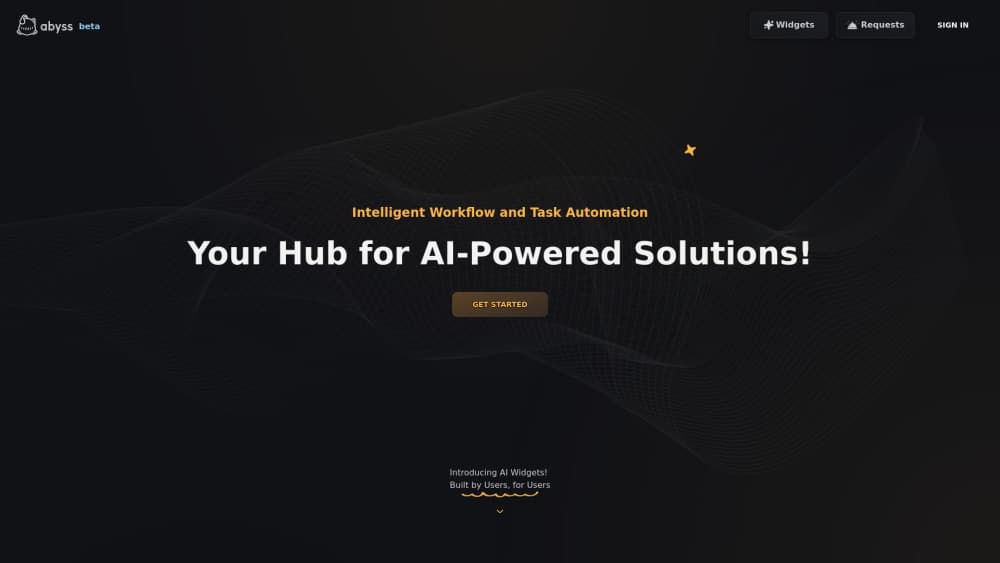
Abyss is a marketplace where you run AI Widgets: small Python apps that handle one task. Browse or build a widget, supply inputs, and get an output, with no prompt writing needed.
About Abyss
What Is Abyss
Abyss is a subscription-based marketplace for AI Widgets, sold by Abyssal Corporation. A widget is a compact Python application built for one job, like extracting text from a PDF or cleaning a spreadsheet. Many add an AI model underneath (GPT, Claude, Gemini, Grok or a NIM), and the platform handles deployment so the code runs when you press a button. You don't write prompts and you don't touch Python if you only want to use what's already there.
The catalog sets Abyss apart from a plain chatbot. Instead of one general model answering everything, you pick a widget shaped for your exact task, fill in its form, and read the files it returns. Builders publish widgets too, and they set a price per run in Byssium, the store credit. When people run your widget, the credits flow to you and you can withdraw them as real money.
Two limits matter before you sign up. Running a widget costs Byssium, and the free tier gives you a starting balance that refreshes, so heavy use pushes you toward the paid plan. And the platform is web only, so there's no desktop app or mobile client to install.
Getting Started
- Create a free Abyssian account on abysshub.com and land on the Widgets store
- Open a widget, read its sample run to see what inputs and outputs look like, then fill the form or upload your files
- Press Run and download the output files it produces
- To build your own, upload a Python project with a run.py entry point, layer an interface over it, and run a test before you publish
Product Information
A quick look at Abyss's pricing, supported platforms, and performance.
Best for
The users, tasks, and scenarios where this tool fits best.
Users
- Non-technical users who need one task done
- Python developers who want distribution
- Freelancers and small teams
- AI enthusiasts comparing models
Tasks
- Document processing
- File conversion and cleanup
- Report and template generation
- Task-specific automation
- Custom tool creation
Scenarios
- A lawyer has a stack of contracts to scan for key terms
- A student needs a form filled from notes
- An HR team screens resumes in bulk
- A builder wants income from a script
- A team can't find an existing widget
Key features
The AI Widgets Store
The store is the core of the marketplace. Each widget is a self-contained app built for a defined task, with a form-based interface on top. You browse, search and open any widget, see a sample run with its inputs and outputs, then run it yourself. Because the interface hides the code, a widget built by a developer works the same for someone who has never opened a terminal.
Widget Creator for Python Projects
Builders publish widgets by uploading a Python project with a fixed structure: a run.py entry point, a requirements.txt for packages, an optional requirements.system for apt packages, and an output folder that holds what the user gets back. Inputs arrive as environment variables, so your script reads them with os.environ.get(). Abyss takes care of deployment, and a successful test run doubles as the public example.
Interface Builder With Standard Input Types
Before a widget goes live, you design the form users fill in. Abyss supplies the building blocks: text fields, text areas, number fields, radio groups, checkboxes, dropdowns, date pickers and file inputs where you set the accepted extensions. A file named resume.pdf saved to the path data arrives as data.pdf. The point is a fixed, predictable form, so users never guess what to type.
Requests and Bounties
If the widget you need doesn't exist, the Requests page lets you describe the automation you want. You can attach a bounty to draw builders to it. When someone finishes the widget, it goes live for everyone on the platform and the creator collects the bounty. It's a way to turn a one-off need into a shared tool.
Byssium Credits and Creator Payouts
Abyss runs on Byssium, an in-store credit you buy with or without a paid plan. Each widget's creator sets the price per run, and the credits a user spends pass to the creator in full; Abyss earns from the credit exchange and its subscription cut. Creators can withdraw earnings as real currency, which makes a published widget a small product rather than a portfolio piece.
Abyssian and Abyssian Prime Membership
The free Abyssian tier is what you get on sign-up, and it opens browsing, search, and creating widgets and requests. Abyssian Prime costs $14.99 per month and adds a starting balance of 1500 Byssium that refreshes every 30 days, a 10% discount on all widgets, extra profile and shop customization, and priority access to new features. If you run widgets often, the discount and the credit top-up are the reason to pay.
Compute Limits That Keep Widgets Light
Abyss caps each project at 512 MB of memory and 4 vCPUs with 4 GB of RAM. That ceiling shapes what a widget can be: quick, focused tasks rather than long training jobs. It also keeps runs fast and predictable, and it's the same limit for every builder, so performance doesn't quietly depend on who wrote the code.
Pros and cons
Pros
- A fixed form replaces prompt writing, so the same widget gives consistent results for every user
- Creators set their own price per run in Byssium and can withdraw earnings as real money
- The free Abyssian tier covers browse, run and build access, and it throws in a Byssium allowance to test
- Requests with bounties turn a missing tool into a built one, still free for everyone afterward
- A clear Python project structure keeps publishing simple for developers who already have a script
Cons
- Each run costs Byssium, so heavy users end up on the $14.99 monthly plan rather than staying free
- The platform is web only, which rules out offline work and a desktop or mobile app
- The 512 MB and 4 vCPU limit blocks heavier tasks like large model training or big batch jobs
- Building a widget still needs Python, so non-coders can only use what others publish
- No public API means you can't call widgets from your own apps or wire them into a pipeline
Frequently asked questions
Abyss is a marketplace for AI Widgets, sold by Abyssal Corporation. A widget is a small Python app built for one task, sometimes powered by an AI model like GPT, Claude or Gemini. You browse widgets, fill in a form, press Run, and download the output.
Related content
Explore related tools, skills, and articles for Abyss.
Abyss Alternatives

Udon
Udon · Coding · ProductivityUdon turns an Apple Silicon Mac into a home server you run from a browser, with container controls, file shares, and an optional AI sysadmin.

offstage
offstage cloud · Coding · Productivityoffstage gives AI coding agents and CI jobs a real Mac: a fresh macOS account on Apple silicon, driven over an API and billed by the second.
BotBus
Chengdu Tuyang Tusen Technology Co., Ltd. · Coding · ProductivityBotBus lets you control AI coding agents from your phone and watch: approve commands, start tasks and read results while the code stays on your desktop.