

Adapt
Adapt · Leaning
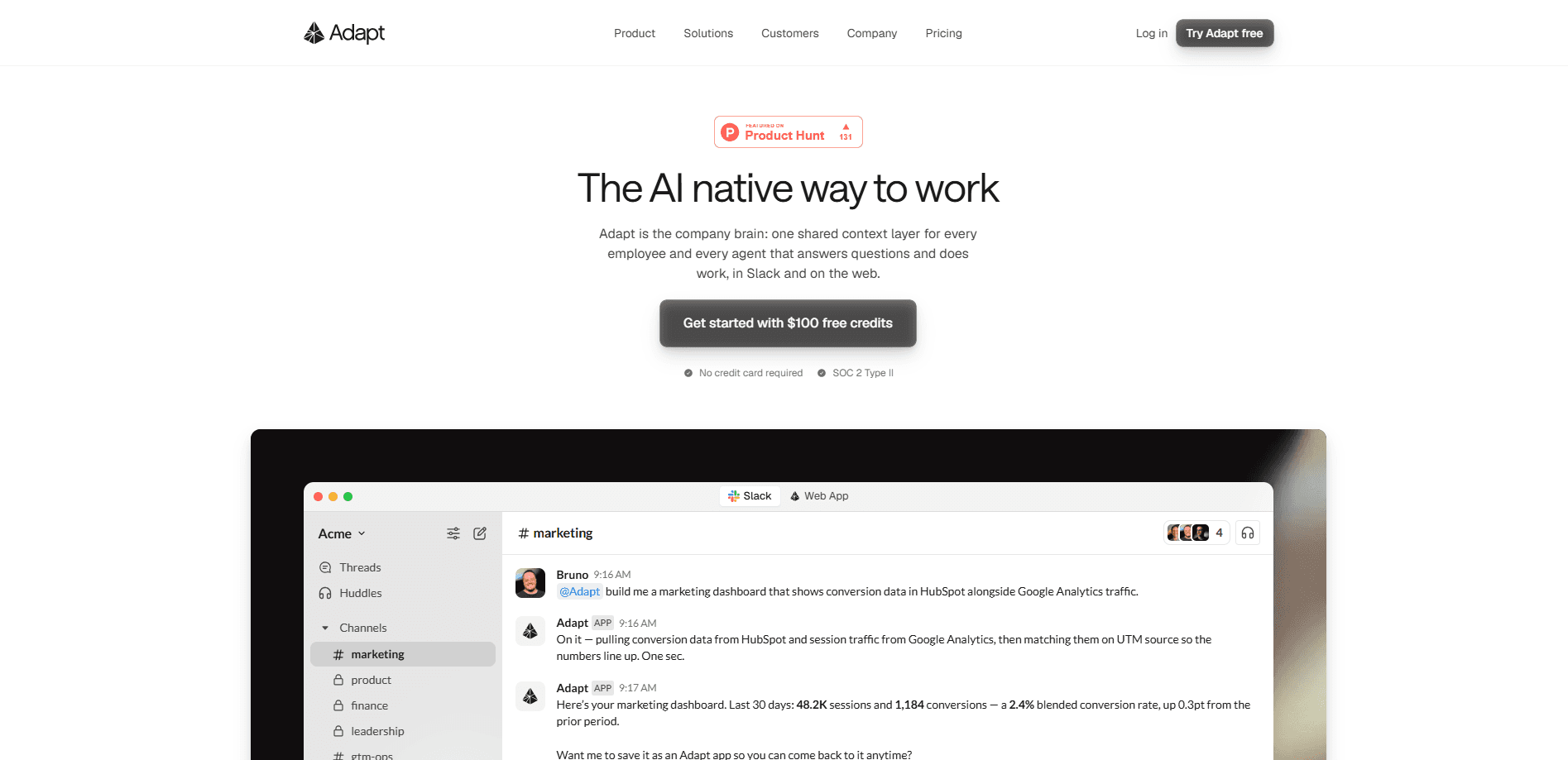
Adapt is an AI company agent platform that works as a "company brain" for your business. It's built for AI workflow automation, not just chat. It pulls context from the tools you already use, then answers questions, automates workflows, and builds small internal apps without you wiring everything together by hand. Teams meet it in Slack or on the web, and it ships with its own model router and sandbox layer so every request lands in the right place.
About Adapt
What Is Adapt
Adapt is an AI-native layer that sits across the systems a company runs on and turns them into one place to ask, build, and act. Instead of humans shuttling context between tools, a single agent reads across your stack, runs code in a secure environment, and takes action where the work happens. The pitch is ownership: you control the agent's memory, tools, permissions, and usage rather than renting a locked-down SaaS app.
It's built for teams that already live in Slack and a pile of SaaS tools. Adapt isn't a plug-in chatbot for one department. It's meant to become the common AI layer for the whole company, so setup and governance matter more than they would for a single-seat assistant. Want something you bolt on in five minutes and forget? This isn't it.
Adapt was founded by Jim Benton, Sean Smith, and John Andrew Entwistle, and it's backed by Headline, Activant, and a group of operators. The company runs out of San Francisco's Presidio.
Getting Started
- Book a demo at adapt.com to pick a plan and scope what the agent can touch.
- Connect Slack and your core tools so Adapt can read context and take action where your team works.
- Set model routing and permissions, then point the agent at the workflows you want it to own.
- Test on a narrow task first, review what it did, and widen access as you trust it more.
Product Information
A quick look at Adapt's pricing, supported platforms, and performance.
Best for
The users, tasks, and scenarios where this tool fits best.
Users
- Operations and support teams
- Engineering and data teams
- Founders and small companies
Tasks
- Answering cross-tool questions
- Automating repetitive workflows
- Building internal apps
Scenarios
- A support agent who can't find a customer's account details needs it resolved in a minute, not forty-five.
- A team that wants every department reading from the same company context instead of duplicating dashboards.
- A company weighing model lock-in that wants to swap models by changing config, not rebuilding.
Key features
One Agent Across Every Surface
Adapt shows up where your team already works, mainly Slack and the web. As a Slack AI agent, it handles a question, a build request, or an action without you jumping between tabs. The goal is flow: you stay in the tool you're in and the agent reaches into the others. It's the core reason teams call it a company brain rather than a chatbot.
Model Router With Adaptive Routing
Every request is scored and routed to a tier: xfast, fast, balanced, or deep. Hard problems go to a frontier model, everything else goes to a faster open-weight one, and the router handles keys, retries, streaming, and spend behind a single endpoint. Mid-stream failover means a provider 500 or a rate limit reroutes in flight, so the user never sees a retry.
No Model Lock-In
A model is a string, not an architecture decision. Swapping one out is a config change, not a migration. Adapt puts Claude, GPT, and Gemini next to the best open-weight releases. Your own evals decide the winner, not a vendor's roadmap, which matters if you don't want your stack pinned to one lab.
Real Sandbox Compute
Every agent gets access to microVM sandboxes with persistent filesystems, scoped secrets, and cron. Think of it as the agent runtime under the hood. It's what lets the agent actually execute code instead of just talking about it. Scoped secrets keep credentials limited to what a task needs, and the persistent filesystem means work carries forward between runs.
Company-as-Code Setup
One command scaffolds plain TypeScript, with no framework to learn and no config screens to click through. Every integration is a file you own, so each team meets the agent inside the tool they already use. It's aimed at people who'd rather read code than a settings page. No drag-and-drop here.
Deployment On Your Terms
Adapt supports self-hosting, a VPC, or managed on-prem, and it's SOC 2 Type II compliant. For companies that can't send sensitive data to a hosted service, that flexibility is often the deciding factor. You control what the agent can access and what it can't.
Pros and cons
Pros
- Connects context across many tools, which cuts the manual back-and-forth that eats support and ops time.
- Model router with failover and adaptive tiers reduces the odds of a single provider outage taking the agent down.
- Self-host, VPC, and on-prem options plus SOC 2 Type II suit teams with strict data rules.
- Company-as-code approach in plain TypeScript appeals to engineering-led teams that want to extend it.
Cons
- No published free-tier details beyond unlimited seats with metered usage, so real costs are hard to predict up front.
- Credit-based pricing means a busy agent can get expensive fast, and 1 credit equals just $0.01 of usage.
- Platform is limited to web and Slack, so teams on Teams or other chat tools are out of luck. No native app yet.
- Setup leans on a demo and engineering effort, which is heavy for a small team that just wants a quick tool. It isn't cheap either.
Frequently asked questions
Adapt is an AI company agent that reads across your tools and data, then answers questions, runs workflows, and builds internal apps. You use it through Slack or the web, and it handles the context-shuffling that people normally do by hand.
Related content
Explore related tools, skills, and articles for Adapt.
Adapt Alternatives

HireKey
HireKey · Voice & Language · Productivity · LeaningHireKey is an AI job search copilot built by a former tech recruiter. It checks role fit, tailors resumes, runs interview practice and tracks every application.

Lune
Retrograde Labs · Productivity · LeaningLune is a research search engine for scientific AI agents. It runs as an MCP server that lets Claude, ChatGPT and Cursor search peer-reviewed computer science papers and cite them.
Coddy
Coddy · Coding · LeaningCoddy is a gamified platform to learn to code through short interactive lessons in 20+ languages, with a browser editor, an AI tutor and free certificates.