

Lune
Retrograde Labs · Productivity · Leaning
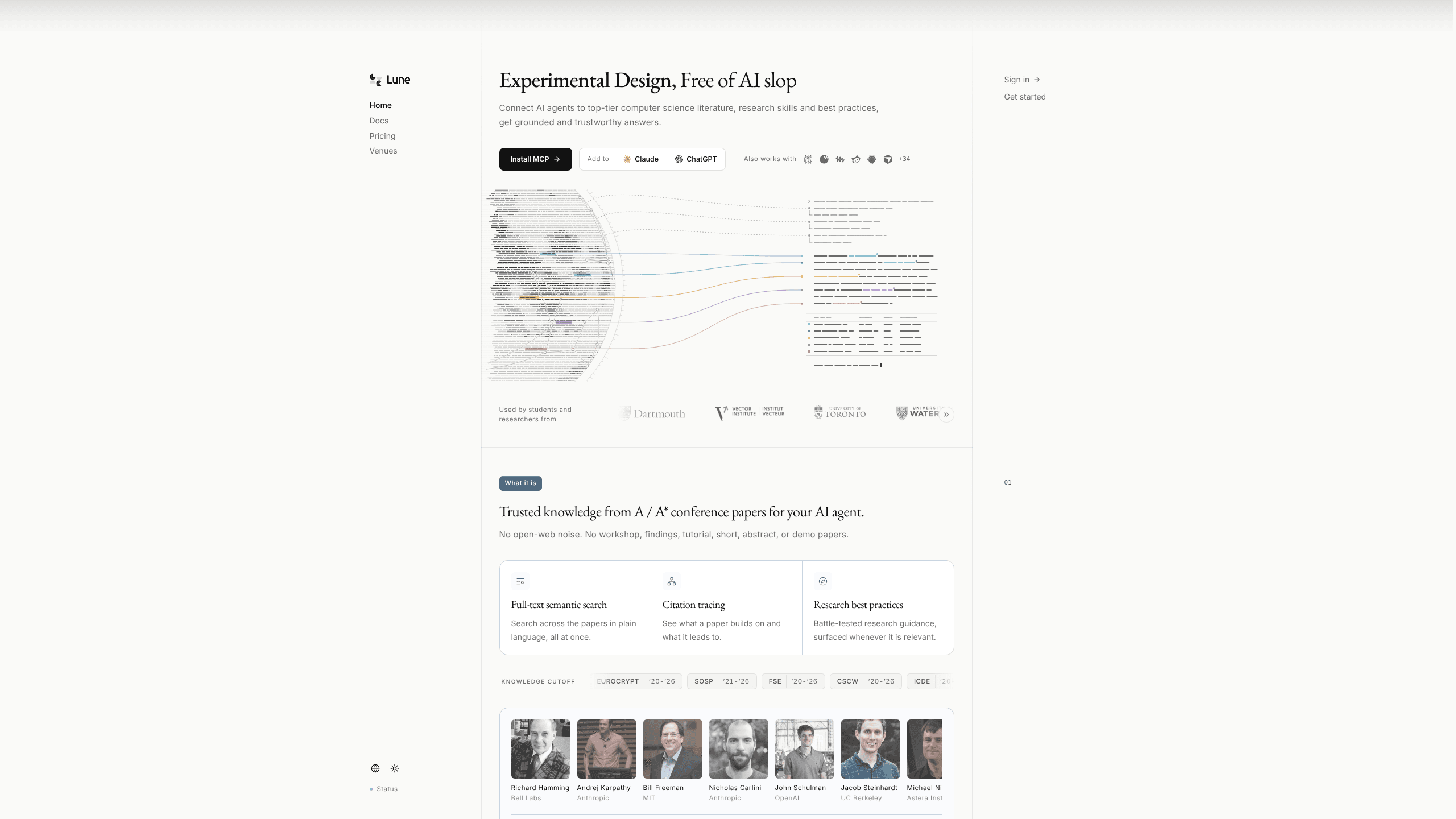
Lune is a research search engine for scientific AI agents. It runs as an MCP server that lets Claude, ChatGPT and Cursor search peer-reviewed computer science papers and cite them.
About Lune
What Is Lune
Lune Research is a tool from Retrograde Labs that works as an MCP server for research. It sits between an AI assistant and the computer science literature. You connect it once, then ask your agent a question in plain English. The agent calls Lune's tools and gets paper records back: title, authors, venue, year, abstract, and a link that opens. When Lune has permission to index a paper's full text, the agent can read the relevant sections and quote them.
The point is to stop a model from answering from memory. Ask a chatbot for the foundational papers on retrieval-augmented generation and it may hand you a confident citation that doesn't exist. Lune forces a retrieval step first, and every claim in the answer traces back to a paper record you can inspect.
Coverage is the trade-off. Lune indexes conferences ranked A or A* by CORE and CCF, from 2016 onward. AI and machine learning venues such as NeurIPS, ICML, ICLR, ACL and CVPR are in. So are security conferences like CCS and USENIX Security, systems work from OSDI and SOSP, data papers from KDD, SIGMOD and VLDB, plus WWW and STOC. Workshop papers, tutorials and short papers stay out. That focus helps when you want accepted literature and nothing else, and frustrates when the paper you need sits outside those venues.
Getting Started
- Sign in at luneresearch.com with Google or an email address. New accounts come with 300 welcome credits.
- Open the Install page in the dashboard and pick your app. The list covers Claude, Claude Code, ChatGPT, Codex, Cursor, VS Code, GitHub Copilot and other MCP clients.
- Remote apps connect to
https://mcp.luneresearch.comand sign in through OAuth. Local clients runnpx -y @retrograde-labs/lune-mcp-serverwith an access key inLUNE_API_KEY. - Ask a question in the app. The agent picks the tool itself, usually
search_papersfirst, thenget_paper_fulltextor a citation lookup. - Check the dashboard when a limit appears. It shows the current plan, today's remaining allowance and the credit balance.
Product Information
A quick look at Lune's pricing, supported platforms, and performance.
Best for
The users, tasks, and scenarios where this tool fits best.
Users
- Graduate students and PhD candidates
- Research engineers and applied scientists
- Lab leads and technical recruiters
Tasks
- Literature reviews
- Novelty checks
- Evaluation planning
- Draft cleanup
Scenarios
- First week in an unfamiliar subfield
- A reviewer asks for a missing baseline
- Explaining a technical decision to a non-specialist
Key features
Full-text search across top-tier venues
Search runs in plain language over abstracts and, where Lune holds the rights, full text. A query like "methods that reduce hallucination in retrieval systems" returns accepted papers rather than blog posts. Results carry venue, year, authors and a stable link.
Citation tracing in both directions
Every indexed paper keeps its citation relationships. You can ask what a paper builds on, then ask which later work cites it. That turns one good hit into a reading path, which is the part general web search usually fails at.
Research guidance from experienced scientists
Lune keeps a library of practical guidance for literature reviews, evaluation design, ablation studies, peer review, research writing and venue selection. The agent retrieves it next to the papers, so advice about running an experiment arrives with evidence behind it.
Batch tools for bigger jobs
Four tools work in batches. search_papers_many runs query variants, extract_from_papers pulls a field from several papers, verify_claims checks a list of claims, and gather_evidence collects support for a question. Each item costs one request, and unused items are refunded.
Hosted miniapps with nothing to install
Assistant, Critique and Workspace open in a browser with Lune already connected. Assistant answers a research question with citations, Critique reviews a draft or an idea against the literature, and Workspace answers from documents you upload. Handy for trying the corpus before wiring it into an agent.
A talent database built from publication records
The Talent Database holds researcher profiles with their papers, venues, years active and an email address. Search by research area in your own words, then check the record before reaching out. Email reveals draw on the same daily allowance as paper searches.
Pros and cons
Pros
- The corpus is narrow on purpose. Every result comes from a ranked conference, so you spend less time filtering out preprints, tutorials and SEO blog posts.
- Setup is one connector or one command. Claude, ChatGPT, Cursor and VS Code all work, and the hosted miniapps need no key at all.
- Pricing stays small and flat: $4.99 a month for 300 requests a day, with credits at $0.99 per 300 that never expire.
- Full text, citation trails and research guidance sit behind one connection, so the agent doesn't juggle three separate tools.
Cons
- Coverage starts in 2016 and stops at selected computer science venues, which leaves out medicine, biology, the humanities and older work.
- The daily allowance resets at midnight UTC for everyone, so users in Asia and on the US west coast lose their quota in the middle of the working day.
- Local MCP clients need Node.js and an environment variable, which pushes non-technical users toward the hosted miniapps.
Frequently asked questions
It gives an AI agent a citable path into peer-reviewed computer science papers. You ask a research question, the agent searches Lune's corpus, reads abstracts or full text, follows citations, and answers with sources you can open.
Related content
Explore related tools, skills, and articles for Lune.
Lune Alternatives

Base Code
Base44 (Wix) · Coding · ProductivityBase Code is a shared cloud development environment from Base44. Teammates describe changes to an existing GitHub codebase in chat, preview them live and send them back as pull requests.

Knocket
Knocket (Tencent RTC team) · Productivity · Business · ChatbotKnocket is a free live chat and contact page tool that lets visitors message you from your website, app, or a shareable link, with every reply handled from Telegram or one inbox.

FloorGen
Vinit Kumar (FloorGen) · Productivity · China AIFloorGen is a browser-based floor plan maker that turns a sentence or a sketch into an editable 2D plan and a 3D walkthrough. Export to PDF, DXF or video, and draw without an account.