

ADK-TS
IQ AI · Coding
ADK-TS is an open-source TypeScript framework for building AI agents. It supports multiple LLM providers, ships with tools, sessions, and memory, and runs your first agent in one line.
About ADK-TS
What Is ADK-TS
ADK-TS is a framework for building AI agents in TypeScript, the programming language many web and Node.js developers already use every day. As a TypeScript AI agent framework, it targets people who'd rather define agents in code than in a dashboard. IQ AI maintains it as an open-source project under the MIT license, so you can read the source, fork it, or ship it inside a commercial product without paying for a license.
The framework handles the parts of agent development that usually turn into a pile of glue code. You get provider-agnostic model access, a tool system for connecting external services, and session management that keeps conversation context across turns. Instead of wiring those yourself, you describe an agent and let the framework run the reasoning loop.
Its main limitation is that it's aimed at developers who write code. There's no drag-and-drop builder for non-technical users, and the docs are still labeled a work in progress, with some sections incomplete. If you don't work in TypeScript or JavaScript, the benefits shrink fast.
Getting Started
- Install the CLI globally with
npm install -g @iqai/adk-cli, then runadkto scaffold a project, or add the package to an existing app withnpm install @iqai/adk. - Set an API key in a
.envfile. Google Gemini works with justGOOGLE_API_KEY; other providers use their own keys. - Define an agent with the AgentBuilder API, or a plain
LlmAgent, and point it at a model name. - Attach tools, a session service, or sub-agents if the task needs them, then run the agent and read the response.
Product Information
A quick look at ADK-TS's pricing, supported platforms, and performance.
Best for
The users, tasks, and scenarios where this tool fits best.
Users
- TypeScript and Node.js developers building AI features into web apps
- Full-stack engineers who want typed agent logic instead of prompt scripts
- Teams that need to switch LLM providers
Tasks
- Building chatbots and assistants with persistent memory
- Chaining several agents into a pipeline
- Connecting agents to external data and services
Scenarios
- Prototyping an agent idea in an afternoon
- Wiring a research assistant that cites sources
- Shipping an agent into a Node.js service or serverless function
Key features
One-Line Agents with AgentBuilder
The AgentBuilder API lets you create a working agent in a single chained call, then ask it a question. AgentBuilder.withModel("gemini-2.5-flash").ask(...) returns the model's answer directly, which makes it practical to test an idea before committing to a full architecture. From there you can extend the same builder with sessions, tools, and sub-agents.
Multi-Provider Model Support
ADK-TS defaults to Google Gemini but treats other providers as first-class. You can pass a model name as a string and let the framework detect the provider, or use Vercel AI SDK model instances for deeper integration. OpenAI, Anthropic, Groq, Mistral, and OpenRouter's catalog of models all connect through the same agent code.
Extensible Tool System and MCP
Tools give agents the ability to act, not just talk. You define custom tools with declarative schemas so the model knows when and how to call them. The Model Context Protocol support goes further, letting an agent plug into external MCP servers for blockchain, market data, messaging, and file operations, or you can build your own server from a starter template.
Sessions and Persistent Memory
Every conversation runs inside a Session object that tracks message history and mutable state. Sessions are strongly typed and automatically created, loaded, and saved as the conversation continues. That means an agent remembers earlier turns without you writing storage logic, and you choose the backend that fits your app.
Multi-Agent Workflows
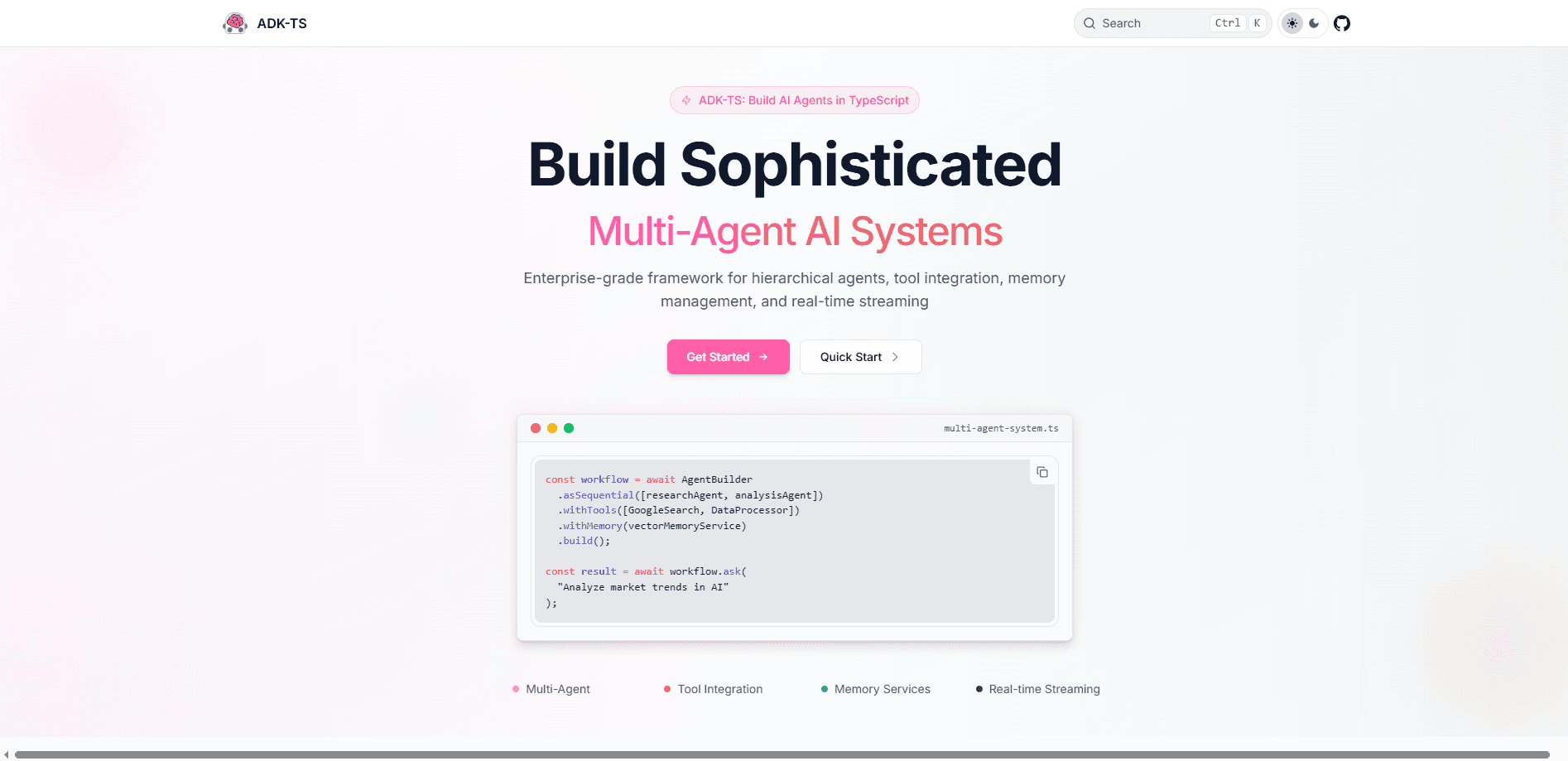
Workflow agents combine several specialized agents into one system. Sequential workflows pass work from one agent to the next, parallel workflows run agents at the same time, and loop workflows repeat until a condition is met. A research-then-analyze-then-summarize pipeline is a few builder calls.
Streaming and Observability
Agents can stream responses token by token, which suits interactive chat and live interfaces. For production use, ADK-TS includes OpenTelemetry tracing so you can follow an agent's steps and see where time and tokens go. That observability matters once an agent moves past the demo stage.
Pros and cons
Pros
- Full type-safety across models, tools, and sessions, so editors catch mistakes before runtime.
- Provider-agnostic design avoids lock-in, letting you swap LLMs without rewriting agent logic.
- Ships with sessions, memory, streaming, and tracing rather than leaving them as add-ons.
- MIT license and an npm package make adoption cheap for individuals and companies alike.
Cons
- Built for coders only, with no visual builder for people who don't write TypeScript.
- Documentation is still marked a work in progress, so some sections are incomplete.
- It assumes comfort with TypeScript and Node.js tooling, which raises the entry bar for beginners.
- Running agents still needs your own LLM API keys, so there's a per-use cost to budget for.
Frequently asked questions
ADK-TS is used to build AI agents in TypeScript. Developers use it for chatbots, research assistants, content pipelines, and any task where an agent needs to call tools, remember context, or coordinate with other agents.
Related content
Explore related tools, skills, and articles for ADK-TS.
ADK-TS Alternatives

Udon
Udon · Coding · ProductivityUdon turns an Apple Silicon Mac into a home server you run from a browser, with container controls, file shares, and an optional AI sysadmin.

offstage
offstage cloud · Coding · Productivityoffstage gives AI coding agents and CI jobs a real Mac: a fresh macOS account on Apple silicon, driven over an API and billed by the second.

BotBus
Chengdu Tuyang Tusen Technology Co., Ltd. · Coding · ProductivityBotBus lets you control AI coding agents from your phone and watch: approve commands, start tasks and read results while the code stays on your desktop.