

Harden
Agentic Integrity Foundation · Coding · Other
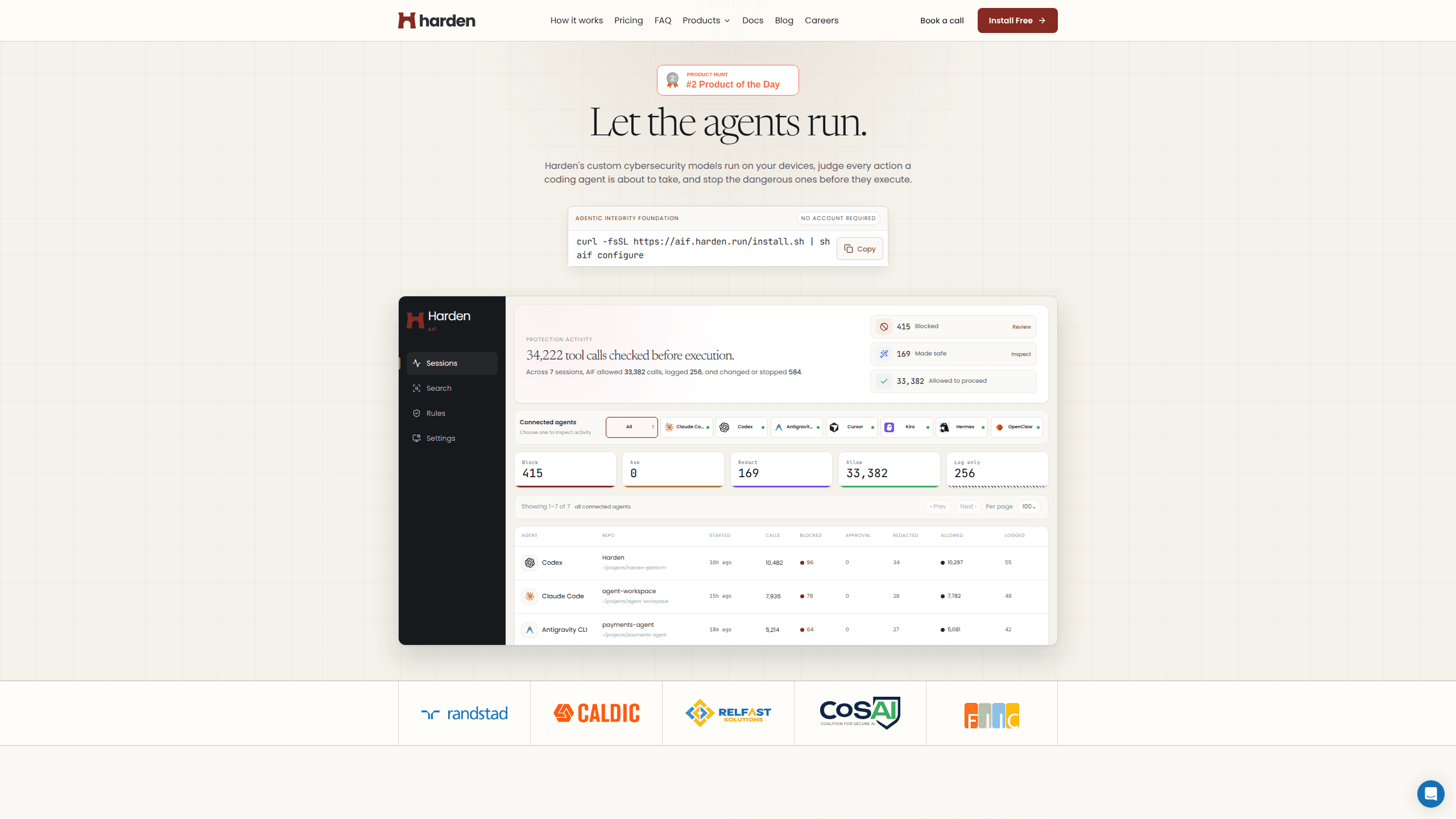
Harden is a security layer for AI coding agents. Its core product, the Agentic Integrity Foundation (AIF), checks what a coding agent wants to do before it runs the command, then allows, blocks, pauses, or scrubs the action based on the rules you set. Think of it as guardrails for coding agents: a checkpoint that sits between the agent and your machine. It works with Claude Code, Codex, Cursor, and other agents through a single command-line install, and it keeps a local record of every decision so you can see exactly what happened.
About Harden
What Is Harden
Harden is built by the Agentic Integrity Foundation, a company that makes safety products for what it calls the dark software factory, the messy reality of AI agents shipping code. Think of AIF as an AI agent security layer: its job is to sit between your coding agent and your machine. Instead of letting an agent run whatever it wants and hoping for the best, AIF intercepts each covered action and decides whether it should proceed.
The problem it solves is specific. Coding agents are powerful because they can touch the file system, run shell commands, call APIs, and push code. That's also what makes them dangerous. A single bad instruction, a prompt injection buried in a file, or just an overeager agent can delete the wrong directory or ship a hardcoded secret. AIF gives you a checkpoint before that happens.
The main limitation is scope. AIF is a local protection layer, not a hosted platform, so it protects the machine it runs on. If you want fleet-wide dashboards, approval gates, and compliance reporting across many developers, that sits behind the enterprise tier and custom pricing. There's also a real cost to setup: you need to install the client, configure each agent you use, and tune the rules so they fit your workflow rather than fighting it.
Getting Started
- Install the CLI with the one-line script, then open a new shell so the
aifcommand is available. - Run the quickstart to detect and configure the coding agent you use, such as Claude Code or Cursor.
- Run the safe demo to see recorded allow and block decisions on your own machine before you trust it on real work.
- Open the local history to review what the agent tried to do and how AIF responded.
- Tighten the rules around secrets, destructive commands, and network egress to match your project's boundaries.
Product Information
A quick look at Harden's pricing, supported platforms, and performance.
Best for
The users, tasks, and scenarios where this tool fits best.
Users
- Developers running coding agents daily
- Security-conscious teams
- Solo builders shipping fast with AI
Tasks
- Blocking destructive shell commands
- Preventing secret leaks
- Reviewing agent behavior
Scenarios
- Overnight agent runs
- Pull requests from AI-written code
- Onboarding a new agent
Key features
Pre-Execution Action Checks
AIF inspects a covered action before it runs, not after the damage is done. That ordering matters. A post-hoc scanner can tell you what went wrong; AIF tries to keep the wrong thing from happening at all. The check produces one of six labels: allow, block, ask, redact, log only, or model error, so you always know what the tool decided. This is the heart of what AI coding agent security should mean.
Human-in-the-Loop Pausing
Not every risky action deserves a hard block. The ask label pauses an action and waits for a person to approve or decline it with the aif review command. This is the middle ground for tasks that look suspicious but might be legitimate, like a deploy step or a database migration an agent wants to trigger.
Secret Redaction
When an action would expose a protected value, AIF replaces it with a safe placeholder and lets the retry go through. You can see the rewritten command before running it again. Secrets are the worst thing to leak. For teams shipping fast, this is often the difference between catching a leaked key at the terminal and finding it in a public repo.
Repository Boundary Enforcement
AIF treats the project directory as a boundary. Commands that reach outside it, like deleting files in a parent folder, get blocked by default. Simple rule. Big payoff. It stops the most common category of agent mistake: acting on paths it never should have touched.
Broad Agent Coverage
The tool ships with documented setup for Claude Code, Codex, Cursor, Antigravity CLI, Hermes, Kiro, and OpenClaw. Each integration lists version baselines, setup commands, and coverage notes. So you know what's protected. And what isn't. Coverage varies by agent, and the docs don't pretend otherwise.
Local Decision History
Every decision is recorded on your machine rather than a remote server. You open the local viewer to read the recorded commands and the reasoning behind each allow, block, or redact. It doubles as an audit trail and a way to tune rules that fire too often.
Pros and cons
Pros
- Catches dangerous agent actions before they run, not in a post-mortem.
- Free and open-source CLI, so you can test it on a real machine without a sales call.
- Decent coverage across the popular coding agents, with per-agent version notes.
- Human review path keeps you from blocking legitimate work outright.
Cons
- Tuning rules takes time, and a strict setup can slow down routine agent tasks.
- Only macOS and Linux are supported, so Windows users are out of luck.
- Fleet dashboards and compliance reporting sit behind enterprise pricing, which you have to request.
- Coverage depends on which agent you use, and some integrations protect less than others.
Frequently asked questions
Harden's AIF is a local security layer that checks what a coding agent wants to do before it runs. It allows, blocks, pauses, redacts, or logs each covered action, and records the decision locally.
Related content
Explore related tools, skills, and articles for Harden.
Harden Alternatives

Udon
Udon · Coding · ProductivityUdon turns an Apple Silicon Mac into a home server you run from a browser, with container controls, file shares, and an optional AI sysadmin.

offstage
offstage cloud · Coding · Productivityoffstage gives AI coding agents and CI jobs a real Mac: a fresh macOS account on Apple silicon, driven over an API and billed by the second.

BotBus
Chengdu Tuyang Tusen Technology Co., Ltd. · Coding · ProductivityBotBus lets you control AI coding agents from your phone and watch: approve commands, start tasks and read results while the code stays on your desktop.