

Agentic Document Extraction
LandingAI · Productivity
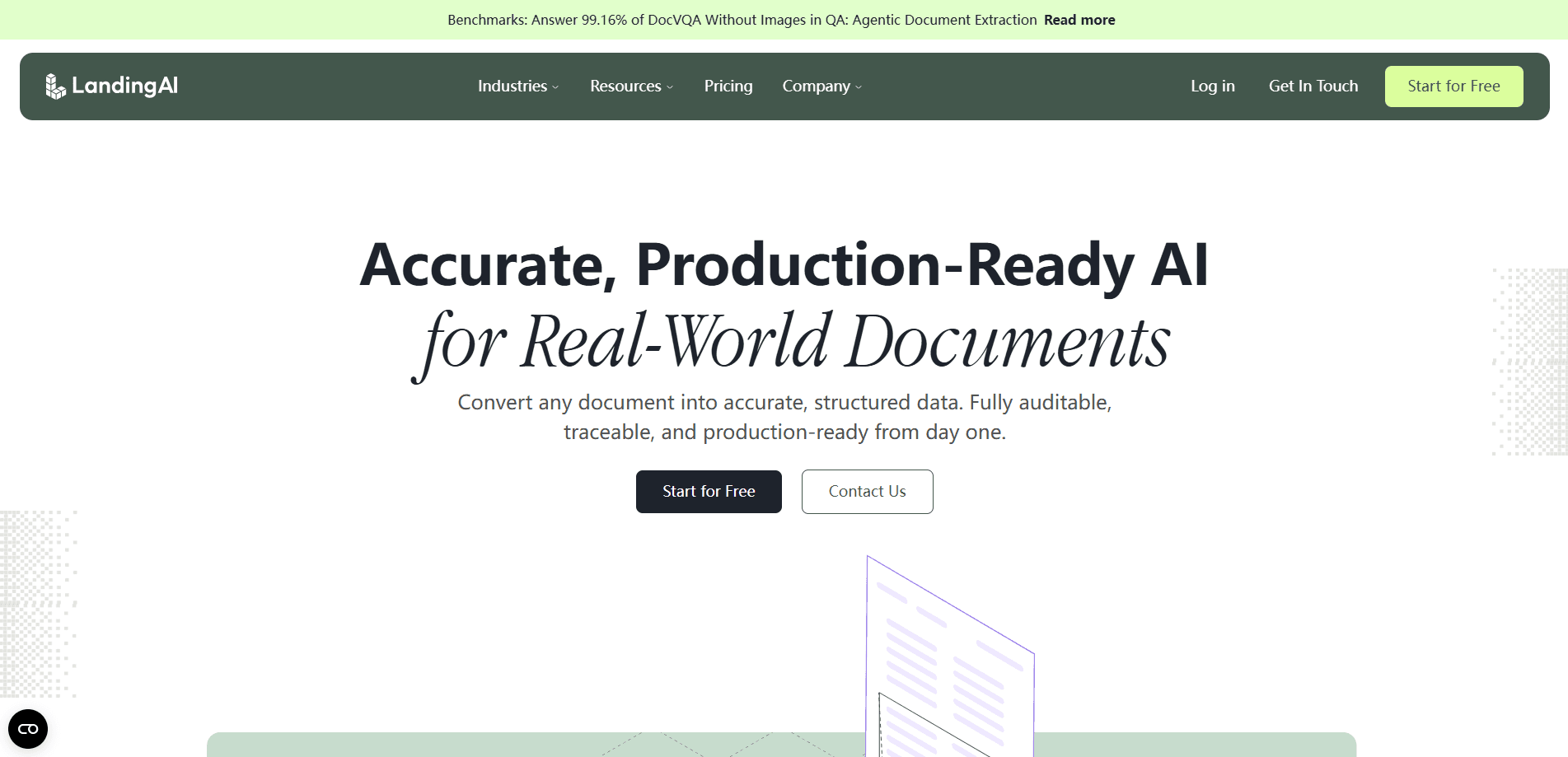
Agentic Document Extraction (ADE) is LandingAI's document AI platform that converts complex PDFs, scans, and images into structured JSON and LLM-ready Markdown. It's built for teams that need more than a plain text dump. Every extracted chunk comes with page numbers, precise coordinates, and a confidence score you can audit. If your workflows run on invoices, loan files, or regulatory reports, ADE is aimed squarely at that job. Think of it as PDF to JSON with a paper trail.
About Agentic Document Extraction
What Is Agentic Document Extraction
Agentic Document Extraction is a vision-first document extraction API from LandingAI. Instead of reading a document as plain text, it looks at the page the way a person does, then returns structured data with the location of each field. The output lands as hierarchically grounded JSON or Markdown that feeds directly into a database, a search index, or a RAG pipeline. No re-parsing required.
The appeal is traceability. Teams using generic large language models on PDFs often fight hallucinations and missing source attribution. ADE ties every piece of extracted content back to a page number and a bounding box, so a reviewer can jump straight to the source and confirm it.
The catch is that this is a developer tool, not a desktop app. ADE is sold as REST APIs with Python and TypeScript libraries, so you need someone comfortable wiring up an integration. Is it worth that setup cost? For high-volume document work, usually yes. Pricing runs on credits rather than a flat subscription. That keeps small tests cheap, but costs scale with how much you process.
Getting Started
- Create an account at ade.landing.ai and claim the free credits that come with the Explore plan.
- Generate an API key and set it for the Python or TypeScript library, or call the REST API directly.
- Send a document to the Parse API to get reading-order Markdown and per-block coordinates.
- Add the Extract API with a schema when you want specific fields pulled into structured JSON.
- Move the same job to the standard tier to cut credit use roughly in half once you're ready for production.
Product Information
A quick look at Agentic Document Extraction's pricing, supported platforms, and performance.
Best for
The users, tasks, and scenarios where this tool fits best.
Users
- Backend and data engineers
- Operations and compliance teams
- Data science teams building RAG pipelines
Tasks
- Turning invoices and statements into structured records
- PDF to JSON conversion at scale
- Structured data extraction from dense tables and multi-page reports
- Auditing document parsing results
Scenarios
- Loan and credit underwriting
- Know your customer checks
- Regulatory reporting
Key features
Vision-First Parsing
ADE reads documents through proprietary vision models rather than relying on an embedded text layer. That matters for scanned files, dense tables, and multi-page layouts where ordinary PDF text extraction tends to drop or scramble content. Plain text extraction fails here. The result is Markdown in reading order, plus a structured block tree you can traverse programmatically.
Grounded Coordinates and Confidence Scores
Every chunk comes back with a page number, coordinates, and a confidence score. This is the feature that separates ADE from a generic extraction script. You can show a reviewer exactly where a value came from. You can also filter results that fall below a quality threshold. For regulated work, that's the difference between a usable pipeline and one nobody trusts.
Schema-Driven Field Extraction
The Extract API takes a schema you define and returns matching fields as structured JSON. You decide what to pull, whether that's an invoice total, a contract clause, or a list of line items. Because the schema drives the output, downstream systems get a predictable shape. No surprises. That beats free-form text you have to re-parse later.
Modular APIs and SDKs
ADE splits its work across APIs for parsing, splitting, and extraction, so you pick the pieces your workflow needs. You can call them through REST or through Python and TypeScript libraries. Same job, same cost. Whether you run it in the Playground, the API, or an SDK, the price doesn't move.
Service Tiers You Control
Each job runs on a standard or priority tier. Standard is the default for API calls and consumes about half the credits of priority, while the Playground always runs at priority. That gives you a simple lever. Prototype quickly at priority, then move production traffic to standard and watch the per-page cost drop.
Credit-Based Pricing
Everything runs on a single credit unit. One credit equals one cent. Credits are fungible across every ADE service, so you track one balance rather than a menu of per-feature charges you have to reconcile at the end of the month. You can buy them self-service by card or through an annual enterprise agreement, and both spend at the same rate.
Pros and cons
Pros
- Output includes page numbers, coordinates, and confidence scores, so results are auditable rather than a black box.
- Vision-first parsing handles scanned documents, complex tables, and multi-page layouts that trip up text-layer tools.
- Modular parse, split, and extract APIs let you adopt only what your workflow needs.
- The standard tier costs roughly half of priority, giving a clear lever for controlling per-page spend.
- Generous free credits on the Explore plan make it cheap to test a real workload before committing.
Cons
- It's API-only, with no end-user app, so adoption requires engineering time to build and maintain an integration.
- Credit costs scale with document volume and complexity, so heavy workloads need ongoing budget tracking rather than a fixed monthly bill.
- Enterprise pricing is quote-based, which makes it hard to estimate large-scale costs without contacting sales.
Frequently asked questions
It converts complex PDFs and images into structured JSON and Markdown for downstream workflows. Common uses include pulling fields from invoices, building retrieval datasets, and turning document archives into queryable data. It's document parsing for teams that need structure, not just text.
Related content
Explore related tools, skills, and articles for Agentic Document Extraction.
Agentic Document Extraction Alternatives

Base Code
Base44 (Wix) · Coding · ProductivityBase Code is a shared cloud development environment from Base44. Teammates describe changes to an existing GitHub codebase in chat, preview them live and send them back as pull requests.

Knocket
Knocket (Tencent RTC team) · Productivity · Business · ChatbotKnocket is a free live chat and contact page tool that lets visitors message you from your website, app, or a shareable link, with every reply handled from Telegram or one inbox.

FloorGen
Vinit Kumar (FloorGen) · Productivity · China AIFloorGen is a browser-based floor plan maker that turns a sentence or a sketch into an editable 2D plan and a 3D walkthrough. Export to PDF, DXF or video, and draw without an account.