

AgentSDR
Kandid AI · Productivity · Marketing · Business
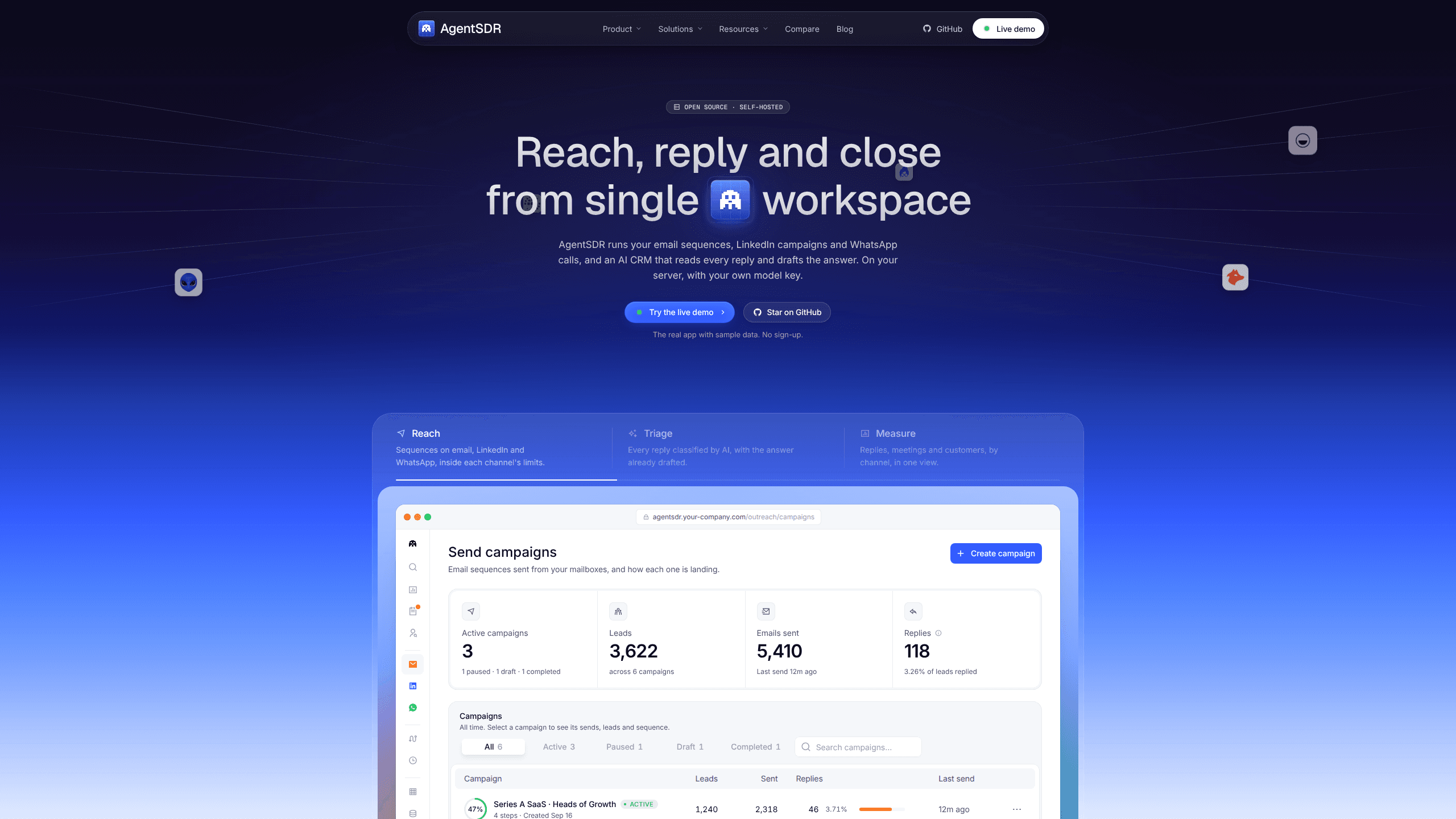
AgentSDR is an open-source AI SDR you host yourself. It runs cold email sequences, LinkedIn outreach and WhatsApp calls, then sorts every reply in an AI CRM and drafts the answer.
About AgentSDR
What Is AgentSDR
AgentSDR is a sales outreach workspace you install on your own server. It handles three channels side by side, email, LinkedIn and WhatsApp, and puts every lead and every conversation in one database. The code is public under the MIT license, and the AI steps run on a model key you provide.
That changes the commercial side of outbound software. Most AI SDR tools bill per seat and per contact, and they hold your prospect data on their servers. AgentSDR charges nothing for the software. You pay for the machine it runs on, the accounts it connects to, and the tokens your model key consumes.
Outside the AI parts, AgentSDR is a normal TypeScript app built on Next.js and PostgreSQL, packaged as a Docker Compose stack. If you've deployed a self-hosted tool before, you'll recognize the shape of the install: copy an environment file, set four secrets, run one command, create the admin account.
The parts you connect yourself
Nothing is pre-wired. Email sending runs through Google Workspace mailboxes connected with a service account, LinkedIn and WhatsApp go through Unipile, call recordings land in a Cloudflare R2 bucket, and every model call goes to OpenRouter with your own key. Enrichment providers like Apollo are optional.
That's what self-hosted sales automation looks like in practice: your lead database, your conversations and your credentials stay inside infrastructure you control. It also means three of those connections cost money on their own, which is the real cost of running the tool.
Where it stops short
Two limits matter before you start. Email only sends from Google Workspace, so a Microsoft 365 shop has no path today. WhatsApp calling depends on a Chrome extension working inside WhatsApp Web with the English interface, which rules out some setups. And LinkedIn automation always carries some account risk. AgentSDR stays inside the published limits, but no vendor can promise your account stays untouched.
Getting Started
- Check the machine: Docker with Compose on Linux, macOS or Windows, and about five minutes for the first start.
- Download the compose file, create a
.envwith your public app URL and four random secrets, then rundocker compose up -d. PostgreSQL starts with the app. - Open your address, land on the setup page, and create the admin account with your name, organization and login.
- Connect Google Workspace for email, Unipile for LinkedIn and WhatsApp, Cloudflare R2 for recordings, and OpenRouter for AI, all from Settings inside the app.
- Import a CSV or XLSX of leads, build a sequence or a LinkedIn campaign, and watch replies arrive in the CRM with drafts attached.
Product Information
A quick look at AgentSDR's pricing, supported platforms, and performance.
Best for
The users, tasks, and scenarios where this tool fits best.
Users
- Founders running their own outbound
- Small sales teams with a technical operator
- RevOps leads who want the data in-house
Tasks
- Multi-step cold email at volume
- Qualifying inbound replies
- Cleaning a messy lead list
Scenarios
- A two-person agency wants to run outreach for six clients
- A founder sells to Europe and needs LinkedIn plus email in one place
- A team already paying for OpenRouter wants one model bill
Key features
Email sequences built around mailbox limits
Sequences run from your own Google Workspace mailboxes, connected through a service account with domain-wide delegation. Any CSV column can act as a merge field, spin text varies the wording, and each mailbox carries its own daily cap (30 by default), sending window and signature. One-click unsubscribe and automatic bounce suppression are handled for you, and several campaigns can share the same pool of mailboxes.
LinkedIn campaigns that stay inside the limits
Through Unipile, AgentSDR runs campaigns across several LinkedIn accounts at once. The flow is an invite, an accept message and three follow-ups, with 30 invites a day on premium accounts and 5 on free ones. A random 30 to 60 second gap sits between invites, sends stay inside each account's working hours, and an account that hits LinkedIn's own limit pauses for the rest of the day.
WhatsApp calls with recording and transcription
You link a number through Unipile and install the AgentSDR Call Recorder extension in Chrome. When you start a call from the app, the extension dials inside WhatsApp Web and records both sides, and your chosen model writes the transcript. The recording goes to your own storage bucket. Messages sync as well, with a warm-up step for new numbers.
An AI CRM that reads every reply
Each inbound reply gets classified as interested, customer, not interested or other, and the AI drafts an answer from the knowledge base you load. Drafts wait in an action-required queue until someone sends them, either as written or edited. The AI can move a lead forward in the pipeline when it's confident; a backward move, a low-confidence call, or a brand new customer waits for a person.
One lead database with AI enrichment tables
People and companies live in a single database shared by all three channels, with duplicates matched on email or LinkedIn. Imports come from CSV or XLSX, and you can add columns of your own type. Enrichment tables go further: a column can call an API, run a formula, ask your model a question, or pull company data from a provider, and the finished table becomes a campaign.
Self-hosted deployment you actually own
The whole app ships as a Docker Compose stack with PostgreSQL 18. Integration credentials are encrypted at rest with AES-256-GCM, call recordings are reached only through short-lived signed links, and each organization's data stays separate. Teammates sign in with their own accounts as owners, admins or members, and since it's a Next.js codebase, adding a column type or a channel is ordinary application work.
Pros and cons
Pros
- No per-seat or per-contact pricing on the software itself. Your bill comes from the server, the Unipile subscription and model tokens, which you can size to your volume.
- Leads, replies, call recordings and provider keys stay on infrastructure you control, and the encryption key never leaves your environment.
- Email, LinkedIn and WhatsApp share one lead database and one inbox, so a prospect's history doesn't fragment across tools.
- The AI is held behind an approval queue for outbound replies, which keeps a human in the loop on anything that leaves the building.
- MIT-licensed TypeScript code means you can read exactly how classification and drafting work, and change it.
Cons
- You run the infrastructure: Docker, PostgreSQL, domain, HTTPS, backups and upgrades. There's no support line to call when a nightly job fails.
- Email sending only works through Google Workspace mailboxes. Teams on Microsoft 365 or a plain SMTP provider can't send from AgentSDR today.
- WhatsApp calling needs the Chrome extension and the English interface of WhatsApp Web, and both LinkedIn and WhatsApp depend on a paid Unipile subscription.
- Opens and clicks aren't tracked at all, so you lose the open-rate view that other outreach tools report. Reply rate becomes your main engagement signal.
Frequently asked questions
The software is. It's open source under the MIT license and you host it yourself, so there are no seats, editions or per-contact fees. What you pay for is the server, the accounts you connect, and your own AI usage through OpenRouter.
Related content
Explore related tools, skills, and articles for AgentSDR.
AgentSDR Alternatives

Base Code
Base44 (Wix) · Coding · ProductivityBase Code is a shared cloud development environment from Base44. Teammates describe changes to an existing GitHub codebase in chat, preview them live and send them back as pull requests.

Knocket
Knocket (Tencent RTC team) · Productivity · Business · ChatbotKnocket is a free live chat and contact page tool that lets visitors message you from your website, app, or a shareable link, with every reply handled from Telegram or one inbox.

FloorGen
Vinit Kumar (FloorGen) · Productivity · China AIFloorGen is a browser-based floor plan maker that turns a sentence or a sketch into an editable 2D plan and a 3D walkthrough. Export to PDF, DXF or video, and draw without an account.