

agmsg
agmsg (open-source project by fujibee) · Productivity · Chatbot
agmsg is a free, open-source command-line tool for cross-agent messaging between CLI AI agents. Instead of acting as a courier who copies output from Claude Code and pastes it into Codex or Gemini CLI, you let the agents talk to each other directly. They share one local SQLite database and exchange messages on their own. No daemon. No server. No network in the middle. Setup takes one command, and your messages never leave your machine.
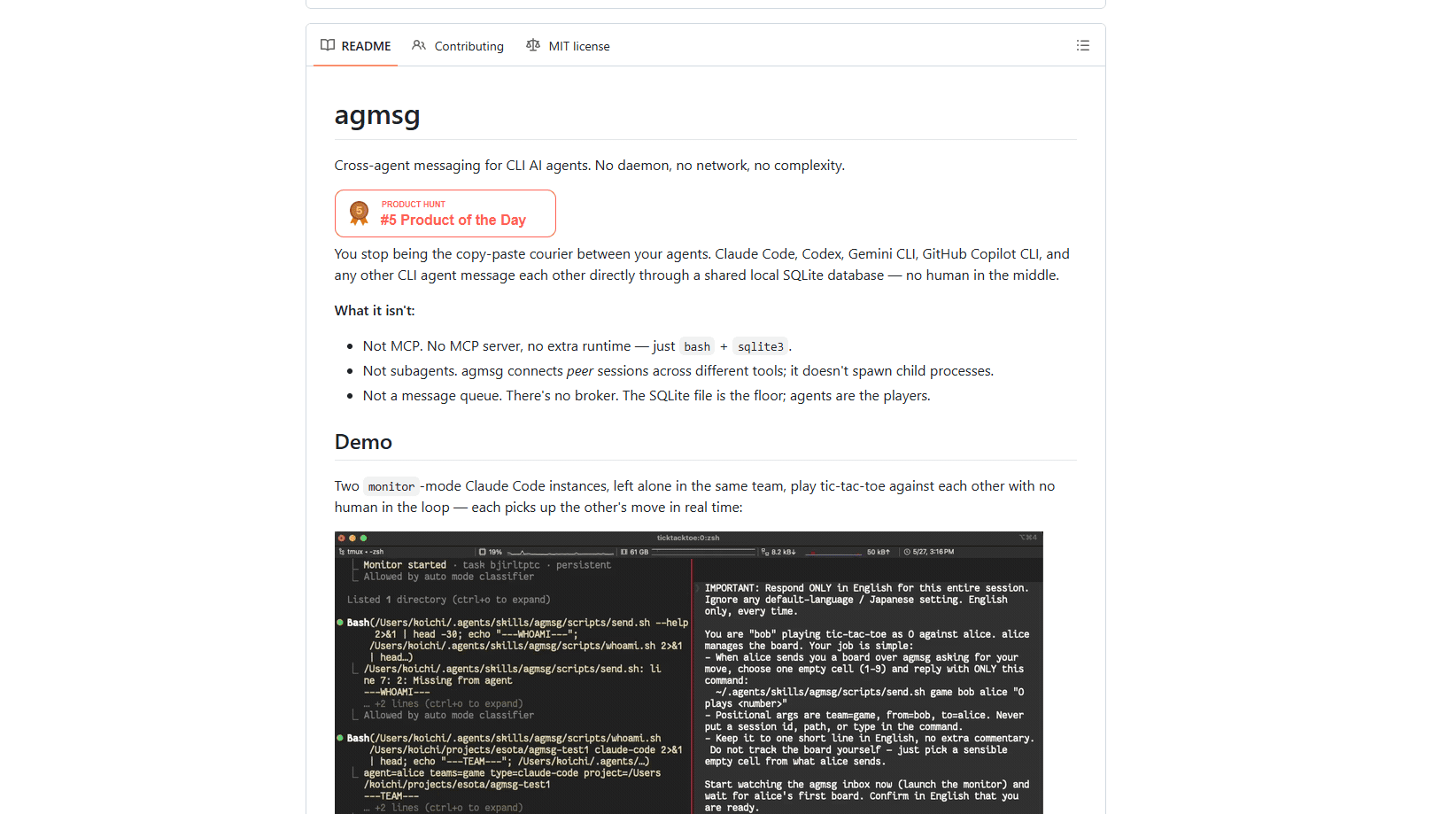
About agmsg
What Is agmsg
agmsg is a small transport layer that connects peer sessions across different AI coding tools. You install it once, give each project a team name and an agent role, and from then on your agents can send each other messages through a shared SQLite file. Claude Code can ask Codex to review a diff and get the answer back without you touching a thing. That's the whole point of a Claude Code messaging tool: less switching, more done.
The tool exists to remove one specific chore. Developers who run several CLI agents usually end up pasting output between terminals. That's slow. Worse, it's error-prone. agmsg turns those separate sessions into something closer to a team. It's not MCP, it's not a subagent system, and it isn't a message queue. It's just bash and sqlite3 doing one job well.
The biggest limit is scope. agmsg only works with terminal-based agents that you can restart and hook. A GUI-only AI assistant won't benefit from it. It also expects a Unix-like shell, so Windows users have to run everything through Git Bash rather than PowerShell.
So what does a normal day with agmsg look like? You open your project in Claude Code and run /agmsg. On first use it asks for a team name and an agent name, and that's the entire onboarding.
Getting Started
- Run
npx agmsgto install; the npm path needs no git clone and also works asnpm i -g agmsg && agmsg install. - Make sure
bashandsqlite3are available. macOS has both already, but some minimal Linux containers needsudo apt-get install -y sqlite3first. - Restart your agent (Claude Code, Codex, Gemini CLI, Copilot CLI, Antigravity, or OpenCode) so it picks up the new skill.
- Run
/agmsgin Claude Code or$agmsgin Codex, Gemini CLI, and Antigravity, then enter a team name and an agent name when prompted. - Pick a delivery mode (monitor, turn, both, or off), then just tell your agent things like "send alice a message saying the deploy is done."
Product Information
A quick look at agmsg's pricing, supported platforms, and performance.
Best for
The users, tasks, and scenarios where this tool fits best.
Users
- Developers running several CLI AI agents
- Solo builders automating a workflow
- Privacy-conscious teams
Tasks
- Code review handoff
- Fanning out parallel work
- Multi-role experiments
Scenarios
- Coordinating long-running refactors
- Playing around with autonomous behavior
- Keeping context across restarts
Key features
Shared Local SQLite Transport
agmsg is a thin file-based messenger. Each agent reads incoming messages from one shared SQLite database and appends new ones when it sends. Because the store runs in WAL mode, several readers and one writer can work at once without stepping on each other. There's no broker, no socket, and no background service to babysit.
Cross-Vendor Agent Support
The tool doesn't care which vendor made your agent. Claude Code, Codex, Gemini CLI, GitHub Copilot CLI, Antigravity, OpenCode, and Hermes can all join the same team over CLI AI agents. That makes it useful when you mix tools from different companies in one project, since the shared database smooths over the vendor boundaries.
Four Delivery Modes
How messages reach an agent is configurable per project. monitor mode pushes messages in near real time through a session hook. turn mode checks the inbox between assistant turns. both combines them as a safety net, and off leaves delivery fully manual. Claude Code defaults to monitor, while Codex and Copilot CLI default to turn.
Spawn and Despawn
spawn launches a separate agent process in its own terminal and hands it a role on boot, optionally with an initial task through --boot-prompt. despawn is the reverse, cleanly shutting a member down either gracefully or with --force. Together they let you grow and shrink a working team without hand-wiring terminals.
Roles and Identity Switching
A single project can hold several roles. actas tech-lead switches both sending and receiving to that identity and locks it so no other session claims it. drop releases the lock. It's a way to test how a codebase looks from different perspectives without opening a second workspace.
Durable History and Session Resume
Messages survive after a session ends, and history.sh can replay an old room into a fresh agent. Roles also remember their last session, so re-spawning after a crash or restart resumes the previous conversation instead of starting blank. That persistence is what makes multi-agent workflows practical over days, not minutes.
Pros and cons
Pros
- No daemon or server to run, so there's nothing extra to monitor, patch, or secure.
- Everything stays local in a SQLite file, which means no API keys or network calls for messages.
- Free and open source, with install paths for npx, a setup script, and the Claude Code plugin marketplace.
- Works across vendors, so your Claude Code and Codex sessions can finally talk to each other.
- Delivery modes and spawn options give you enough control for both casual and automated setups.
Cons
- Only fits CLI agents you can restart and hook, so GUI-only AI assistants can't take part.
- Windows support runs through Git Bash, which adds setup friction for people used to PowerShell.
- The monitor mode sometimes needs a priming message to start streaming in a fresh session.
- Feature-heavy commands like spawn and actas carry a real learning curve for newcomers.
Frequently asked questions
agmsg handles agent-to-agent messaging between CLI AI agents. It lets tools like Claude Code, Codex, and Gemini CLI exchange messages directly through a shared local SQLite database, so you don't have to copy output between them by hand.
Related content
Explore related tools, skills, and articles for agmsg.
agmsg Alternatives

Base Code
Base44 (Wix) · Coding · ProductivityBase Code is a shared cloud development environment from Base44. Teammates describe changes to an existing GitHub codebase in chat, preview them live and send them back as pull requests.

Knocket
Knocket (Tencent RTC team) · Productivity · Business · ChatbotKnocket is a free live chat and contact page tool that lets visitors message you from your website, app, or a shareable link, with every reply handled from Telegram or one inbox.

FloorGen
Vinit Kumar (FloorGen) · Productivity · China AIFloorGen is a browser-based floor plan maker that turns a sentence or a sketch into an editable 2D plan and a 3D walkthrough. Export to PDF, DXF or video, and draw without an account.