

Amara
01C (Zero One Creative) · Image
Amara is an AI 3D world builder from the research lab 01C that turns plain text to 3D and voice to 3D prompts into fully editable game environments. Instead of exporting a single static asset, it composes whole scenes, thousands of objects, terrain, lighting, and even running game logic directly inside Unreal Engine. It's aimed at game developers, level designers, and simulation teams who want a head start on worldbuilding without hand-placing every prop.
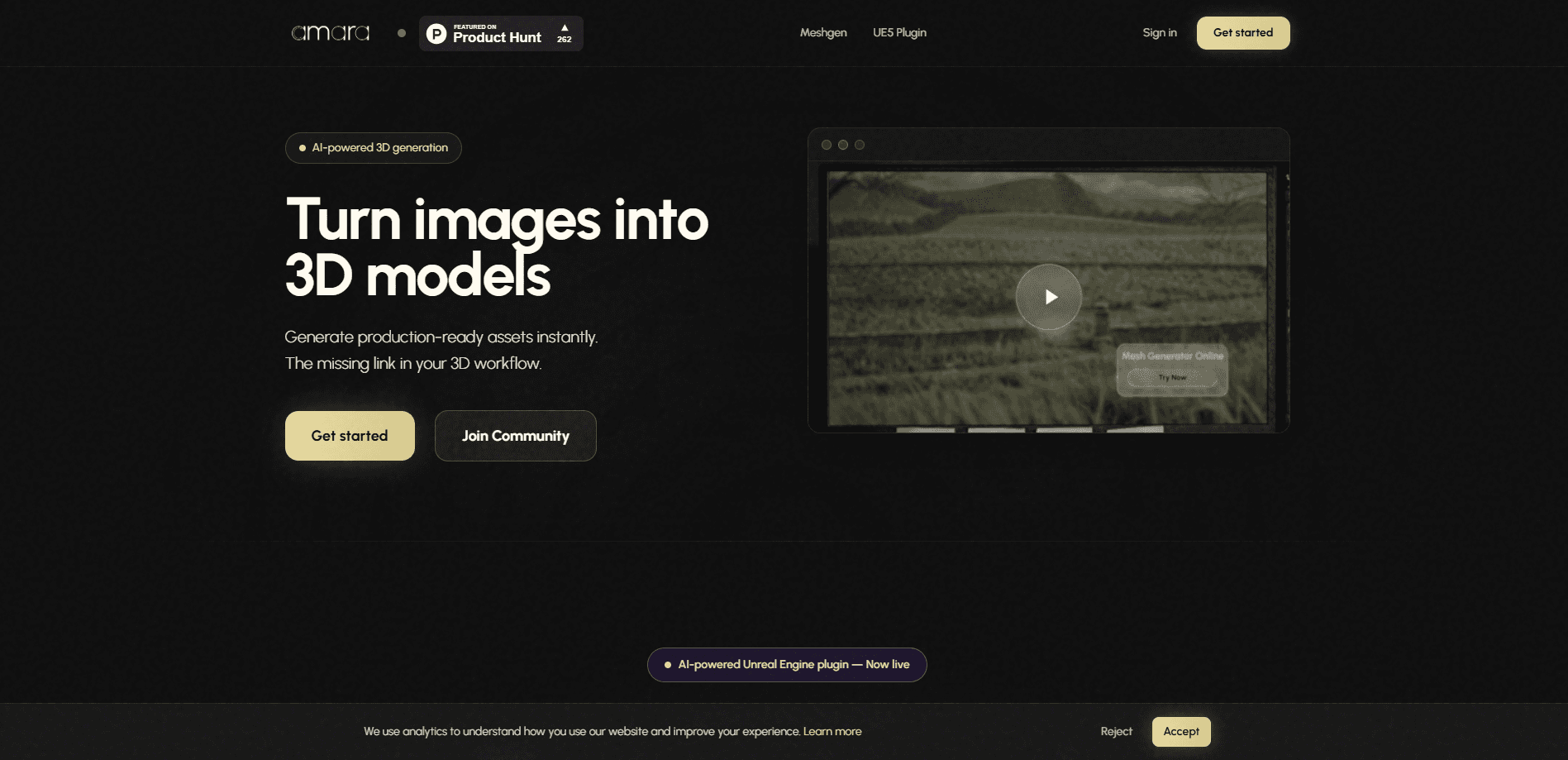
About Amara
What Is Amara
Amara is a 3D agent that builds worlds from a description. It works as a 3D world builder and AI scene generation tool. You type or say something like "a 17th-century English merchant's study," and the system puts together the room, the furniture, the lighting, and the interactive logic behind it. 01C, the lab behind it, frames the goal as models for 3D worldbuilding rather than one-off model generation.
What separates it from most AI 3D generator tools is the output. Many hand you a mesh file to import somewhere else. Amara works inside the game engine itself. The scene arrives already assembled, editable, and interactive. That matters if your real bottleneck isn't modeling a chair but placing ten thousand of them coherently.
The main limitation right now is access. Amara v2 is in staged early access. You join a waitlist before you can use it. It also leans on Unreal Engine as its primary home, which means teams working in other engines or plain web tools won't get the full experience yet.
Getting Started
- Head to the Amara site and join the v2 waitlist to get an early access slot.
- Once you're in, install the Amara plugin for Unreal Engine and open your project.
- Describe the world you want in a text or voice prompt, then let Amara lay out the first version of the scene.
- Bring your own 3D assets or pull from the in-house AmaraSpatial-10K library when you want specific models.
- Iterate with follow-up prompts, adjusting detail, lighting, and effects until the environment matches your vision.
Product Information
A quick look at Amara's pricing, supported platforms, and performance.
Best for
The users, tasks, and scenarios where this tool fits best.
Users
- Game developers
- Level designers
- Simulation and robotics teams
Tasks
- Building full interiors
- Authoring game logic
- Laying out large scenes in stages
- Generating natural environments
Scenarios
- Prototyping a level before committing art budget
- Populating a city district
- Adding rigged characters
- Prepping embodied-AI training grounds
Key features
Prompt-to-Scene Worldbuilding
You describe a world in text or voice, and Amara builds the scene inside Unreal Engine. It acts as an Unreal Engine AI plugin that composes complete interiors, then arranges thousands of parts into whole buildings and a drivable street, with every piece placed so it holds together. No manual placement. That's the pitch.
Physics-Aware Simulation
Amara authors a full simulation, not just a static scene. It writes its own scripts and applies accurate physics, which is the leap from an environment you look at to one that behaves. Building a scene that actually runs, with objects that respond the way they should, is a far harder problem than generating pretty geometry, and it's the one Amara targets. For teams testing gameplay or robotics, that behavior is the whole point.
Playable Game Generation
Any environment Amara builds can become a playable game. Think of it as an AI game environment generator that also writes the rules. It scripts the NPC AI and the logic that runs the scene, so a prompt can end in something you actually control rather than a backdrop.
The AmaraSpatial-10K Library
Rather than generating every object from scratch, Amara can pull from an in-house library of 10,000+ meshes, released under CC BY 4.0. The dataset includes metric-accurate scaling, semantic origin placement, and production PBR textures. That cuts down the cleanup work that plagues looser 3D datasets. Less fixing, more building.
Bring Your Own Assets
You aren't locked into Amara's models. Upload your own 3D assets and the agent places and integrates them into the scene alongside generated ones. That flexibility is what makes the tool usable on projects with an existing art style, not just fresh prototypes.
Staged, Controllable Scene Building
Amara builds huge scenes in stages, and you stay in the loop. You can dial detail up or down, adjust lighting, and switch on live effects like weather or falling cherry blossoms. The result gets sharper each time you iterate. Good for level design.
Dense Natural and Urban Environments
The agent generates entire natural environments with detailed terrain and thick foliage you can navigate directly. It also lays out large-scale city districts that feel full rather than empty. Empty maps are a common weak spot for early AI scene tools. Not here. That density is the difference between a stage set and a place.
Rigged Character Generation
Amara adds fully rigged, animatable characters that are ready to move and perform. Characters become part of the scene from the start. No separate rigging task. Saves a step.
Pros and cons
Pros
- Builds complete, editable worlds inside Unreal Engine rather than exporting static meshes.
- Handles both visuals and behavior, scripting physics and NPC logic on top of the scene.
- Lets you mix your own 3D assets with its generated ones and the AmaraSpatial-10K library.
- Backed by an open dataset (10,000+ meshes, CC BY 4.0) with metric-accurate scaling and PBR textures.
Cons
- v2 is in staged early access, so you can't use it today without a waitlist slot.
- Centers on Unreal Engine, meaning teams in other engines won't get the full workflow.
- Pricing isn't public, which makes it hard to plan budget before you're accepted.
Frequently asked questions
Amara is a 3D agent that builds editable game environments from text or voice prompts. You describe a world and it composes the scene, from interiors and streets to natural terrain and playable logic, inside Unreal Engine.
Related content
Explore related tools, skills, and articles for Amara.
Amara Alternatives

Google EmbeddingGemma 2
Google DeepMind · Writing · Image · CodingGoogle EmbeddingGemma 2 is a 740M-parameter open model that turns text, code, images, audio, and video frames into vectors in one 768-dimension space, running on phones and laptops.

Tractionwave
TractionWave · Image · MarketingTractionWave is an AI attention heatmap tool for static ads. Upload a PNG or JPG and it returns predicted attention, ranked hotspots, and fixes before you spend budget.

Imejis.io
Imejis.io · Image · MarketingImejis.io is an AI design studio for agents and marketing teams. Describe an image in plain words, and it writes the copy, builds the layout, reflows it to every size, then exports a finished file.