
ApiFlux
ApiFlux · Coding
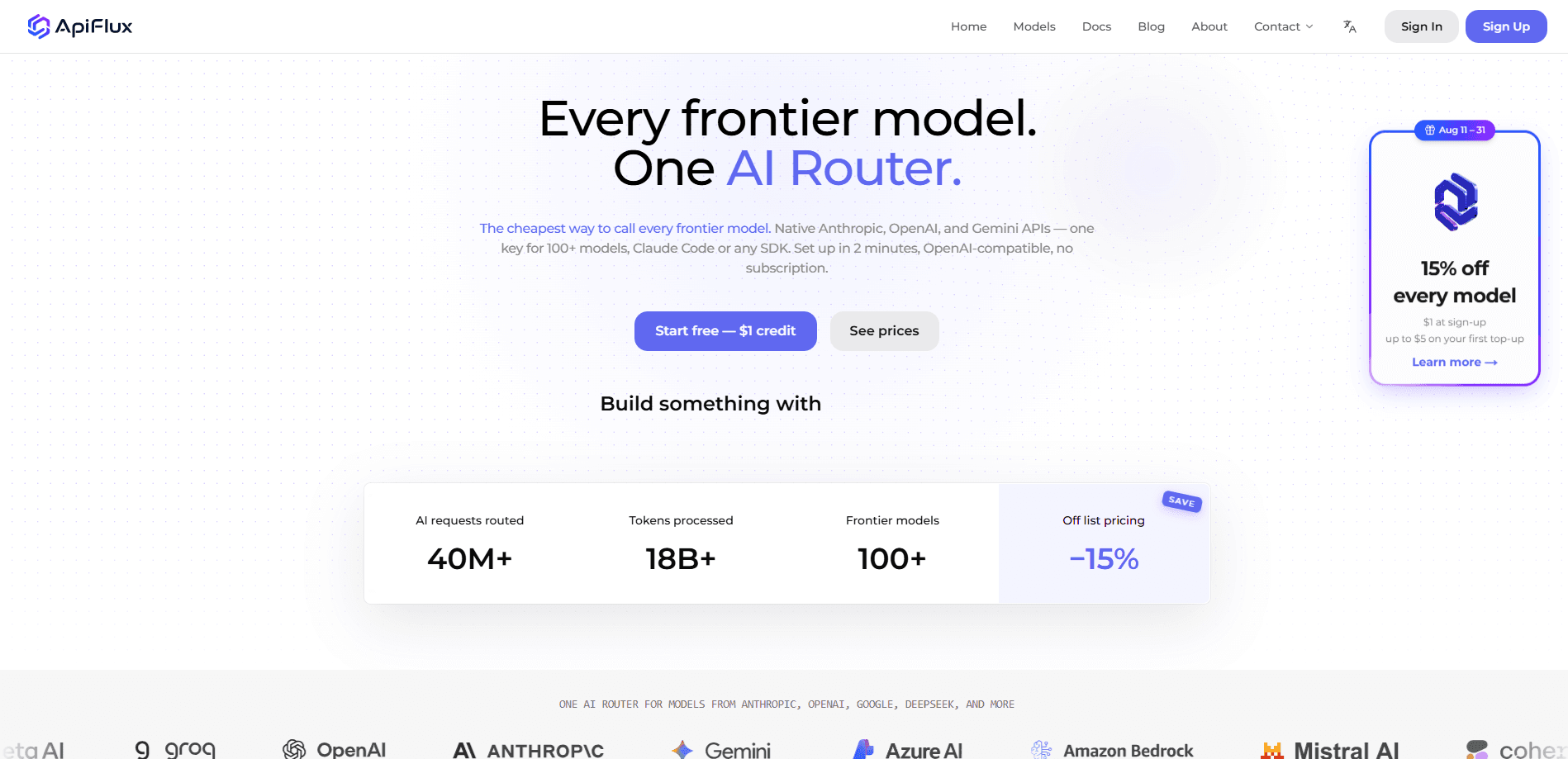
ApiFlux is an AI router that lets you call 100+ large language models from Anthropic, OpenAI, Google, DeepSeek, and other makers through a single API key. It speaks native Anthropic, OpenAI, and Gemini formats, so you point your existing tool or SDK at one endpoint and switch models without rewriting code. The pitch is simple: transparent per-token pricing, automatic failover when a provider stumbles, and a live dashboard that shows what you spend.
About ApiFlux
What Is ApiFlux
ApiFlux sits between your application and the model providers. Think of it as an LLM gateway. Instead of managing separate keys, billing accounts, and SDK quirks for Claude, GPT, Gemini, and a long list of open-weight models, you route everything through one API gateway. It's built for developers and teams who call frontier models in production and care about cost, uptime, and not getting locked into one vendor.
The main problem it solves is operational sprawl. Most teams end up juggling a handful of provider accounts, and when one API degrades or a model is deprecated, someone has to scramble to patch the integration before anyone notices the gap. ApiFlux centralizes that: one key, one invoice, one usage view, plus automatic failover that reroutes requests to a healthy path before your users notice anything.
The limits are worth knowing up front. ApiFlux is a routing layer, not a model of its own. Its reliability depends on the upstream providers it points to. It's also aimed squarely at people who write code. If you want a chat app with a friendly interface, this isn't that. You bring your own tool, script, or coding agent, and ApiFlux handles the plumbing underneath.
Getting Started
- Sign in to ApiFlux and create an API key from your account dashboard.
- Add credits to your balance. There's no subscription, you pay per token as you go.
- Point your tool or SDK at the ApiFlux base URL. It accepts OpenAI-compatible, Anthropic, and Gemini request formats.
- Pick a model by name from the catalog and send a test request to confirm the key works.
- Follow one of the setup guides if you use Claude Code, Codex CLI, or OpenCode to connect a coding tool in a few minutes.
Product Information
A quick look at ApiFlux's pricing, supported platforms, and performance.
Best for
The users, tasks, and scenarios where this tool fits best.
Users
- Developers building AI features into an app
- Engineering teams running production traffic
- Solo builders and coding-agent users
Tasks
- Calling many models from one codebase
- Cutting token costs
- Comparing model output
- Building a multi-model API for an app
Scenarios
- Migrating a prototype to production without rebuilding your provider setup from scratch.
- Handling a provider outage during peak hours without your users hitting errors.
- Running a coding agent that needs long context and frequent model calls at a controlled cost.
Key features
One Key for 100+ Models
ApiFlux routes to more than 100 models across Anthropic, OpenAI, Google, DeepSeek, Alibaba, Moonshot, and Z.ai. You manage one key and one balance instead of a separate account for each maker. Why bother with a dozen dashboards? The catalog lists each model's input and output price per million tokens, context length, and supported input types, so you can shop around before you commit.
Native Multi-Protocol Support
The router accepts OpenAI-compatible, Anthropic, and Gemini request formats rather than forcing everything through one shim. That matters for tools that expect a specific API shape. You can connect Claude Code to the Anthropic endpoint, add ApiFlux as a custom OpenAI-compatible provider in OpenCode, or configure it as a Codex model provider, all against the same account.
Automatic Failover
When an upstream provider degrades, ApiFlux reroutes the request to a healthy path before your users see a failure. For anyone running production traffic, that removes a chunk of manual firefighting. It doesn't make outages disappear. It just keeps a single bad provider from taking your whole feature down.
Transparent Per-Token Pricing
Rates are shown per million tokens with the maker's list price alongside them, so the discount is visible rather than buried. There's no subscription and no monthly fee, you top up a balance and spend it as you call models. For teams that watch their AI spend closely, that transparency makes budgeting less of a guessing game.
Live Usage Dashboard
Every request feeds token usage, latency, cost, and errors into one dashboard, with no extra instrumentation on your side. You can see which models you lean on, where latency spikes, and what each integration actually costs. No logging pipeline required. That's the kind of data that usually takes weeks to assemble.
Built for AI Coding Tools
ApiFlux ships step-by-step guides for Claude Code, Codex CLI, and OpenCode, which are the tools many developers already run daily. The setup is designed to take a couple of minutes: drop in the base URL, paste your key, and pick a model. It's a practical shortcut for anyone who wants cheaper tokens without wrestling with config files.
Pros and cons
Pros
- One key and one balance cover 100+ models, which cuts down on account juggling.
- Native Anthropic, OpenAI, and Gemini formats mean fewer integration rewrites.
- Automatic failover keeps requests flowing when a provider has a bad day.
- Transparent per-token pricing, with no subscription or monthly minimum.
- Ready-made setup guides for popular coding agents get you running fast.
Cons
- No free plan, so you have to add credits before testing anything.
- It's a routing layer, so uptime still depends on the providers behind it.
- The product targets developers. Non-coders looking for a chat interface won't find one here.
Frequently asked questions
It's an AI router. You send model requests to one endpoint, and ApiFlux forwards them to the right provider, whether that's Anthropic, OpenAI, Google, or another maker. It handles auth, billing, and failover so you don't have to.
Related content
Explore related tools, skills, and articles for ApiFlux.
ApiFlux Alternatives
Forefront
Forefront · CodingForefront is a web platform for building with open-source AI. It lets you fine-tune leading open-source language models on your own data, evaluate how they perform, and run them through an API or export them to host yourself. Developers who want the convenience of a closed-source platform but insist on owning their models and data are the target audience here.

Startkit
StartKit.AI · CodingStartkit is a boilerplate for building AI SaaS and AI wrapper products. Think of it as an AI startup boilerplate with the boring parts already wired up: authentication, Stripe and Lemon Squeezy payments, usage limits, transactional email, and an AI API starter that talks to OpenAI, Anthropic, Groq, or Llama. You clone the repo, set your price, and start on the part of your product that people actually pay for. It's Next.js under React and Tailwind, so most of the boilerplate code already feels familiar.
Testim
Tricentis · CodingTestim is an AI-powered test automation platform for building and running end-to-end tests across web, mobile, and Salesforce applications. It leans on machine learning to keep tests stable when an interface changes, so teams spend less time fixing broken selectors. Not bad for an automated testing tool you can start using today. You create tests by recording actions in a browser, then optionally add JavaScript when you need more control. It's a solid pick for busy QA teams.