

APIPark
Eolink (APIParkLab) · Coding · Other
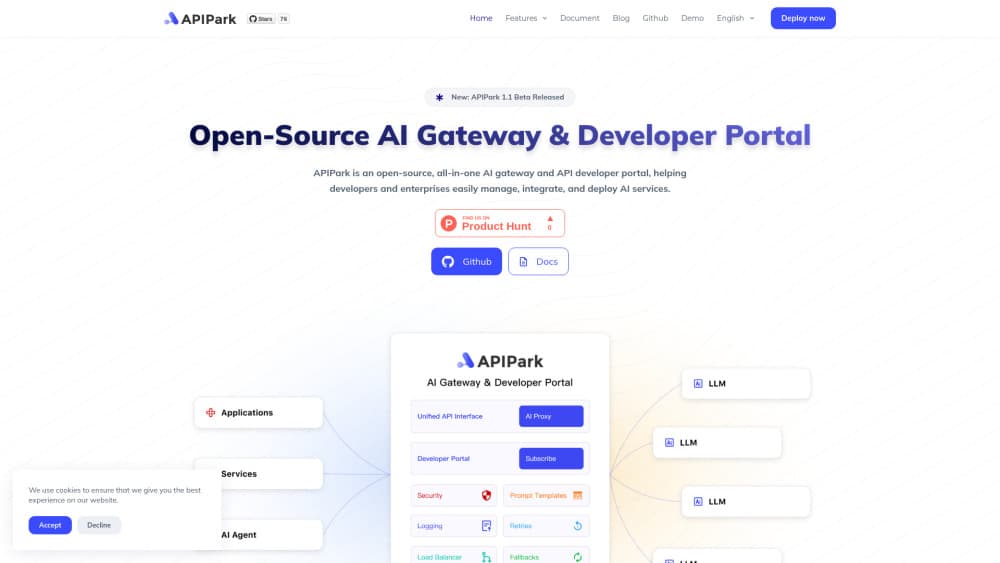
APIPark is an open source LLM API gateway and API management platform. It unifies 100+ model APIs behind one key, plus approval flows, billing, and usage logs.
About APIPark
What Is APIPark
APIPark is an open source LLM API gateway that sits between your apps and the AI models or APIs they call. Instead of wiring each app to OpenAI, Claude, Gemini and a dozen others one by one, you point everything at APIPark and let it route the request. It ships under the Apache 2.0 license, so you can run a self-hosted AI gateway on your own servers and use it commercially at no cost. The team behind it, Eolink, spent seven years on API tooling before building this.
The problem it targets is mess, not speed. A team that adds a second or third model usually ends up with scattered API keys, no record of who called what, and code that breaks the moment a model is swapped out. APIPark standardizes the request and response format across providers, so you can unify AI model APIs and swap the model behind a service without a rewrite of the app in front of it. This API management platform can also blend a model with a saved prompt and publish the result as a plain REST API, which is how teams turn a sentiment check or a translation step into a callable endpoint.
Two limits are worth knowing up front. Running it takes some DevOps work: the quick-start script handles a single machine in about five minutes, but a real deployment with clustering, a database and log shipping is your own responsibility. And because it's open source, there's no vendor hotline. Support comes from the community and the project's own documentation.
Getting Started
- Run the quick-start script on a Linux host with Docker installed. It pulls the images and stands up the gateway plus the developer portal in about five minutes.
- Sign in to the portal, open the AI model settings and add a provider. Paste an upstream API key, or point it at a self-hosted model through Ollama or a compatible endpoint.
- Create a service, attach the models and prompts it should expose, then publish it so it appears in the API portal with its own base URL.
- Issue API keys to the applications that need access, and set a subscription or approval step if you want calls reviewed before they go live.
- Watch calls, latency and token spend on the dashboard, and forward request logs to your existing logging platform.
Product Information
A quick look at APIPark's pricing, supported platforms, and performance.
Best for
The users, tasks, and scenarios where this tool fits best.
Users
- Backend and platform engineers who already call more than one model and are tired of juggling separate keys and SDKs. You need a server or a cluster to run it on.
- Teams small enough to lack an API governance tool but large enough to worry about who is spending tokens. The approval flow matters once more than a handful of people hold keys.
- Companies that want to expose internal APIs, or resell spare AI capacity, to partners or other business units. The billing and subscription features are aimed at exactly this.
- Developers who build agents that need to reach internal or third-party APIs, since APIPark can wrap a REST API as an MCP server the agent can call.
Tasks
- Swapping the model behind a live service without touching the app. Standardized request formats mean you change a setting, not code.
- Turning a prompt into an endpoint. Save a prompt, pair it with a model, publish it, and you have a translation or classification API your whole team can call.
- Enforcing approval before access. A consumer requests a specific API, and a manager signs off before any call gets through.
- Tracking spend across models. Per-request, per-token and time-based pricing rules feed one balance and one bill instead of a dozen invoices.
- Debugging a flaky integration. Centralized request and response logs make it easier to see whether the fault sits in your app or upstream.
Scenarios
- Standing up an internal AI platform for a company where several teams each want their own model access. Tenant separation keeps one team's usage and keys out of another's.
- Running a paid API marketplace. Independent developers can list and sell endpoints, and buyers top up one balance to reach all of them.
- Keeping a service online through a provider outage. Multi-model fallback routes traffic to a working provider when the first one stalls.
- Handling a burst of traffic without a rewrite. Cluster deployment spreads load across gateway nodes rather than leaning on one box.
- Locking down sensitive data. Data masking strategies strip or filter fields in a call before the prompt ever reaches a model.
Key features
One endpoint for 100+ AI models
APIPark connects to the major providers, from OpenAI, Azure and Anthropic to Gemini, DeepSeek, Mistral, Llama, Qwen, Zhipu and Baichuan, plus local runtimes like Ollama. Every one of them answers to the same OpenAI-style request format. That means an app written against one model can call another by changing a single parameter, and the maintenance cost of a model switch drops to near zero. You can add a custom provider too, as long as it speaks the OpenAI schema.
Prompts packaged as REST APIs
Not every AI task needs a chat interface. APIPark lets you save a prompt, bind it to a model, and publish the pair as a standard REST API. A support team can build a sentiment endpoint, a product team a translation endpoint, without either of them writing model code. Consumers call it like any other API and never see the prompt or the model underneath.
Approval flows and key management
Access isn't open by default. A consumer requests a specific API or model, and a service manager approves or rejects the request before any call goes through. Once approved, the consumer uses a single key that spans the models and APIs they're allowed to touch, which removes the tangle of per-vendor credentials. Every resource belongs to the tenant that owns it.
Billing and subscriptions
For teams that charge for access, APIPark handles the money side. It supports pricing by call count, by token volume and by time package, with automatic deduction against a single account balance. A buyer tops up once and spends across every service they're subscribed to, and the platform keeps an itemized record of each deduction along with its approval state.
Monitoring and log export
The dashboard shows call volume, latency, error rates and token usage across services and tenants, so a spike or a failure is visible without digging through app logs. Request and response logs can be pushed straight to a third-party logging platform. That matters when your existing stack already collects everything else.
MCP server support
APIPark can expose a REST API as an MCP server. This gives an AI agent a way to reach tools and data it otherwise couldn't see. It offers both system-level servers, which span all public services, and service-level servers, which scope access to a single service for finer control. That split lets you hand an agent broad reach or a narrow, restricted slice based on what it's trusted to do.
Pros and cons
Pros
- Free for commercial use under Apache 2.0, with no license fee and no per-seat cost, so cost scales with your servers rather than your headcount.
- Standardized API formats across providers turn a model swap into a config change instead of a code change.
- The approval flow and tenant separation give real governance without buying a separate enterprise API product.
- Pack a prompt as a REST API and the barrier drops for teams that want AI features without model expertise.
- MCP server support connects the gateway to the current wave of AI agents rather than treating agents as an afterthought.
Cons
- There's no support contract or uptime guarantee. If the gateway breaks in production, you fix it or wait on the community.
- A self-hosted AI gateway means you own upgrades, backups, cluster setup and security patches. That's real work, and it's the cost the free license doesn't show.
- The Git repository is active but modest in scale (roughly 1,800 stars), so some integrations you might want may not exist yet.
- The billing and marketplace features only pay off for teams that actually resell or charge for API access. A single developer calling one model gains little from them.
Frequently asked questions
APIPark is an open source AI gateway and API developer portal. It routes calls to 100+ AI models and ordinary APIs through one endpoint, then handles the keys, approvals, billing, and log records around those calls. Teams use it to cut the number of moving parts in an AI integration.
Related content
Explore related tools, skills, and articles for APIPark.
APIPark Alternatives

Udon
Udon · Coding · ProductivityUdon turns an Apple Silicon Mac into a home server you run from a browser, with container controls, file shares, and an optional AI sysadmin.

offstage
offstage cloud · Coding · Productivityoffstage gives AI coding agents and CI jobs a real Mac: a fresh macOS account on Apple silicon, driven over an API and billed by the second.

BotBus
Chengdu Tuyang Tusen Technology Co., Ltd. · Coding · ProductivityBotBus lets you control AI coding agents from your phone and watch: approve commands, start tasks and read results while the code stays on your desktop.