

Askflow
Askflow AI (Upward Digital OU) · Leaning · Business
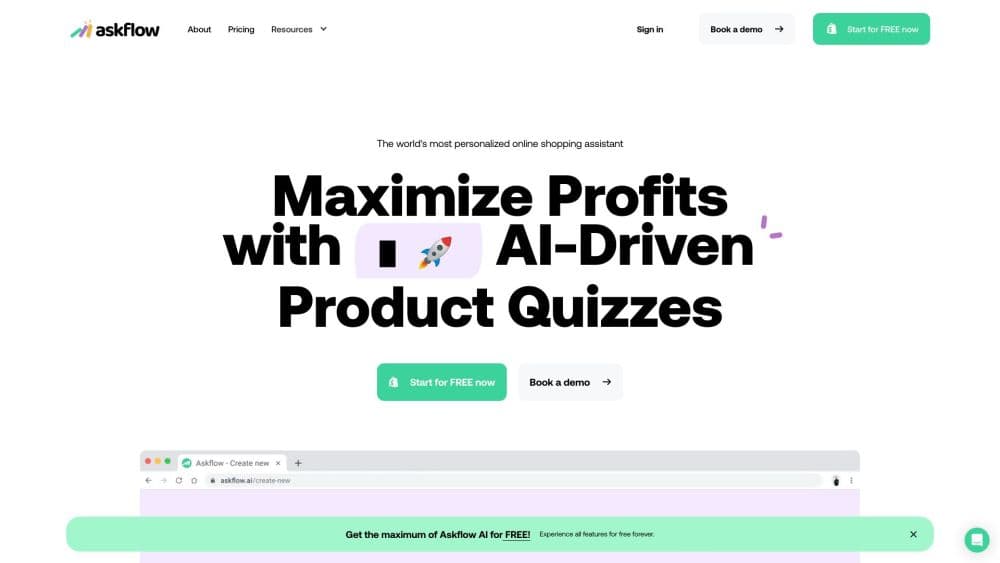
Askflow is an AI shopping assistant for Shopify and WooCommerce stores. It chats with shoppers, recommends products and bundles, recovers carts, and captures email or SMS leads.
About Askflow
What Is Askflow
Askflow AI is a shopping assistant app that sits on top of an online store. It adds two things to the storefront: a chat window that talks to shoppers, and a product recommendation quiz that asks a short series of questions. Both feed the same recommendation engine, which reads each visitor's answers, page context, and cart contents before suggesting what to buy.
The company behind the app, Upward Digital OU, listed it on the Shopify App Store in May 2023 and later added WooCommerce support. That timing matters. The app started as a quiz tool for product discovery and grew into a broader assistant that also handles upsells, cart recovery, and lead capture. If you only need the quiz, it still works that way.
The problem it targets is catalog friction. A shopper who wants "a moisturizer for oily skin under $40" gets little help from a search box that expects a product name. A conversation or a quiz lets them describe the need in their own words, and Askflow maps that to SKUs. Askflow's own case study says LEGO used the tool to guide shoppers through quick questions and saw a 20% lift in conversion rate plus 17% fewer product returns. Treat that as a vendor reported result, not an independent benchmark.
Two limits are worth knowing before you install. The assistant is only as good as your product data, so messy titles, missing tags, and thin variant descriptions will produce weak matches. The quiz and chat interface also runs in English only, which rules it out for stores that sell mainly in other languages.
Getting Started
- Install Askflow from the Shopify App Store, or connect a WooCommerce store, and approve the product and order permissions it requests.
- Choose a starting point: let the AI generate a product recommendation quiz from your catalog, or build an assistant from your own questions and branching rules.
- Set the look and the placement. Six templates ship with the app, and you can publish the experience as a page, an embedded block, a pop-up, or a floating widget with a call to action.
- Connect Klaviyo, Google Analytics, or Meta Pixel so leads and events reach the tools your team already checks.
- Run it on a handful of product pages, review the suggestions against your real catalog, then publish once the matches hold up.
Product Information
A quick look at Askflow's pricing, supported platforms, and performance.
Best for
The users, tasks, and scenarios where this tool fits best.
Users
- Shopify store owners with large catalogs
- Beauty and skincare brands
- Fashion and apparel retailers
- Small teams without a developer
Tasks
- Helping a shopper pick between similar variants
- Raising average order value
- Recovering abandoned carts
- Building an email or SMS list
Scenarios
- Product pages where visitors stall
- Seasonal gifting
- Paid traffic landing pages
Key features
AI Product Advisor
The core of the app is a chat assistant that answers product questions and recommends items from your catalog. It reads the current page and the shopper's cart, so the first message can reference the product they are already viewing. Answers stay grounded in your product data rather than general knowledge, which keeps the assistant from inventing specs. Unlike a plain Shopify AI chatbot, it can hand a vague conversation over to the quiz when the shopper cannot name what they want.
AI Quiz Builder
You describe the quiz you want, and the app generates questions, answer options, and a matching rule set in about a minute. Askflow counts these runs as AI quiz generations, and each plan caps them. The output is editable, which matters because generated questions often need trimming to sound like your brand.
Branching Logic
Questions can follow different paths depending on earlier answers, so a shopper who says "sensitive skin" never sees questions about harsh exfoliants. You build the branches in a visual editor without code. This is the part that separates a useful product recommendation quiz from a generic survey.
Bundle and Upsell Suggestions
Askflow recommends add-ons, bundles, and upgrades inside the conversation. Suggestions key off cart contents and what is missing from a routine, so a cleanser recommendation can pull in a matching moisturizer. Shoppers can add the item without leaving the chat, which shortens the path from suggestion to checkout.
Cart Recovery Triggers
The app watches for exit intent, cart inactivity, and returning visitors, then starts a conversation with a reminder or a time limited offer. Messages fire in the storefront rather than by email, so they reach people who never handed over an address. You set which triggers run and how often they can fire.
Lead Capture Without Forms
Instead of a pop-up form, the assistant asks for an email or phone number as part of the conversation, usually in exchange for a discount. Because the request arrives after a few helpful answers, more shoppers tend to complete it. Captured contacts sync to Klaviyo when that integration is on.
Analytics and Integrations
A dashboard tracks quiz starts, completions, recommendations shown, and revenue attributed to the assistant. Events can also flow to Google Analytics and Meta Pixel for retargeting. The reporting is built for store operators rather than analysts, so expect summary numbers instead of a full attribution model. It still ties sessions to ecommerce conversion, which is enough to see whether a quiz route sells or just gets clicks.
Pros and cons
Pros
- One app covers chat, quiz, upsell, and lead capture, which cuts the number of storefront widgets a shopper has to deal with.
- The AI quiz builder produces a working draft in about a minute, so testing a new angle costs little.
- Branching logic is available on every plan, including the entry tier, so small stores are not locked out of the feature that makes quizzes useful.
- Native Klaviyo, Google Analytics, and Meta Pixel connections save a build step for teams already running those tools.
Cons
- Engagement limits bite on the entry plan: 500 quiz engagements and 2 published quizzes per month is thin for a store with steady traffic, and overages cost $0.06 each.
- The interface is English only, so stores selling in German, Spanish, or Japanese would need custom work that the app does not offer.
- Recommendations depend on clean product data, and a catalog with weak tags will need cleanup before the assistant performs.
Frequently asked questions
Askflow adds an AI shopping assistant and a product recommendation quiz to an online store. Shoppers answer a few questions or chat with the assistant, and it suggests products, bundles, and add-ons from your catalog.
Related content
Explore related tools, skills, and articles for Askflow.
Askflow Alternatives

HireKey
HireKey · Voice & Language · Productivity · LeaningHireKey is an AI job search copilot built by a former tech recruiter. It checks role fit, tailors resumes, runs interview practice and tracks every application.
Lune
Retrograde Labs · Productivity · LeaningLune is a research search engine for scientific AI agents. It runs as an MCP server that lets Claude, ChatGPT and Cursor search peer-reviewed computer science papers and cite them.
Coddy
Coddy · Coding · LeaningCoddy is a gamified platform to learn to code through short interactive lessons in 20+ languages, with a browser editor, an AI tutor and free certificates.