

Boost.space
Boost.space · Coding
Boost.space is a no-code platform that centralizes business data from 2,600+ tools and runs AI agents on one shared agent operating system.
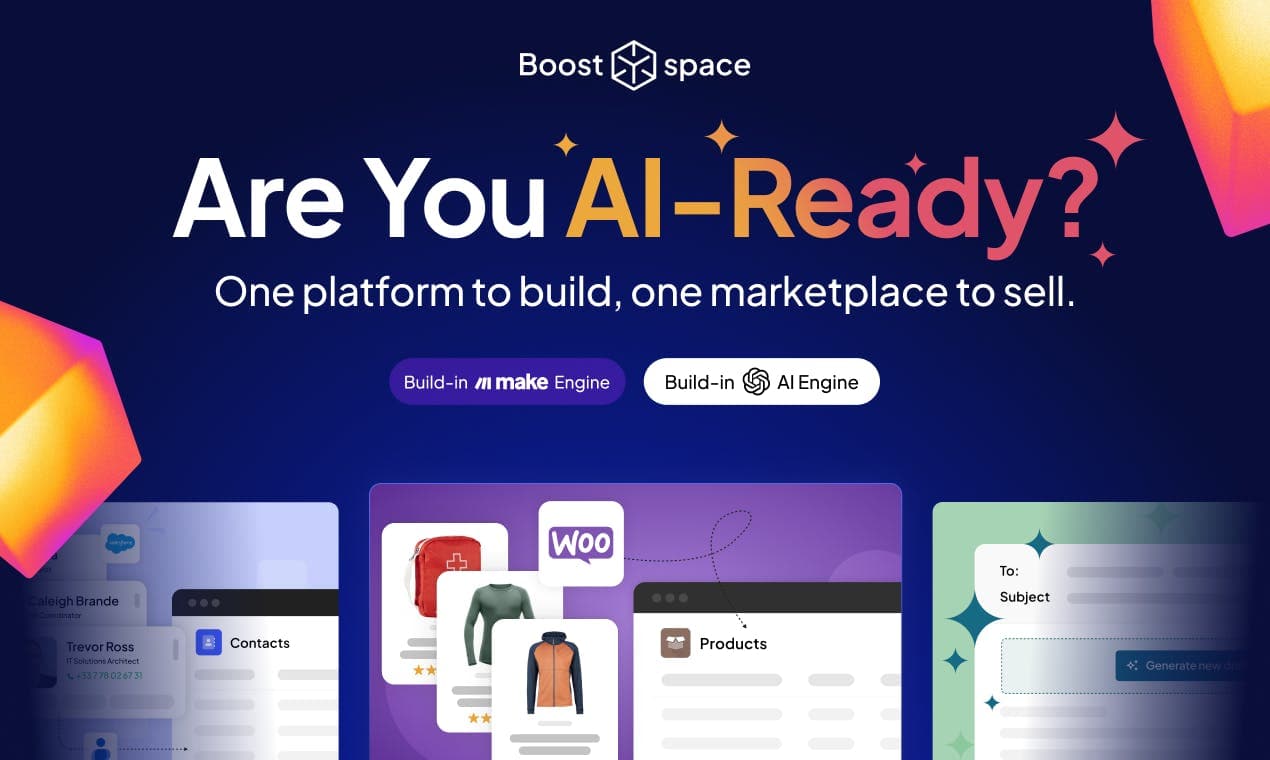
About Boost.space
What Is Boost.space
Boost.space is a web platform for teams that keep their business data scattered across dozens of apps. It gives you a central database, connectors to more than 2,600 tools, and an AI work layer on top. Instead of copying records between systems by hand, you sync them once and work from a single view. That puts it in iPaaS platform territory, just with an AI layer bolted on.
The product has grown into two connected halves. The first is the classic database and automation stack: store product and company records, then push changes between tools like your CRM, storefront, and spreadsheets without writing code. This is business data integration in the practical sense. The second is Agent OS, a layer that adds AI agents and reuses your business context across them. Bob, Boost.space's pretrained commerce agent, is the current flagship example of that second half.
That pairing is the appeal. AI chat tools give advice and then forget it. Boost.space keeps the data current, runs approved processes as repeatable skills, and limits what each agent can see. The tradeoff is scope and cost. The setup expects a real business with data to synchronize, and the managed services that keep that data live run on a monthly plan. Solo users with one spreadsheet get little from it.
Getting Started
- Create a Boost.space account and connect the tools you already use through the integrations library.
- Map your product and company records into the central database so every connected system reads the same data.
- Set synchronization rules so changes flow between tools automatically instead of by manual export.
- Pick a pretrained agent such as Bob, or ask the team to build a custom AI agent around your goal.
- Agree on the data scope, permissions, and monthly plan before launch, then let the agent run and report results.
Product Information
A quick look at Boost.space's pricing, supported platforms, and performance.
Best for
The users, tasks, and scenarios where this tool fits best.
Users
- Operations teams juggling multiple business tools
- eCommerce and catalog managers
- Small businesses with data to synchronize
Tasks
- Centralizing business data
- Two-way data synchronization
- Running an AI agent on real business data
- Turning repeatable work into reusable skills
Scenarios
- Cleaning up a product catalog spread across platforms
- Building an internal automation without code
- Scaling from one assistant to several
Key features
No-code data synchronization
The core promise is that changes in one tool show up in the others without you moving them. Boost.space connects to 2,600+ apps, syncs records on rules you set, and keeps a central database as the source of truth. You configure the flow through a visual interface, so linking a new system doesn't need SQL or a developer who understands every API on your stack. For teams that live in ten tabs, this is the part that saves the most time. It's the data sync platform most no-code buyers are hunting for.
Agent OS
Agent OS gives AI agents shared business context instead of a blank slate. It sits on four layers: a data layer for current records, an action layer that turns approvals into repeatable skills, a security layer that scopes what each agent can touch, and a library of verified connections. The point is reuse. When you add a second agent, it inherits the permissions and skills the first one already proved out. Think of it as the operating system that lets you connect business tools and the agents working across them.
Bob, the commerce agent
Bob is Boost.space's pretrained agent for product catalog work, and it reads your catalog alongside external product data to surface revenue opportunities. It then agrees a plan with you, gets to work, and reports results after four weeks. The company cites access to 9B+ commerce records for research and enrichment, scoped to the assignment. It's a working agent aimed at a long-term goal, not a chat window that hands you advice and stops.
Security and per-role permissions
Each agent gets its own boundaries. A pricing workflow can be shared with a second agent. The finance team's private data stays out, and so does another employee's personal account. You set approved connections and data views per role. That matters once more than one agent touches live records. Without that control, wiring an agent into your real systems is a risk most teams won't take, because one leaked connection can expose far more than the task needs. It's simple insurance.
Portable agent ownership
When you buy an agent, its training, current memory, configuration, and custom skills stay yours even if you cancel Agent OS afterward. Self-contained work keeps running. What stops is access to the managed database, synchronization, connections, and updates. That split is unusual for SaaS: you're not renting the agent itself, only the live services it leans on month to month.
Flexible components
You don't have to buy the whole platform, and the parts you pick can stand on their own. The Boost.space database and ACT, the action layer, can be used or purchased separately when that covers your need. A self-contained assignment may not need the full Agent OS at all. For a narrow job, that keeps the entry cost lower.
Pros and cons
Pros
- Connects 2,600+ tools. Data synchronization covers most of the stack a small business already runs.
- No-code setup means teams can build integration flows without hiring a developer.
- Agent OS reuses business context and skills across agents. Adding a second role takes far less setup.
- Per-role permissions let multiple agents run on live data without exposing private records.
- Delivered agents and their skills stay yours after you stop the monthly plan.
Cons
- No free plan. Small teams pay before they know whether the platform fits.
- The managed database and synchronization need an active Agent OS plan, which adds a recurring cost most no-code tools don't have.
- It's built for businesses with real data to synchronize, so individuals and single-spreadsheet users won't get much from it.
- Pricing is quoted per project, so the exact figure depends on a sales conversation rather than a public price list.
Frequently asked questions
Boost.space is used to centralize and synchronize business data across the tools a company already uses, then run AI agents on top of that shared data. Teams use it to keep records consistent between a CRM, storefront, and spreadsheets. They also use it to give agents like Bob a current view of the product catalog.
Related content
Explore related tools, skills, and articles for Boost.space.
Boost.space Alternatives

Udon
Udon · Coding · ProductivityUdon turns an Apple Silicon Mac into a home server you run from a browser, with container controls, file shares, and an optional AI sysadmin.

offstage
offstage cloud · Coding · Productivityoffstage gives AI coding agents and CI jobs a real Mac: a fresh macOS account on Apple silicon, driven over an API and billed by the second.

BotBus
Chengdu Tuyang Tusen Technology Co., Ltd. · Coding · ProductivityBotBus lets you control AI coding agents from your phone and watch: approve commands, start tasks and read results while the code stays on your desktop.