
Brella
Brella (Finland) · Productivity
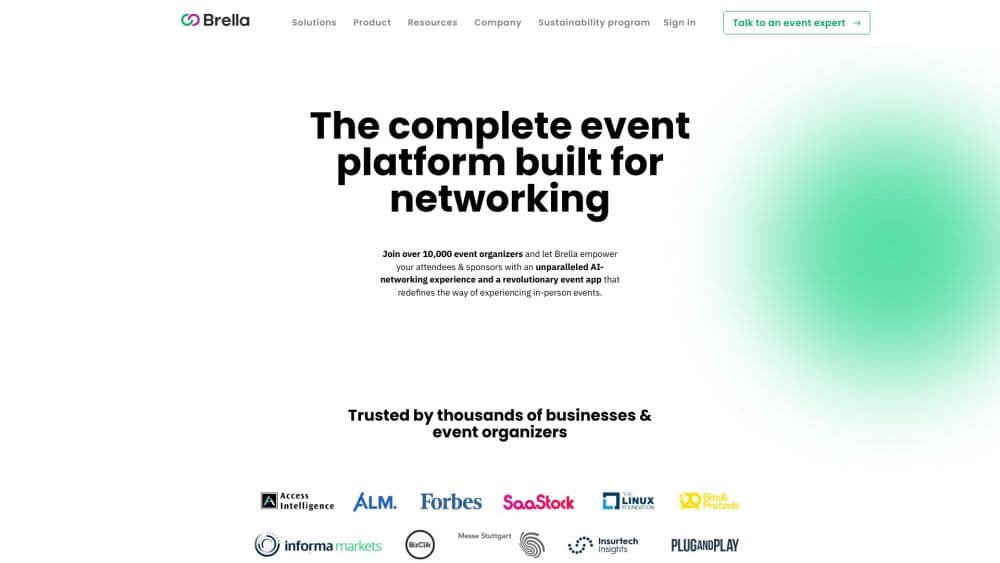
Brella is a white-label event platform whose AI matchmaking and branded event app help organizers turn attendee lists into qualified B2B meetings. It runs in-person, virtual, and hybrid events.
About Brella
What Is Brella
Brella is an event networking platform built around one idea: the meetings attendees book matter more than the content they watch. Organizers use it to run a branded event app, a ticketing and registration flow, sponsor booths, and event matchmaking software that suggests the right people for each attendee to meet. It works for conferences, tradeshows, associations, and internal events, whether they happen on-site, online, or both.
The standout piece is the AI matchmaking. During onboarding, attendees state their goals, and the engine ranks sessions, people, companies, and products against those goals. The company says its matchmaking drives higher meeting acceptance rates than other event apps on the market, and it backs that with a 9.5 out of 10 NPS on its service. That claim is the vendor's own, so treat it as a signal of positioning rather than an independent benchmark.
The catch is that Brella sells to organizations, not individuals. There is no self-serve sign-up and no published price list. You talk to the sales team, get a quote, and the cost scales with your event size and feature set. That model works for event teams with a budget, and it's a wall for anyone who wants to try the tool in an afternoon.
Getting Started
- Book a demo with Brella's team, since there is no free sign-up and pricing is quoted per event.
- Work with your Customer Success Manager to set up the event: goals, agenda, attendee onboarding, branding, and the matchmaking rules you want.
- Import or invite attendees through registration, the built-in ticketing, or a third-party registration tool you already use.
- Attendees fill in their profiles and pick their goals, which feeds the AI matchmaking before and during the event.
- Open the floor. Attendees book meetings, scan contacts, and join sessions, while organizers watch live meeting metrics from the admin panel.
Product Information
A quick look at Brella's pricing, supported platforms, and performance.
Best for
The users, tasks, and scenarios where this tool fits best.
Users
- Event organizers
- Conference and tradeshow teams
- Association and internal event managers
Tasks
- Driving qualified B2B meetings
- Running a branded event app
- Measuring event ROI
- Connecting your existing stack
Scenarios
- A multi-day industry conference with hundreds of attendees
- A hybrid event where some attendees are remote
- An invite-only member summit
Key features
AI Matchmaking
This is the B2B meeting software at the heart of the product, and it's the core. Attendees describe their goals during onboarding, and the engine recommends people, sessions, companies, and products that fit those goals. Organizers customize what gets recommended per attendee, so the suggestions match the event's purpose instead of a generic algorithm. For a B2B event, this is the difference between an app people ignore and one that produces a full meeting calendar.
White-Label Event App
The app is yours, not Brella's. You set the color scheme, logo, page names, tabs, and onboarding flow, and attendees engage with your brand from the first screen. There are native iOS and Android apps plus a responsive web app for every device, so nobody is left out by hardware. Custom domains and custom pages round out the branding, which matters when a sponsor is paying for visibility.
Sponsorship and Monetization Tools
Brella treats sponsors as a first-class part of the event. Virtual booths hold interactive content, banner and ad slots are configurable, and a hosted buyer program and meet-at-booth feature push sponsors toward real conversations. Live booth chat and contact scanning give sponsors measurable activity. For events that lean on sponsorship revenue, these tools are the path from a sponsor's check to a number they can report.
Meeting and Networking Analytics
The data side answers the question sponsors actually ask: what did this event produce? You see meeting and networking metrics, who met whom, pre-event versus during-event engagement, and sponsorship sales data. Real-time tracking means organizers can adjust on the floor rather than reading a report a week later. A dedicated sponsor portal lets sponsors pull their own numbers.
Integrations and Public API
Brella is built to sit inside your existing stack rather than replace it. There are native integrations configurable in the admin panel with no code, a REST API with documentation for custom work, and webhooks for real-time data flow. With 500-plus integrations and a Zapier option, you can keep the registration, CRM, and marketing tools you already run. A managed integrations team handles the build if you'd rather not.
Registration, Ticketing, and Access Control
The platform covers the front door of an event: built-in registration and ticketing, third-party ticketing integrations, Stripe payments, invite-only events with unique join codes, and custom experiences by ticket type. Access control groups attendees and sponsors and limits networking, sessions, stories, or RSVPs as needed. For events with tiered access or gated areas, this keeps the right people in the right rooms.
Pros and cons
Pros
- AI matchmaking and networking are the product's focus, not an add-on, which suits B2B events where meetings are the point.
- White-label branding, native apps, and custom domains make the event app look like yours.
- A public API, webhooks, and 500-plus integrations mean the platform fits your stack instead of forcing a switch.
- Meeting and sponsorship analytics give organizers and sponsors numbers they can act on and report.
- Consultative setup and a dedicated Customer Success Manager help teams get the matchmaking configured correctly.
Cons
- There is no published pricing and no self-serve plan, so you cannot test the tool without going through sales.
- The cost scales with event size and features, which pushes smaller or one-off events toward simpler and cheaper tools.
- Matchmaking quality depends on attendees filling in their profiles and goals, so a passive attendee list gets weaker results.
- The feature set is broad, and smaller organizers may pay for capabilities they never use.
Frequently asked questions
Brella runs events and drives networking at them. Organizers use it for the event app, registration and ticketing, AI matchmaking, sponsor tools, and analytics, mainly for conferences, tradeshows, and association events.
Related content
Explore related tools, skills, and articles for Brella.
Brella Alternatives

Udon
Udon · Coding · ProductivityUdon turns an Apple Silicon Mac into a home server you run from a browser, with container controls, file shares, and an optional AI sysadmin.

offstage
offstage cloud · Coding · Productivityoffstage gives AI coding agents and CI jobs a real Mac: a fresh macOS account on Apple silicon, driven over an API and billed by the second.

BotBus
Chengdu Tuyang Tusen Technology Co., Ltd. · Coding · ProductivityBotBus lets you control AI coding agents from your phone and watch: approve commands, start tasks and read results while the code stays on your desktop.