

Brief
Brief · Productivity
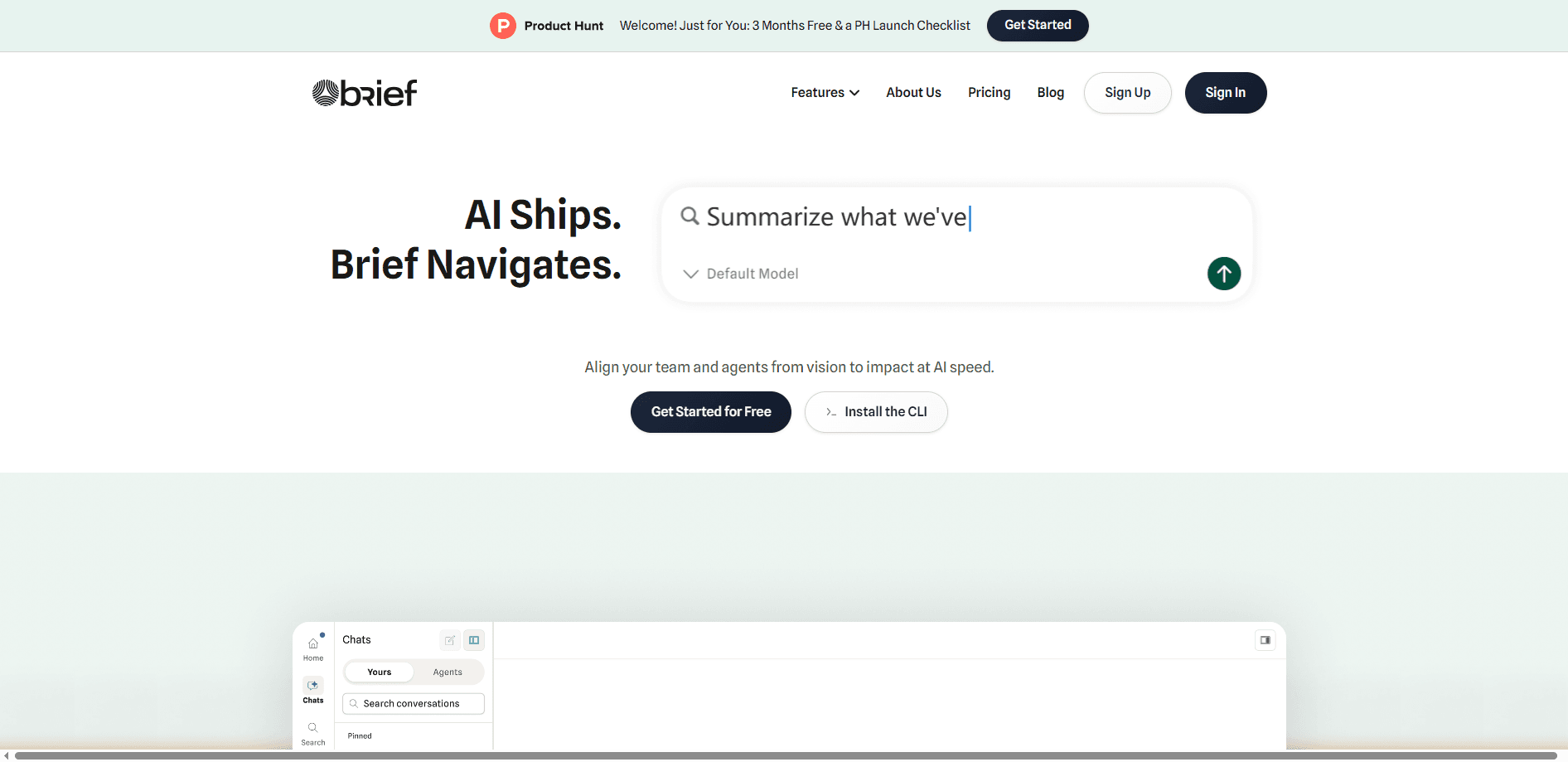
Brief is an AI product navigator that keeps your team and your coding agents pointed at the same truth. It watches the tools you already use, pulls out product decisions as they happen, and builds a searchable Product Graph. You reach that graph through a web app, an MCP server, a CLI, and IDE plugins, so engineers and AI agents get context on demand instead of guessing.
About Brief
What Is Brief
Brief is a context layer for product teams that use AI to write code. It isn't a task tracker or a wiki. The pitch is simple: your decisions live scattered across Linear, Jira, Notion, Slack, and GitHub, and the people and agents building the product can't see all of them. Brief collects those decisions and links them into one searchable Product Graph.
The main problem it solves is misalignment. A plan changes in a meeting. The codebase, the tickets, and the AI coding agent context never hear about it. So builders ship the wrong thing. Brief tries to close that loop by making the "why" behind a feature reachable from inside the editor.
The biggest limitation right now is scope. Brief is still early, and it leans hard on integrations. If your decisions happen in tools it doesn't read, or in people's heads and nowhere else, the graph will have holes. It works best for software teams that already track work in the major SaaS tools.
Getting Started
- Sign up at app.briefhq.ai and create your workspace.
- Connect your existing tools, starting with Linear, Jira, Notion, Slack, and GitHub.
- Let Brief scan those sources and build the first version of your Product Graph.
- Add the MCP server or CLI to Cursor, Claude Code, or Windsurf so your agents can query it.
- Open the web app to search decisions and check what's linked.
Product Information
A quick look at Brief's pricing, supported platforms, and performance.
Best for
The users, tasks, and scenarios where this tool fits best.
Users
- Product managers
- Engineering leads
- Startup founders
Tasks
- Onboarding a new engineer
- Feeding AI coding agents
- Auditing why a feature exists
Scenarios
- A priority shifts in Slack and you need the change to reach the codebase and the agents.
- You're out of the room and an engineer needs a call you'd normally make.
- An AI agent is about to refactor a module and needs to know what it must not break.
Key features
Product Graph
Brief reads your connected tools and turns raw activity into linked decisions. Each decision points back to the source and forward to the work it affects. The result is a searchable map of what your product is doing and why. That's the core of everything else Brief does.
MCP Server and CLI
Your AI coding agents aren't left guessing. Brief exposes the Product Graph through an MCP server and a command-line tool, so Cursor, Claude Code, Windsurf, and any MCP-compatible assistant can pull product context mid-task. Why does it matter? An agent can check the reasoning behind a feature before it changes the code.
Tool Integrations
Brief pulls decisions straight from where they happen: Linear, Jira, Notion, Slack, and GitHub. No new app. You don't move your workflow into a new tool. Brief watches the tools you already use and extracts the signal on its own.
Web App Dashboard
The web app is the human side of the Product Graph. You search decisions, trace how they connect, and see where the product is headed. It's the place to check that your team and your agents are working from the same picture.
Automatic Decision Capture
Brief is built to capture decisions as they happen, not after someone remembers to write them down. There's no new ritual and no extra documentation pass. The reasoning gets recorded while the conversation is still live.
Pros and cons
Pros
- Works with the tools teams already use, so there's no forced workflow change.
- Feeds context to AI coding agents through MCP, which addresses a real gap in agentic dev work.
- Free tier with 50 AI credits a month lets you test the Product Graph before paying.
- Central idea, aligning people and agents around the same decisions, is a genuine pain point for growing teams that ship fast.
Cons
- Value depends on integrations. If your decisions live in meetings, in someone's head, or outside the connected tools, the Product Graph stays incomplete and your agents keep working from a partial picture.
- Pro seats run $49/mo per user, and Teams is $89/mo with a five-seat minimum, which adds up fast for small shops.
- The product is young, so features and pricing may keep shifting.
Frequently asked questions
Brief captures product decisions from your existing tools and builds a searchable Product Graph. Your team and your AI coding agents then query that graph for the context they need, so nobody ends up building blind.
Related content
Explore related tools, skills, and articles for Brief.
Brief Alternatives

Base Code
Base44 (Wix) · Coding · ProductivityBase Code is a shared cloud development environment from Base44. Teammates describe changes to an existing GitHub codebase in chat, preview them live and send them back as pull requests.

Knocket
Knocket (Tencent RTC team) · Productivity · Business · ChatbotKnocket is a free live chat and contact page tool that lets visitors message you from your website, app, or a shareable link, with every reply handled from Telegram or one inbox.

FloorGen
Vinit Kumar (FloorGen) · Productivity · China AIFloorGen is a browser-based floor plan maker that turns a sentence or a sketch into an editable 2D plan and a 3D walkthrough. Export to PDF, DXF or video, and draw without an account.