

Bucket
Reflag (formerly Bucket) · Productivity
Bucket is a feature management platform for B2B SaaS teams that handles gradual rollouts, company-level targeting, and adoption tracking.
About Bucket
What Is Bucket
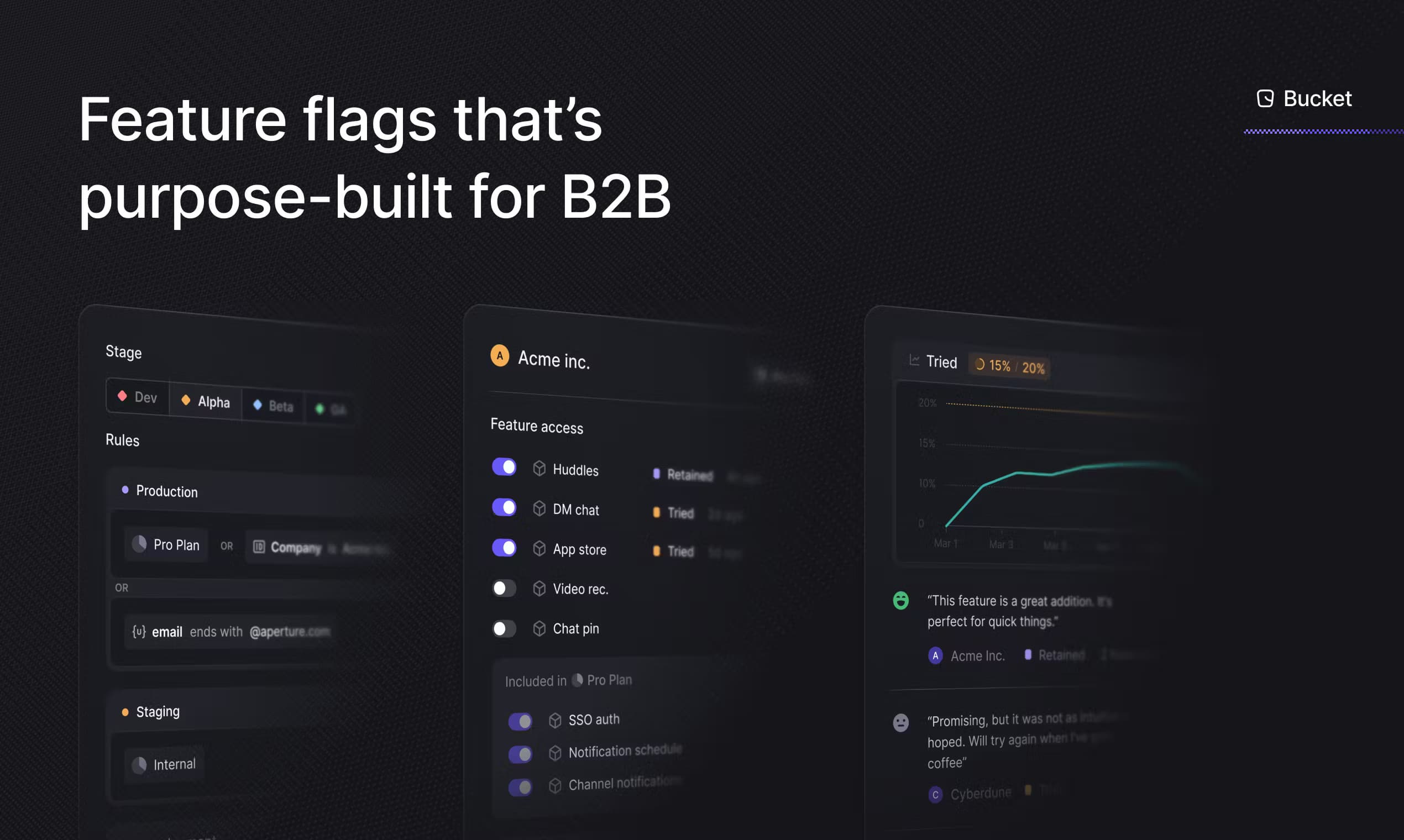
Bucket is a feature flag platform made for B2B SaaS companies. Instead of bolting flags onto a system built for consumer apps, it treats the company as the central unit, so you can enable a feature for one account, a segment of accounts, or everyone at once.
The product now runs under the name Reflag, following a rebrand, but the underlying approach is unchanged. Founders Rasmus Makwarth and Ron Cohen built it for teams that ship software continuously, who need a safety net between writing code and releasing it. That gap is where most production incidents start.
The main limit is scope. Bucket targets companies rather than individual consumers, so a solo developer building a hobby project will find more than they need. It's also a paid-tier tool at scale, with usage measured in monthly tracked users, which matters as your user base grows.
Getting Started
- Sign up at bucket.co or the Reflag signup page, then create a project for the app you want to manage.
- Install the SDK for your stack, such as React, Vue, Next, or Node, and connect it with your publishable key.
- Define a flag and decide who sees it, whether that's a single company, a percentage of traffic, or every account.
- Wrap the new feature in that flag inside your code, then release it to a small group first and watch behavior.
- Turn the flag on for more companies as confidence grows, then clean it up once the feature is stable for everyone.
Product Information
A quick look at Bucket's pricing, supported platforms, and performance.
Best for
The users, tasks, and scenarios where this tool fits best.
Users
- B2B SaaS engineering teams
- Product managers at growing startups
- Developers who ship continuously
Tasks
- Rolling out a new feature to a small slice of customers first
- Running a beta or early-access program
- Tracking whether a feature gets adopted
- Killing a broken feature instantly
Scenarios
- A SaaS team launching a redesign and wanting to test it on ten friendly accounts before a full release.
- An engineering lead who needs to ship work created with AI coding tools and wants flags reviewed before they reach production.
- A support team enabling a requested feature for one enterprise client without exposing it to everyone.
Key features
Company-Level Targeting
Most flag tools think in terms of individual users. Bucket organizes everything around the company instead. That's the account that actually pays and renews. You can flip a switch for a whole customer account in one move, which is what B2B teams usually want. If you sell to teams rather than single people, this saves a lot of manual work.
Gradual Rollouts
You can release a feature to a tiny share of your audience, watch how it behaves, then increase exposure step by step. Nothing forces you to commit to a full launch on day one. Rolling out gradually is the core reason teams adopt a feature flag platform in the first place. Start small. Widen later.
Feature Adoption Tracking
Shipping a feature doesn't tell you if anyone uses it. Bucket pulls engagement data into one view so you can see which companies picked up a new capability and which ignored it. That's the difference between guessing and knowing. Most teams guess. Bucket doesn't.
Self-Cleaning Flags
Old flags pile up and turn code into a mess. Bucket archives stale flags and removes the obsolete code that referenced them, automatically. Anyone who's spent an afternoon deleting dead flags, one by one, while a product manager waits on a demo build that should have shipped last week, knows exactly what a relief this is.
SDKs and Developer Experience
SDKs cover React, Vue, Next.js, Node.js, and more, with type safety built in. You install the package, pass a publishable key, and call a hook or client method to check a flag. The setup stays close to how developers already write code. No new mental model required.
Integrations with Linear and Slack
You can create and manage flags from Linear, where your engineering work already lives, and route flag changes into Slack so the team stays informed. Tying a flag to the specific issue that caused it keeps context in one place instead of scattering it across a ticket, a commit message, and a Slack thread nobody will ever search again.
MCP and Agent Support
Bucket supports the Model Context Protocol, which lets AI coding agents in editors like Cursor and VS Code read and manage flags directly. If your team leans on AI tools to write code, flags created that way can still be tracked and reviewed. Most of these teams already use flags. Bucket just aims the model at accounts rather than people, which is the difference that matters when your customers are companies.
Remote Config and Kill Switch
Beyond on-and-off flags, you can push configuration values remotely and change behavior without shipping new code. A kill switch gives you one lever to disable something for every user the moment it breaks. When something goes wrong at 2 a.m., that lever is the whole point.
Pros and cons
Pros
- Company-level targeting fits B2B SaaS better than user-only flag tools, so you manage access by account instead of by individual.
- Self-cleaning flags reduce code clutter over time, which matters on teams that ship often.
- A free Starter plan with unlimited seats lets small teams try the platform before paying.
- SDKs for common JavaScript frameworks and an MCP integration keep setup close to a normal dev workflow.
- Linear and Slack integrations place flag management where engineering work already happens. No context switching.
Cons
- The free plan caps you at 1,000 monthly tracked users and 3 environments, so growing teams hit a paid tier quickly.
- The Pro plan jumps to $125/mo, which is a real cost for a small startup still finding its footing. Not cheap.
- Solo developers building consumer apps will find the company-level model heavier than they need.
- Pricing and feature details shift with the rebrand to Reflag, so it's worth confirming current terms on the official site.
Frequently asked questions
Bucket manages feature flags for B2B SaaS products. Does your team ship features and worry about blast radius? That's the problem it solves. Teams use it to release features gradually, target specific companies, and see which accounts adopt what you ship.
Related content
Explore related tools, skills, and articles for Bucket.
Bucket Alternatives

Base Code
Base44 (Wix) · Coding · ProductivityBase Code is a shared cloud development environment from Base44. Teammates describe changes to an existing GitHub codebase in chat, preview them live and send them back as pull requests.

Knocket
Knocket (Tencent RTC team) · Productivity · Business · ChatbotKnocket is a free live chat and contact page tool that lets visitors message you from your website, app, or a shareable link, with every reply handled from Telegram or one inbox.

FloorGen
Vinit Kumar (FloorGen) · Productivity · China AIFloorGen is a browser-based floor plan maker that turns a sentence or a sketch into an editable 2D plan and a 3D walkthrough. Export to PDF, DXF or video, and draw without an account.