

Car Comparison
CarComparisonAI · Productivity
Car Comparison is a free web tool that lines up two vehicles side by side, using EPA and NHTSA data to compare specs, safety records, and five-year ownership costs.
About Car Comparison
What Is Car Comparison
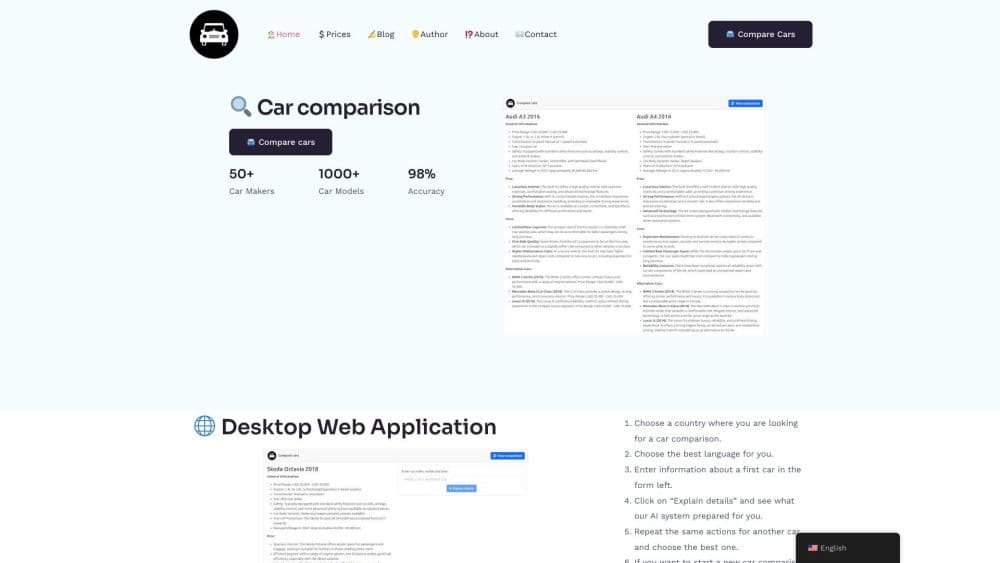
Car Comparison is an independent car comparison site for US shoppers who have narrowed a shortlist to two or three models. You pick two cars, and the page sets MSRP, combined MPG, cargo volume, body type, seating, horsepower, drivetrain, safety ratings, recalls, and an estimated five-year ownership cost next to each other. A short verdict follows, written in plain English, with the trade-off spelled out instead of a hidden score.
The cost model is what separates this car comparison tool from a spec sheet. Fuel or electricity, insurance, maintenance, and depreciation are estimated on the same assumptions for every vehicle, so a hybrid and a gas SUV can be judged on equal terms. Defaults are 15,000 miles a year, five years of ownership, $3.2 per gallon of gas, and $0.16 per kWh of home electricity. You can change any of them, and your numbers stick across the site.
The scope stays small on purpose. The beta database holds 10 popular 2025 vehicles from 4 makes, last refreshed in August 2026, all priced for the US market. Full exterior dimensions aren't there yet, and MSRPs exclude taxes, dealer fees, and incentives. Treat the result as a way to compare cars side by side, not as a quote.
Getting Started
- Open carcomparisonai.com. There's no signup, no email, and no account to manage.
- Pick two cars from the current list. Popular pairings such as the Honda CR-V and Toyota RAV4 are one click away.
- Set your driving assumptions. Miles per year, ownership period, gas price, and electricity price apply to every comparison you open afterward.
- Read the comparison and the verdict. Check the specs you care about, then look at the best-value pick and the reason behind it.
Product Information
A quick look at Car Comparison's pricing, supported platforms, and performance.
Best for
The users, tasks, and scenarios where this tool fits best.
Users
- US shoppers choosing between two finalists
- Families sizing up cargo and seating
- Budget-minded buyers
Tasks
- Checking whether a hybrid's lower fuel bill offsets its higher price
- Comparing an EV with a gas crossover
- Testing a dealer's pitch
Scenarios
- You have two 2025 models on a shortlist and need a decision this week
- You're replacing a car within the next month
- A friend or relative asks which of two cars to buy
Key features
Specs side by side
Every comparison lines up the numbers most shoppers check first: starting price, combined MPG, cargo space, body type, seating, horsepower, and drivetrain. The layout keeps the two cars in the same rows, so a difference jumps out without scrolling between tabs. A car specs comparison like this saves the back-and-forth of manufacturer pages that use different formats.
Five-year ownership cost
The estimate adds fuel or charging, insurance, maintenance, and depreciation over five years, with every assumption shown. Insurance and maintenance use class averages by powertrain type rather than personal quotes, which keeps the comparison fair but not exact. Depreciation is modeled as a percentage of MSRP across your ownership period. It's a relative tool, built to compare two cars, not to predict your exact bill.
EPA and NHTSA data
Fuel economy comes from the EPA through FuelEconomy.gov, and safety ratings, recalls, and complaint counts come from NHTSA. Official figures are labeled as official, and estimates are labeled as estimates, so you can tell which is which. Recall and complaint data follows the specific model year shown.
A verdict you can inspect
Each page ends with a plain-English summary and a best-value pick, plus the reason behind it. The site doesn't hand out a single proprietary score, and it doesn't accept payment for placement. If you disagree with the recommendation, the underlying price, efficiency, space, safety, and cost figures stay visible.
Assumptions that stay put
Your miles per year, ownership period, fuel price, and electricity price are saved in the browser and reused on the next comparison. That consistency matters when you're weighing three cars over a couple of weeks. Your profile and garage stay in your browser too, and the site says it doesn't collect them.
EVs, hybrids, and gas cars on one model
Electric cars use electricity cost, while gas and hybrid cars use fuel cost, and both run through the same ownership model. That makes a Tesla Model Y versus Toyota RAV4 comparison possible without switching calculators. The same logic covers popular sedans and SUVs, including the Civic versus Corolla and Camry versus Accord pairings.
Pros and cons
Pros
- Free to use with no signup, email, or account, so a comparison takes seconds to start.
- Official EPA and NHTSA figures are separated from estimates, which makes the numbers easier to trust and check.
- One cost model covers gas, hybrid, and electric cars, so cross-shopping doesn't require three different tools.
- The methodology is public and the verdict explains its reasoning instead of hiding behind a score.
- Saved driving assumptions keep every comparison on the same footing over time.
Cons
- The beta database covers only 10 vehicles from 4 makes, all 2025 models, so most shoppers won't find their shortlist here yet.
- Full exterior dimensions such as length, width, and height are missing, which matters for tight parking spots and garage fit.
- MSRPs exclude taxes, dealer fees, and incentives, and the ownership estimate is not a personalized quote.
- It's a US market tool. Canadian or European pricing and trims aren't covered.
Frequently asked questions
Car Comparison is a web tool from CarComparisonAI that puts two vehicles side by side. You choose two cars, review price, specs, MPG, safety signals, and five-year cost, then read a short verdict that names the better value and explains why.
Related content
Explore related tools, skills, and articles for Car Comparison.
Car Comparison Alternatives

Udon
Udon · Coding · ProductivityUdon turns an Apple Silicon Mac into a home server you run from a browser, with container controls, file shares, and an optional AI sysadmin.

offstage
offstage cloud · Coding · Productivityoffstage gives AI coding agents and CI jobs a real Mac: a fresh macOS account on Apple silicon, driven over an API and billed by the second.

BotBus
Chengdu Tuyang Tusen Technology Co., Ltd. · Coding · ProductivityBotBus lets you control AI coding agents from your phone and watch: approve commands, start tasks and read results while the code stays on your desktop.