

Cocoon by Telegram
Telegram · Business
Cocoon by Telegram is a decentralized AI compute network built on the TON blockchain. It lets people who own GPUs rent out spare processing power and earn crypto, while buyers get private, confidential AI compute on demand. Telegram itself runs as the network's first big customer, which gives the project a real workload from day one rather than a hypothetical one. If you have a capable GPU sitting idle or you need AI inference that doesn't expose your data, Cocoon is aimed at both sides of that market.
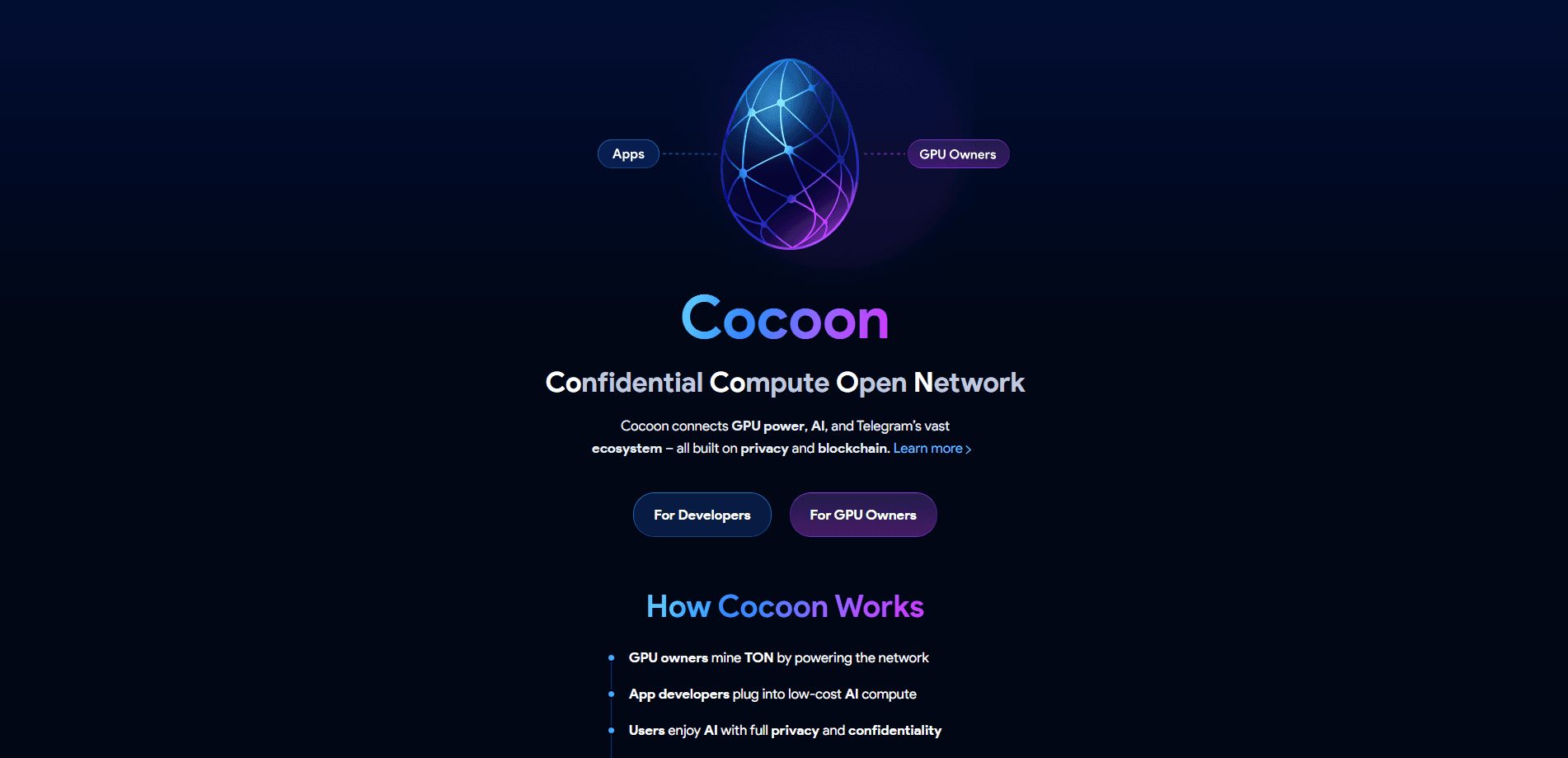
About Cocoon by Telegram
What Is Cocoon by Telegram
Cocoon is a network that connects GPU owners with people who need AI compute. The idea is simple. Instead of routing every AI request through a handful of giant data centers, Cocoon spreads the work across machines owned by regular people and smaller operators. Providers earn cryptocurrency for the cycles they contribute. Buyers pay for the compute they consume.
The project stands out for two reasons. First, it's tied to Telegram, which means it reaches an audience of hundreds of millions of users without building that audience from scratch. Second, it puts privacy at the center. Requests are processed in a way that keeps the underlying data protected, so the machine doing the work doesn't get a clear view of what it's handling.
That privacy focus matters more than it sounds. Most AI services today see everything you send them. That's a problem. If you're handling client records, medical notes, or legal documents, a confidential compute network is one way to get the answers you need without handing your raw data to a stranger's server. That distinction, where the machine processes data without reading it, is the whole point of the design.
The catch is that decentralized networks still depend on real, quality hardware showing up. If enough good GPUs don't join, performance and reliability suffer. That's true here too.
Getting Started
- Go to the official Cocoon site and decide your role: compute provider or AI compute buyer.
- For providers, confirm your GPU meets the hardware and setup requirements, then install the client and register your machine to the network.
- Connect a wallet that can hold TON so your earnings have somewhere to land.
- Bring your machine online and let it start accepting jobs; monitor your uptime and earnings from the dashboard.
- For buyers, fund your account, submit an inference request, and read the results once the network returns them.
Product Information
A quick look at Cocoon by Telegram's pricing, supported platforms, and performance.
Best for
The users, tasks, and scenarios where this tool fits best.
Users
- GPU owners with spare capacity
- Privacy-conscious teams
- Telegram-native users
Tasks
- AI inference on private data
- Renting out GPU cycles
- Building privacy-first AI apps
Scenarios
- Handling client records
- Slashing idle hardware costs
- Experimenting with decentralized compute
Key features
Decentralized GPU Compute Marketplace
Cocoon matches people who need AI processing power with people who have GPUs to spare. There's no single data center in charge. The network pools capacity from many machines. For buyers, that can mean more competitive pricing than a locked-in cloud contract. For providers, it's a way to monetize hardware you already own.
Confidential Computing for Private AI
The headline feature is privacy. Requests are processed so that the machine doing the work doesn't get a clean look at the underlying data. That's the difference between handing your files to a server you don't control and getting an answer while the data stays shielded. It won't satisfy every compliance regime on its own, but it's a meaningful step past the default, because it shifts the assumption from "the server sees everything" to "the server does the work and learns almost nothing about your data in the process."
Built on the TON Blockchain
Cocoon settles on TON, the blockchain tied to Telegram's platform. Payments and provider rewards run through that chain, which keeps the money side of the network native to crypto rather than bolted on. If you already hold or follow TON, the pieces fit together.
Telegram as the First Major Customer
Telegram is the brand behind the project, and it's also the network's first large buyer of compute. That matters. A compute network with a real customer has a reason to exist beyond speculation. It also hints at how the demand side scales: through the platform's own AI features and the developers building on it. When the first customer already runs one of the largest messaging apps on the planet, adoption stops being a hypothetical problem to solve later.
Provider Earnings in Crypto
GPU owners earn for the cycles they contribute, paid out in cryptocurrency. The appeal is straightforward. Hardware that would otherwise sit dark becomes an income stream. How much you earn depends on your GPU, your uptime, and how much demand the network is seeing at any given moment.
Open On-Ramp Through Telegram
Because Cocoon lives in Telegram's orbit, onboarding doesn't require learning a brand-new world of tools. That's a lower barrier than most decentralized compute projects manage, and it's a big part of why the network can grow its provider base quickly rather than waiting years for a critical mass of independent operators to arrive.
Pros and cons
Pros
- Real privacy angle: confidential computing addresses a genuine concern for anyone handling sensitive data.
- Built-in demand from Telegram as the network's first major customer.
- Clear earning path for GPU owners who want their idle hardware to pay for itself.
- TON settlement keeps payments native to a blockchain Telegram users already know.
- Low-friction onboarding compared with standalone decentralized compute networks.
Cons
- Early-stage product: exact pricing, hardware support, and performance guarantees are still settling, so don't build a business plan on unconfirmed numbers.
- Decentralized performance varies: results depend on which machines are online, so latency and reliability won't match a dedicated cloud instance.
- Crypto exposure: provider earnings and payouts are tied to token values that swing widely, which adds risk if you're counting on a stable income.
- Confidentiality claims need your own scrutiny: verify the current privacy guarantees before trusting the network with anything regulated.
Frequently asked questions
It's a decentralized AI compute network built on the TON blockchain. GPU owners contribute processing power and earn crypto. Buyers get access to private, confidential AI compute. Telegram runs as the network's first major customer. Wondering how it differs from renting a cloud GPU? Privacy is the real gap.
Related content
Explore related tools, skills, and articles for Cocoon by Telegram.
Cocoon by Telegram Alternatives
Liveplan
Palo Alto Software · BusinessLivePlan is business plan software that helps founders and small business owners turn an idea into a funder-ready plan. It combines AI-assisted writing, market research with cited sources, and connected financial forecasting so your income statement, cash flow, and balance sheet move together when you change one number. Over 1.5 million businesses have used it to plan, forecast, and track performance against real accounting data. That's a lot of founders. It's also a signal the tooling survived contact with real lenders.

Swms
Swms AI · Writing · Productivity · BusinessSwms is an AI safety compliance tool that turns a plain description of a job into ready-to-use safety documents. Describe your project, trade, and known hazards, and it writes a safe work method statement, job hazard analysis, safe work procedure, RAMS, or safety data sheet in seconds. It also ships with Oscar, a chat assistant that answers workplace safety questions in any language. Teams in construction, mining, transport, and warehousing use it to cut the paperwork that usually eats into a workday.

Rows
Rows (Superhuman) · Productivity · BusinessRows is an AI spreadsheet and data analysis tool that imports live data from more than 50 sources, then lets you work with it using plain language instead of SQL queries or nested formulas. You can pull numbers out of PDFs, connect ad platforms, databases, and bank accounts, and ask the AI to build reports, merge datasets, or set up models that recalculate themselves. It runs in the browser, works like a spreadsheet, and now sits under the Superhuman umbrella.