

Contract Power
ContractPower, Inc. · Productivity
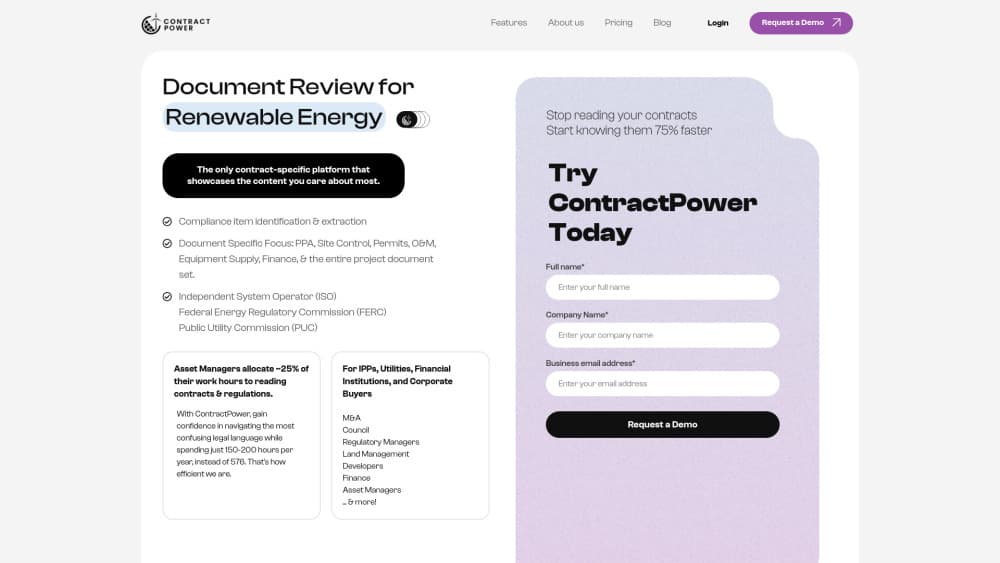
ContractPower is a contract intelligence platform for renewable energy teams. It reads PPAs, LGIAs and O&M agreements, answers questions with clause citations, and tracks every deadline.
About Contract Power
What Is ContractPower
ContractPower is web software that reads renewable energy contracts and turns them into searchable text plus a schedule of things you have to do. It handles the document types that fill an asset manager's week: power purchase agreements, large generator interconnection agreements, battery storage agreements, O&M contracts, leases, and EPC agreements.
The problem it solves is memory, not drafting. A 200-page PPA hides notice windows, cure periods, and renewal dates in different sections, and the person who negotiated it often left the company two years ago. This PPA contract review software pulls those terms out, tags them by type, and puts a date and an owner next to each one. That focus is what separates renewable energy contract AI from a general legal assistant.
The limits matter too. It doesn't write contracts, doesn't replace counsel, and doesn't negotiate anything. It reads what you already signed and keeps watch on it. Plans start at $500 per month billed annually, so the product is aimed at companies with a portfolio rather than someone checking a single lease.
Getting Started
- Book a demo, or start the 14-day trial on the Base plan. The trial allows up to 10 contracts.
- Upload documents into the File Manager. The platform detects the type and assigns an ID, and you confirm or override the guess.
- Run ClauseSense to extract obligations, then send the items you care about to the tracker.
- Assign an owner and an assignee, set reminder windows, and anchor tasks to project milestones such as COD or takeover date.
- Ask questions inside one project, or across up to 100 PDFs at once in the Diligence Module.
Product Information
A quick look at Contract Power's pricing, supported platforms, and performance.
Best for
The users, tasks, and scenarios where this tool fits best.
Users
- Asset managers running 10 to 50 operating projects
- M&A and development teams on a 60-day clock
- In-house legal and outside counsel
- Finance and tax equity teams
Tasks
- Finding a curtailment or cure clause fast
- Building an obligation calendar for a new asset
- Checking a tariff change against live contracts
- Diligence on an acquisition target
Scenarios
- Portfolio onboarding after an acquisition
- A cure notice due in two days
- Quarterly reporting to leadership
Key features
ClauseSense Obligation Extraction
ClauseSense reads each agreement and pulls out notice windows, renewal deadlines, cure periods, payment milestones, and reporting duties. Every item gets one of four labels: rights and privileges, restrictions, required notices, or deadlines. That split tells your team what needs action and what is only informational. The extraction logic was built around real PPAs, LGIAs, BESSAs, and O&M contracts rather than general legal text, which is where generic models tend to miss energy-specific duties.
Compliance Tracker With Reminders
The tracker turns extracted items into tasks with a due date, an owner, and an assignee, and both people get the reminder. You can set up to three reminder windows per task, so a 30-day cure period warns at 30 days, 7 days, and 1 day. Tasks can anchor to milestones like COD, effective date, or takeover date, and they reschedule themselves when a project date moves. Most contract obligation tracking fails at this step, when a date changes and nobody updates the spreadsheet. For interconnection work it doubles as an LGIA compliance tracker, since milestone dates live in the same schedule as notice windows.
Diligence Module for M&A
Load up to 100 PDFs in one session and ask a single question across all of them. Answers carry paragraph and page citations, and the module includes definition lookup so a cross-referenced term doesn't send you hunting. A role selector reframes answers for asset management, legal, or finance, which matters when three teams review the same data room for different risks.
PowerReg ISO Tariff Search
PowerReg indexes tariffs from CAISO, ERCOT, PJM, MISO, SPP, NYISO, and ISO-NE, and lets you query them in plain language. The cross-reference view shows which of your contracts a new provision affects, so a rule change doesn't turn into a week of manual reading. Coverage expands based on customer demand, so smaller markets may lag the major ones.
Project-First File Manager
Files sit in a Project, Entity, Contract chain instead of a generic folder tree, which matches how renewable portfolios are actually organized. The platform detects document type on upload and flags a file as an amendment when it looks like one, before it overwrites an existing record. Renaming or deleting a project cascades through its entities and contracts, and the tracker and obligations follow the change.
Pre-Made Agents
One-click workflows cover obligation extraction, fleet-wide pricing comparison, risk flag reports, and change-in-law analysis. You pick a contract, a project, or the whole portfolio, and the agent runs without prompt writing. Reports export, which is useful when the audience is an investment committee rather than a legal team.
Executive Compliance Dashboard
A single view shows compliance rate, overdue count, mean time to completion, and at-risk items across every project. A stacked bar matrix breaks compliance down by project and can be filtered by obligation type or time horizon. Critical exceptions sit at the top with a drilldown to the exact clause, so a status meeting starts from facts instead of a round of emails.
Pros and cons
Pros
- Clause-level citations on every answer, so a lawyer can verify a claim in seconds instead of trusting a summary.
- Obligations turn into dated tasks with two named people and up to three reminder windows, which is the part most AI contract analysis tools skip.
- The document model fits energy work: PPAs, LGIAs, BESSAs, O&M, EPC, and tax equity docs are treated as different animals.
- Bulk diligence across 100 PDFs makes acquisition review practical without adding seats at a law firm.
- Security posture is documented: SOC 2 Type II, GDPR, AES-256 encryption, SSO on Enterprise, and a no-training policy on customer documents.
Cons
- Entry price is $500 per month billed annually, so freelancers and single-asset owners are priced out.
- The product is built for U.S. renewable energy, and the tariff library focuses on U.S. ISO and RTO markets. Teams outside that market get much less value from PowerReg.
- The Lite plan caps editor seats at one to three, which gets tight for a team that wants finance and legal working in the same workspace.
- Amendment management is still labeled roadmap, so changes to a contract depend on re-uploading and re-extracting for now.
Frequently asked questions
It reads renewable energy contracts, extracts the obligations inside them, and tracks those obligations to a due date with reminders. You can also ask questions in plain English and get answers that cite the section and page. Think of it as a contract reader plus a compliance calendar, not a drafting tool.
Related content
Explore related tools, skills, and articles for Contract Power.
Contract Power Alternatives

Udon
Udon · Coding · ProductivityUdon turns an Apple Silicon Mac into a home server you run from a browser, with container controls, file shares, and an optional AI sysadmin.

offstage
offstage cloud · Coding · Productivityoffstage gives AI coding agents and CI jobs a real Mac: a fresh macOS account on Apple silicon, driven over an API and billed by the second.

BotBus
Chengdu Tuyang Tusen Technology Co., Ltd. · Coding · ProductivityBotBus lets you control AI coding agents from your phone and watch: approve commands, start tasks and read results while the code stays on your desktop.