

CopyCat
CopyCat · Coding · Productivity
CopyCat is a platform that turns plain-language instructions into browser agents. Describe a repetitive web task and it builds an agent that runs it on a schedule.
About CopyCat
What Is CopyCat
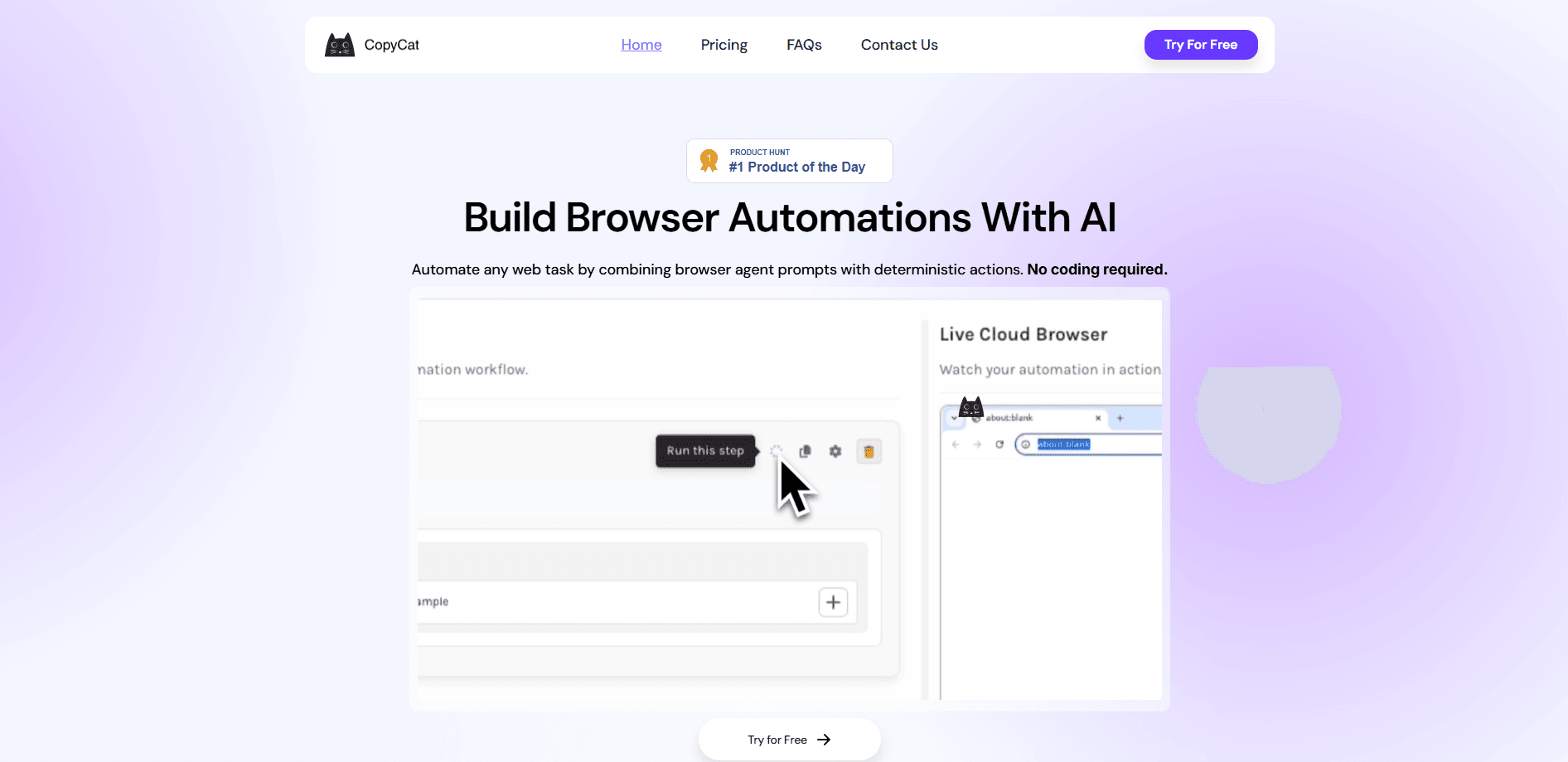
CopyCat is a browser automation platform built for businesses that depend on web work no API can reach. You write out the process the way you would explain it to a new hire. CopyCat reads that description and generates a browser agent that carries out the steps, opening pages, clicking, typing and moving data, without you writing a line of code.
The company came out of Y Combinator's Winter 2025 batch. The founders, Zyad, Abhi Balijepalli and Graham Sabin, ran into this problem at their previous company, where the team lost hours every week filling in app store release forms because no API existed. That experience shaped the pitch: most businesses still lean on brittle browser scripts for the parts of their operations that never got an API.
A browser agent here is a mix of two things. An AI layer reads the page and decides what to do next, and deterministic actions carry out the parts that must land the same way every time. That pairing matters when a task runs unattended. A pure AI agent improvises, and improvisation fails quietly at 2 a.m. A pure script breaks the moment the page changes. CopyCat aims for the middle, so the agent can handle a redesigned button without going off track.
Getting Started
- Describe the process in plain language, the same way you would brief a teammate
- Let CopyCat generate a browser agent from that description and run a test pass
- Review the run, correct any step, then set a schedule for when it should fire
- Connect the destinations you already use, such as Google Sheets or Slack, so results land where your team looks
Product Information
A quick look at CopyCat's pricing, supported platforms, and performance.
Best for
The users, tasks, and scenarios where this tool fits best.
Users
- Operations teams
- Startups shipping without engineering slack
- Back-office and admin staff
- Teams that already run fragile scripts
Tasks
- Form filling at volume
- Data collection from the web
- Cross-tool data moving
- Scheduled monitoring
- Recurring back-office runs
Scenarios
- An app store release form has to be filled every time you ship
- A vendor portal only offers a download and no API
- A weekly report needs numbers from three separate web dashboards
- A site redesigns its layout
- An ops hire is doing the same clicks for the fifth hour
Key features
Plain-Language Agent Builder
You describe the process in words, and CopyCat generates the agent. There is no drag-and-drop flow chart to assemble and no scripting language to learn. The point is that the person who knows the task best, usually not a developer, can be the one who builds it. If the generated agent misses a step, you explain the correction in plain language and it updates.
AI Layer Paired With Deterministic Actions
Each agent blends reasoning with fixed actions. The AI part reads the page, finds the right control and copes with small layout changes, while the deterministic part repeats critical steps exactly. This is the design choice that separates CopyCat from a pure AI agent that improvises, and from a brittle script that snaps when a page moves. It is aimed at tasks that need to run unattended without a human watching every pass.
Scheduling and Run Monitoring
Agents run on a schedule you set, and you can watch each pass as it happens. The monitoring view shows what the agent did, step by step, so a failure is visible rather than silent. That visibility is what makes unattended runs usable, because you can see where a run diverged instead of guessing why the output looks wrong.
Integrations With the Tools You Already Use
CopyCat connects to destinations like Google Sheets and Slack, so the results of a run land in the places your team already checks. Rather than creating another dashboard to open, the agent writes into the sheet or channel that holds the rest of the work. The company positions these integrations as part of the core product, not an add-on.
Agents for Common Business Processes
The product ships with agents aimed at recurring business chores, from the app store release form the founders ran into to other repeatable web processes. The idea is that a team starts from a process it already does by hand and hands the loop to an agent, rather than building automation from a blank page.
Built Around Business Reliability
The whole pitch is reliability for work that cannot fail quietly. Browser automation for business has two failure modes, an agent that improvises a wrong step and a script that breaks when a page changes, and CopyCat is designed to sit between them. The founders frame the goal as agents that run seamlessly enough to trust with a process the business depends on.
Pros and cons
Pros
- Building an agent from a written description means the person who knows the task can build it, with no coding
- Pairing AI reasoning with deterministic steps suits tasks that must run unattended and land the same way each time
- Scheduling and step-by-step monitoring make an unattended run visible instead of a black box
- Integrations with tools like Google Sheets and Slack drop results where the team already works
- Aimed at the web processes that never got an API, the work that usually falls back on fragile scripts
Cons
- No published pricing and no free plan, so you have to talk to sales before you can judge the cost
- API availability is not stated publicly, which makes deeper integration harder to plan for
- It targets business processes, so there is little here for a casual user automating a one-off personal task
- The approach adds an AI layer where a simple fixed script would do, which is more than some routine tasks need
Frequently asked questions
CopyCat turns a plain-language description of a process into a browser agent that carries out repetitive web tasks. You describe the steps, the platform generates an agent, and then you schedule it to run and watch each pass. It is built for business work on sites that do not offer an API.
Related content
Explore related tools, skills, and articles for CopyCat.
CopyCat Alternatives

Udon
Udon · Coding · ProductivityUdon turns an Apple Silicon Mac into a home server you run from a browser, with container controls, file shares, and an optional AI sysadmin.

offstage
offstage cloud · Coding · Productivityoffstage gives AI coding agents and CI jobs a real Mac: a fresh macOS account on Apple silicon, driven over an API and billed by the second.

BotBus
Chengdu Tuyang Tusen Technology Co., Ltd. · Coding · ProductivityBotBus lets you control AI coding agents from your phone and watch: approve commands, start tasks and read results while the code stays on your desktop.