

Credyt
Credyt · Business
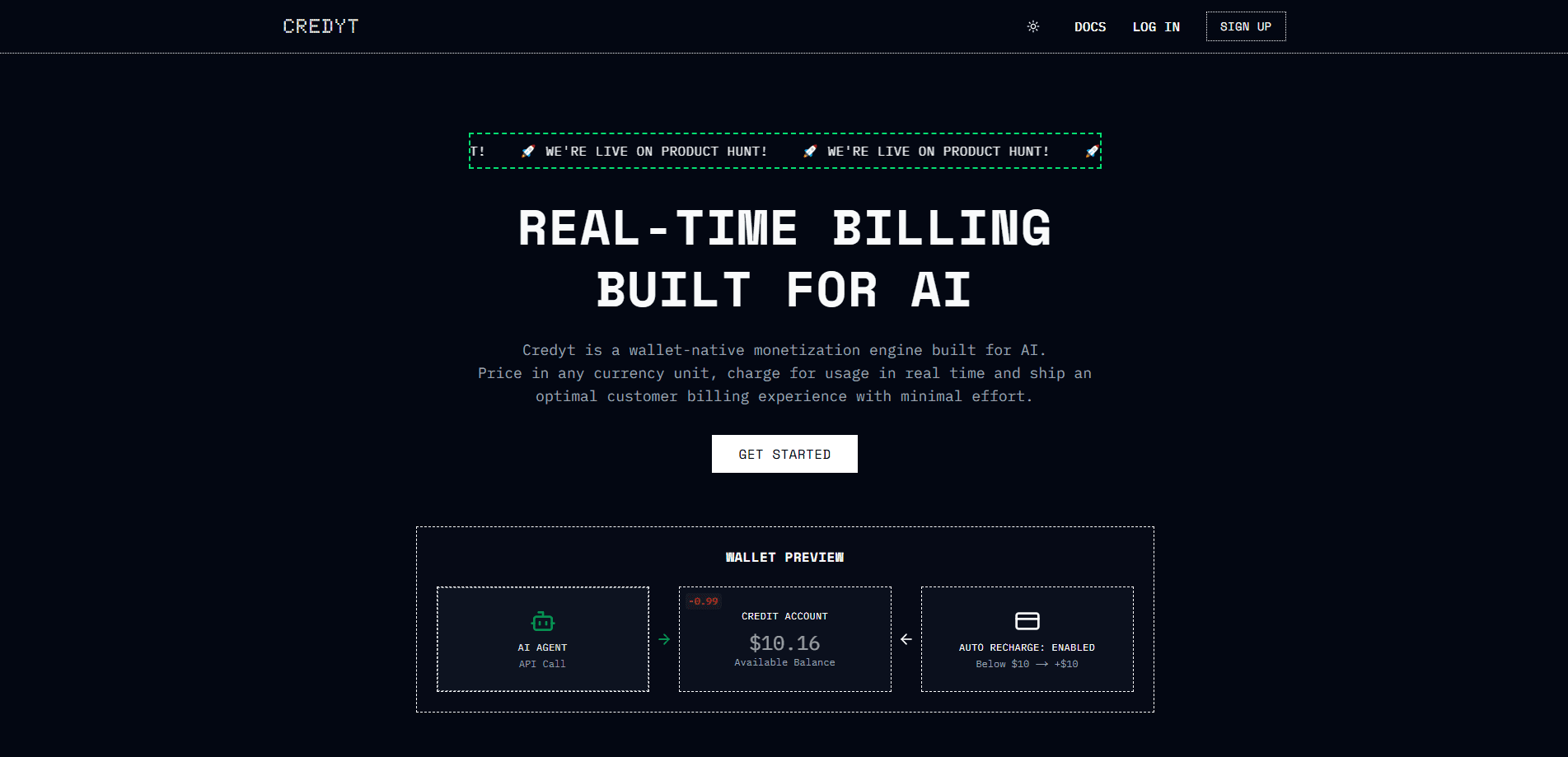
Credyt is a wallet-native monetization platform built for AI companies that need to charge customers as usage happens. It meters every API call, message, or workload, then authorizes, prices, and debits the cost in real time, so you stop fronting compute you haven't collected yet. Teams treat it as AI monetization infrastructure they don't have to build. They use it to run usage-based, subscription, hybrid, credit, or seat-based pricing from one system, with a hosted customer billing portal handling top-ups and spend tracking.
About Credyt
What Is Credyt
Credyt is wallet-native billing and credit management infrastructure designed around a simple problem: with AI, every request costs you real money. Traditional SaaS bills on seats and fixed plans, but AI products burn compute per call, and revenue rarely scales in step with that cost. Credyt connects the two. It watches what each customer consumes, charges for it live, and enforces limits before you overspend on someone else's behalf.
The platform is wallet-native, meaning each customer gets an account that holds balances in fiat or custom assets like tokens, GPU minutes, or credits. Usage is measured and debited from that wallet the moment it happens. No month-end batch run. No surprise invoice your biggest customer refuses to pay.
The main catch is scope. Credyt is developer infrastructure, not a no-code checkout you drop into a marketplace listing. You'll wire up its API and define your pricing logic, which takes engineering time. Is that worth it? For most AI teams, yes. The upside is depth: per-customer cost visibility and real-time enforcement that a generic payment processor won't give you.
Getting Started
- Sign up for a free account at the Credyt site. No card is required to start.
- Create a product and assign the pricing model you want to charge with, such as usage-based, subscription, credits, or a hybrid.
- Connect your app and send usage events to the API as customers consume your product.
- Point customers to the hosted billing portal so they can top up wallets and track their spend.
- Simulate usage first if you want to validate pricing before you go live, then publish.
Product Information
A quick look at Credyt's pricing, supported platforms, and performance.
Best for
The users, tasks, and scenarios where this tool fits best.
Users
- AI startup founders
- Fintech and platform developers
- Product and growth leads
Tasks
- Metering AI usage
- Setting spend limits
- Running credit campaigns
Scenarios
- A lean AI app that can't afford to fund free usage forever
- A team launching a new pricing model
- A business with mixed revenue
Key features
Real-Time Usage Billing
Credyt meters and charges for product usage as it happens, not at the end of a billing cycle. Every API call, message, or AI workload is tracked and billed instantly, which closes the gap between what customers consume and what they owe. Late billing kills AI margins. The company says each event is authorized, priced, and debited atomically, so there's no overnight batch job and no end-of-month reconciliation surprise.
Flexible Pricing Models
You aren't locked into one pricing shape. Credyt supports usage-based, subscription, hybrid, credit, and seat-based models, and lets you price per occurrence or by volume, which means you can charge a customer a flat monthly fee and still bill overages on top of it. Dimensional pricing applies different rates depending on usage attributes, so a long context request can cost more than a short one. The docs also let you bill in fiat or custom assets like tokens, minutes, or credits.
Multi-Account Wallets
Each customer holds one or more wallets that can carry balances in different assets, such as USD, tokens, or GPU minutes. Top-ups run through Stripe, and thresholds and card management work automatically from the customer portal. This multi-wallet setup is what lets one product price itself in whatever unit makes sense for the service, whether that's dollars for a SaaS-style plan or compute minutes for a usage-heavy model product.
Customer Billing Portal
Credyt ships a hosted portal, so you skip building billing screens yourself. Customers log in to top up funds, watch their balance update in real time, and review their spend. Billing UI, solved. For a small team, that's the difference between shipping billing this month and rebuilding a dashboard for six weeks.
Spend Controls and Exposure Management
The platform enforces limits rather than reporting on them after the fact. You can observe spending per customer and cap or pause usage based on thresholds you set. That's the point. For AI teams, it means a runaway integration or an abusive account gets stopped before it burns a month of compute budget.
Wallet API for Promos and Rewards
The Wallet API grants free or bonus credits programmatically, with optional expiry dates. Teams use it to run limited-time campaigns, reward referrals, or extend retention offers. No separate system to sync. Because the credits live in the same wallet used for billing, everything stays in one ledger.
MCP Server and AI Tooling
Credyt offers an MCP server that lets you create products, customers, and subscriptions in natural language from an AI coding assistant, which matters for a market where many customers are vibe-coding their first product and don't want to hand-write API calls. There's also a dedicated integration guide for tools like ChatGPT, Claude, and Lovable. Setup gets faster.
Pros and cons
Pros
- Charges for AI usage in real time, which stops you from financing customer consumption before you collect.
- Supports five pricing models in one system, so you can change strategy without switching tools.
- Handles wallets in fiat and custom assets, useful for token, minute, or credit-based products.
- Hosted billing portal saves weeks of front-end work for small teams.
- Free to start with no card, and pricing is per active wallet rather than a cut of revenue.
Cons
- It's developer infrastructure, so you need API work before anything goes live; there's no plug-and-play checkout.
- The per-active-wallet model means costs can be hard to predict early, when your wallet count swings month to month as customers sign up, try the product, and either stick around or churn out after a single billing cycle.
- There's no Google Play or mobile app, so it only fits web-based AI products.
Frequently asked questions
Credyt is AI billing software for products that sell AI features. It meters usage, charges customers in real time, enforces spend limits, and gives each customer a wallet with a hosted billing portal. It's aimed at companies that sell by usage rather than a flat seat fee.
Related content
Explore related tools, skills, and articles for Credyt.
Credyt Alternatives
Liveplan
Palo Alto Software · BusinessLivePlan is business plan software that helps founders and small business owners turn an idea into a funder-ready plan. It combines AI-assisted writing, market research with cited sources, and connected financial forecasting so your income statement, cash flow, and balance sheet move together when you change one number. Over 1.5 million businesses have used it to plan, forecast, and track performance against real accounting data. That's a lot of founders. It's also a signal the tooling survived contact with real lenders.

Swms
Swms AI · Writing · Productivity · BusinessSwms is an AI safety compliance tool that turns a plain description of a job into ready-to-use safety documents. Describe your project, trade, and known hazards, and it writes a safe work method statement, job hazard analysis, safe work procedure, RAMS, or safety data sheet in seconds. It also ships with Oscar, a chat assistant that answers workplace safety questions in any language. Teams in construction, mining, transport, and warehousing use it to cut the paperwork that usually eats into a workday.

Rows
Rows (Superhuman) · Productivity · BusinessRows is an AI spreadsheet and data analysis tool that imports live data from more than 50 sources, then lets you work with it using plain language instead of SQL queries or nested formulas. You can pull numbers out of PDFs, connect ad platforms, databases, and bank accounts, and ask the AI to build reports, merge datasets, or set up models that recalculate themselves. It runs in the browser, works like a spreadsheet, and now sits under the Superhuman umbrella.