

DailyHelm
DailyHelm · Productivity · Marketing · Business
DailyHelm is an AI business reviewer that sends six specialist agents through your analytics, ads, SEO, store, and code every night, then ranks the problems worth fixing by revenue impact.
About DailyHelm
What Is DailyHelm
DailyHelm is browser-based AI business monitoring that reviews a business once a day and tells the owner what to fix first. You connect the accounts you already use, and six specialist agents read them overnight. In the morning you get one brief instead of six dashboards.
The connections are read-only. DailyHelm can see Google Analytics 4, Google Ads, Search Console, Shopify, Stripe, Square, GitHub, PostHog, Zendesk, and Slack, but it can't post, pause a campaign, or change a setting on your behalf. That line matters: the product diagnoses, and you decide what to touch.
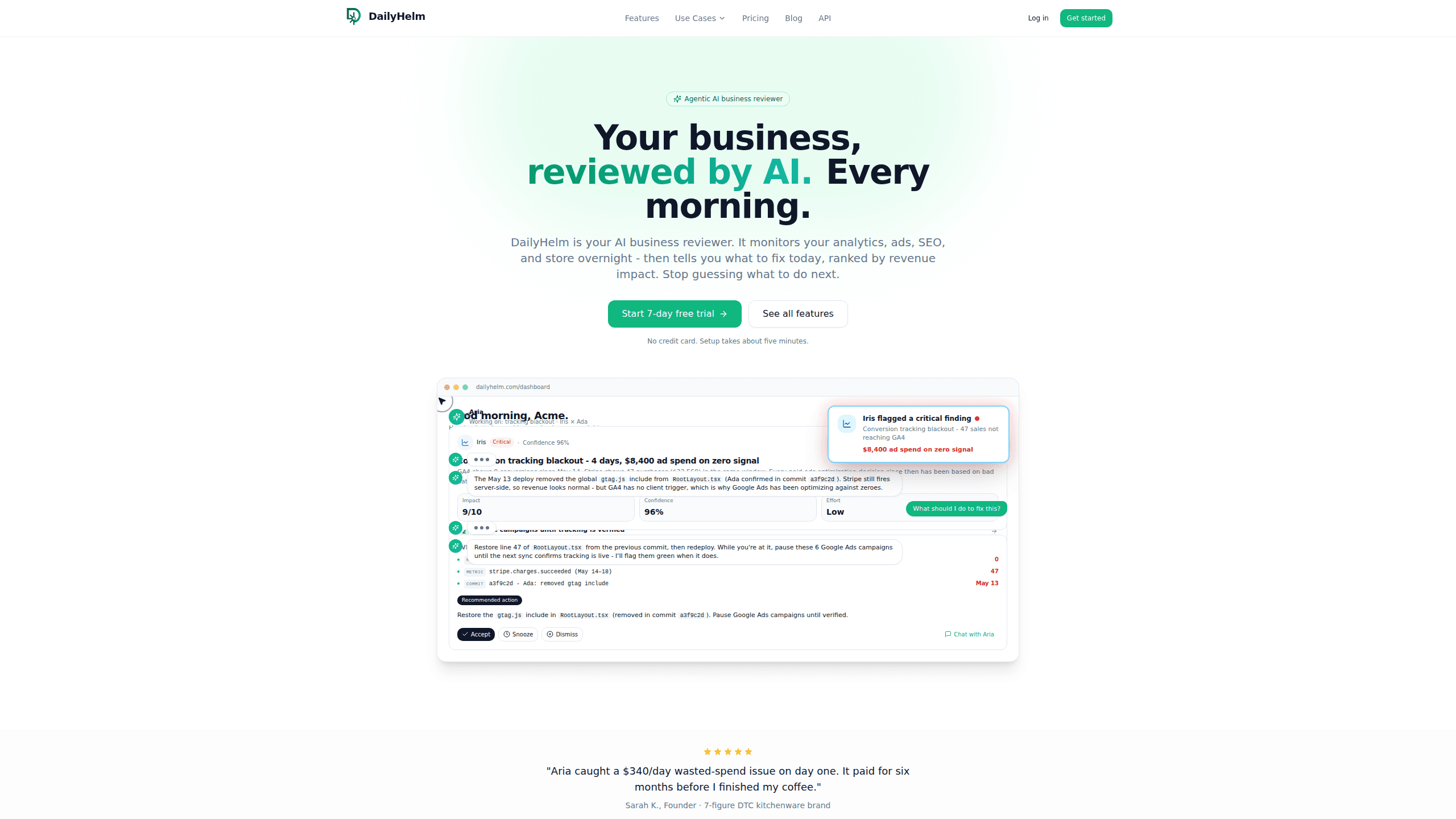
Each finding carries the evidence behind it. A typical entry names the metric that moved, the time window, the dollar amount at risk, and a confidence score. One example from the vendor's own demo: GA4 showed zero conversions for four days while Stripe recorded 47 charges. The brief flagged the gap, traced it to a deploy that removed the tracking snippet, and suggested restoring the line before resuming ad spend.
The limit is scope. DailyHelm monitors and explains. It won't replace a reporting layer for client decks, it offers fewer connectors than the big dashboard platforms, and you still need someone to act on what it finds.
Getting Started
- Sign up at dailyhelm.com and paste your website address. The business profile fills in from the site, which cuts the setup down to a few minutes.
- Connect the platforms you want watched. OAuth is read-only, and you can start with two or three connectors instead of all of them.
- Let the agents run. The first pass takes about five minutes, and the nightly run lands before the start of your working day.
- Read the brief and work the list. Accept a finding, snooze it, or dismiss it, then ask Aria follow-up questions if the recommended fix is unclear.
- Add the API or webhooks if the findings need to land in Slack, a ticketing tool, or your own dashboard.
Product Information
A quick look at DailyHelm's pricing, supported platforms, and performance.
Best for
The users, tasks, and scenarios where this tool fits best.
Users
- Solo founders running a SaaS or an online store
- Small marketing teams without a dedicated analytics hire
- Agencies managing multiple client businesses
Tasks
- Catching broken conversion tracking
- Reviewing ad spend and budget pacing
- Finding site and funnel regressions
Scenarios
- A deploy quietly removed a tracking script
- A free-plan feature starts writing a log entry on every page view and your cloud bill jumps
- An agency needs to brief six clients on Monday
Key features
Six Specialist Agents
DailyHelm splits the work by domain instead of asking one general model to review everything. Iris works as the AI analytics agent for growth, Pitch covers paid ads, Echo watches SEO, Ada reads code and deploy history, Penny tracks cost and cloud spend, and Sage checks site UX and funnel health. Narrow agents produce more specific findings, because each one knows what a normal week looks like in its own data. That division is what separates agentic AI for business from a general chatbot with a data plugin.
Morning Brief Ranked by Revenue Impact
The output is a short list, not a wall of charts. The daily business brief turns raw numbers into revenue impact fixes, each with an impact score out of 10, an effort estimate, and the dollar figure tied to the problem. You read the top three, decide what to do, and get on with the day. Aria, the orchestrator, merges overlapping findings from different agents into one item so the same broken checkout doesn't appear four times.
Evidence Trail on Every Finding
Each item shows the metric it came from, the date range, the affected system, and a confidence percentage. When Ada points at a commit, you get the commit reference. When Iris flags a conversion gap, you get both numbers side by side. You can verify the claim in a couple of minutes instead of trusting a black box.
Aria, the Chat Layer
Aria answers questions about your business using the live connector data and the findings from all six agents. You can ask what broke, when it started, or which change caused it, and get an answer that references the same evidence the brief used. Monthly chat limits apply by plan, and Aria is included on every tier.
Business Health Score
A single score tracks reputation, visibility, social, traffic, and freshness, with a weekly change indicator. Large swings get smoothed, so the number reflects a trend rather than one noisy day. It's a quick way to see whether the month is drifting in the right direction before you dig into individual findings.
REST API and Webhooks
Every account can create API keys for the REST API, which exposes findings, the daily digest, the health score, and business data. Webhooks push events such as finding.created, digest.published, and score.updated to your own endpoint. That makes it possible to route a critical finding into Slack or open a ticket without checking the dashboard.
Pros and cons
Pros
- The brief is short and ordered by money at risk, so a non-technical owner can act on it in minutes.
- Findings cite their evidence, including commits and raw metric values, which makes them checkable rather than mysterious.
- Read-only connectors remove the fear of an AI tool changing live campaigns or store settings.
- Six domain agents beat a single generalist prompt on specificity, especially for tracking gaps that sit between analytics and payments.
- Setup takes about five minutes, and the first findings usually arrive the same day.
Cons
- No free trial. The first month costs $49 instead of $99, and refunds are limited to a 14-day window.
- Not a reporting tool. If you need client-facing dashboards or historical exploration, you'll keep your current BI stack.
- Ten connectors cover the common stack, but smaller platforms and regional payment providers are missing.
- Findings are advice, not automation. Someone still has to apply the fix, and a wrong call costs time.
Frequently asked questions
DailyHelm is an AI business reviewer for small teams. It connects to your analytics, ad, store, payment, and code accounts, reviews them overnight, and delivers a morning brief that ranks problems by revenue impact.
Related content
Explore related tools, skills, and articles for DailyHelm.
DailyHelm Alternatives

Base Code
Base44 (Wix) · Coding · ProductivityBase Code is a shared cloud development environment from Base44. Teammates describe changes to an existing GitHub codebase in chat, preview them live and send them back as pull requests.

Knocket
Knocket (Tencent RTC team) · Productivity · Business · ChatbotKnocket is a free live chat and contact page tool that lets visitors message you from your website, app, or a shareable link, with every reply handled from Telegram or one inbox.

FloorGen
Vinit Kumar (FloorGen) · Productivity · China AIFloorGen is a browser-based floor plan maker that turns a sentence or a sketch into an editable 2D plan and a 3D walkthrough. Export to PDF, DXF or video, and draw without an account.