

Datablit
Datablit · Productivity · Marketing
Datablit is a customer data platform that captures events, runs real-time rules, and tracks experiments in one place. It starts free with 1M events and scales as you grow.
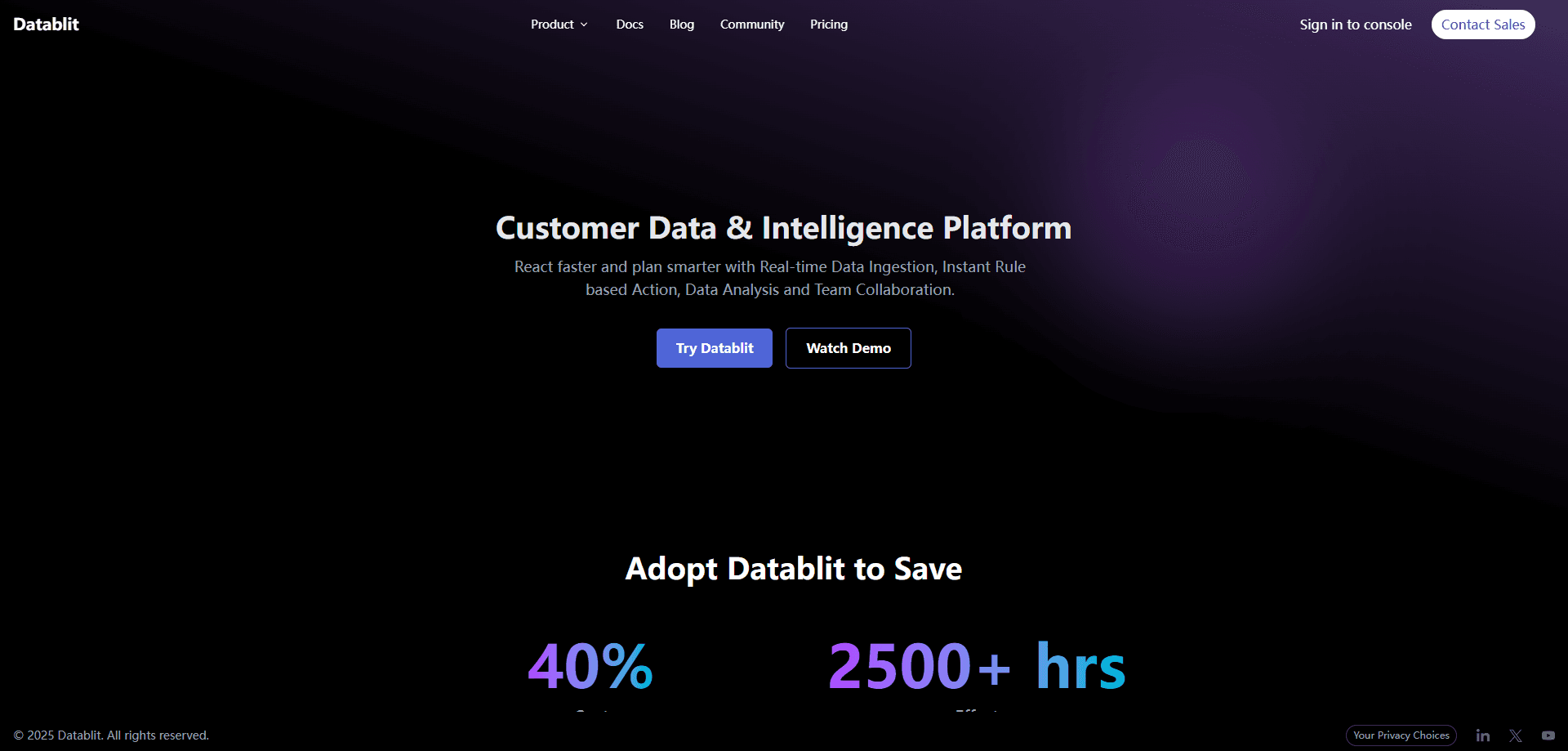
About Datablit
What Is Datablit
Datablit is a customer data platform (CDP) built for product teams that want to collect customer data and act on it without stitching together a pile of tools. The company runs it as a SaaS product, and it covers the whole path from event capture to real-time decisions. You send data in through performance-optimized SDKs, then use the same platform to analyze it, trigger actions, and test features.
The selling point is that analytics, a rules engine, and experimentation share one set of customer data. Most teams run a separate tool for charts, another for A/B tests, and a third for automated messages, which means paying three bills and moving data between systems. Datablit puts those jobs on the same data layer, and the company says that cuts cost and setup time by up to 60 percent.
That consolidation comes with trade-offs. Datablit is a younger product than the big marketing clouds, so its integration list and template library are shorter. It targets product and growth teams who are comfortable wiring up an SDK, not marketers who want a no-code website tag. If your team already runs on another CDP, switching means moving your event pipeline, which is real work.
Getting Started
- Create a free account at console.datablit.com, which covers one project and 1M events.
- Install the SDK for your platform: JavaScript for web, Kotlin for Android, Swift for iOS, or the HTTP API for a backend server.
- Define the events you want to track and send them to Datablit, where they are ingested and processed in real time.
- Set up a Signal to track a key metric and a Rule to trigger an action when that metric meets a condition.
- Open the query dashboard or chart builder to explore the data, then start an experiment when you want to test a change.
Product Information
A quick look at Datablit's pricing, supported platforms, and performance.
Best for
The users, tasks, and scenarios where this tool fits best.
Users
- Product managers
- Growth and marketing teams
- Data and engineering teams
- Startup and small product teams
Tasks
- Event tracking for product teams
- Running A/B tests
- Triggering real-time actions
- Building dashboards
- Consolidating the data stack
Scenarios
- Onboarding a new signup
- Testing a pricing page change
- Reacting to a drop in engagement
- Connecting partners
Key features
Real-Time Event Ingestion
Datablit collects customer data from web, mobile, and backend through performance-optimized SDKs. Events are ingested, processed, and transformed in real time, so a metric updates as the action happens rather than at the next batch. The company says its infrastructure is built to handle billions of events and trillions of data points, which matters once traffic grows past what a spreadsheet or a basic tool can hold.
Signals and the Rules Engine
A Signal is a metric Datablit computes on top of your events, and a Rule is a condition that fires an action when that metric meets a threshold. You build both with logical expressions and metrics in the dashboard, so a non-engineer can ship a real-time action in minutes. That's the part that separates it from a plain analytics tool: it doesn't just show you the chart, it lets you act on the number.
Experimentation and A/B Testing
Datablit runs experiments on high-volume datasets with dynamic user allocation across variants. You define the variants, point the SDK at the experiment, and the platform splits users and reports the outcome. Because the experiment reads the same event data as the analytics side, you don't have to export anything into another tool to measure the result.
Self-Service Analytics and Dashboards
The query dashboard and chart builder let a business team explore customer data without waiting on a data engineer. You can run SQL queries or build charts from the UI, cut the data by segment, and share the result with the team. The pitch is simple: fewer ad-hoc requests to the data team and faster answers for the people making decisions.
AI Data Intelligence
Datablit markets a data intelligence layer that tracks, analyzes, and visualizes customer data to surface insights for longer-term decisions. It's aimed at teams that want patterns flagged without hiring a dedicated analyst for every question. Treat the analytics claims as the vendor's positioning until you see them on your own data.
Team Collaboration
Space and Community features let teammates and external partners work on the same data. Teams can message, hop on an audio or video call, send notifications, and invite people from outside the company into a shared space. It keeps the discussion next to the data instead of scattering it across chat apps and docs.
Pros and cons
Pros
- Analytics, a rules engine, and A/B testing run on one dataset, so you don't export data between three separate tools.
- Real-time ingestion and signals let you trigger actions in seconds rather than waiting on a nightly batch job.
- The free plan is usable on its own, with 1M events, one project, one rule, and one experiment at no cost.
- SDKs cover web, Android, iOS, and the backend, so common platforms connect without custom plumbing.
- A public HTTP API lets a backend server ingest events and pull experiment variants in any language.
Cons
- It's a younger platform than the big marketing clouds, so the integration catalog and template library are shorter, and some niche tools won't connect out of the box.
- The free plan caps you at one project and one experiment, so a team running several products will hit the paid tier quickly.
- Overage pricing is usage-based, which means a traffic spike can raise the bill unless you watch event volume.
- Teams that rely on a no-code tag manager instead of an SDK may find the setup less plug-and-play than a marketing-focused CDP.
Frequently asked questions
Datablit is a customer data platform that collects customer events, runs real-time rules and signals, and supports A/B testing on one dataset. It's built for product, growth, and data teams that want to collect and act on customer data without running several separate tools.
Related content
Explore related tools, skills, and articles for Datablit.
Datablit Alternatives

Base Code
Base44 (Wix) · Coding · ProductivityBase Code is a shared cloud development environment from Base44. Teammates describe changes to an existing GitHub codebase in chat, preview them live and send them back as pull requests.

Knocket
Knocket (Tencent RTC team) · Productivity · Business · ChatbotKnocket is a free live chat and contact page tool that lets visitors message you from your website, app, or a shareable link, with every reply handled from Telegram or one inbox.

FloorGen
Vinit Kumar (FloorGen) · Productivity · China AIFloorGen is a browser-based floor plan maker that turns a sentence or a sketch into an editable 2D plan and a 3D walkthrough. Export to PDF, DXF or video, and draw without an account.