

DataLynn AI Interview Copilot
DataLynn · Productivity · Business
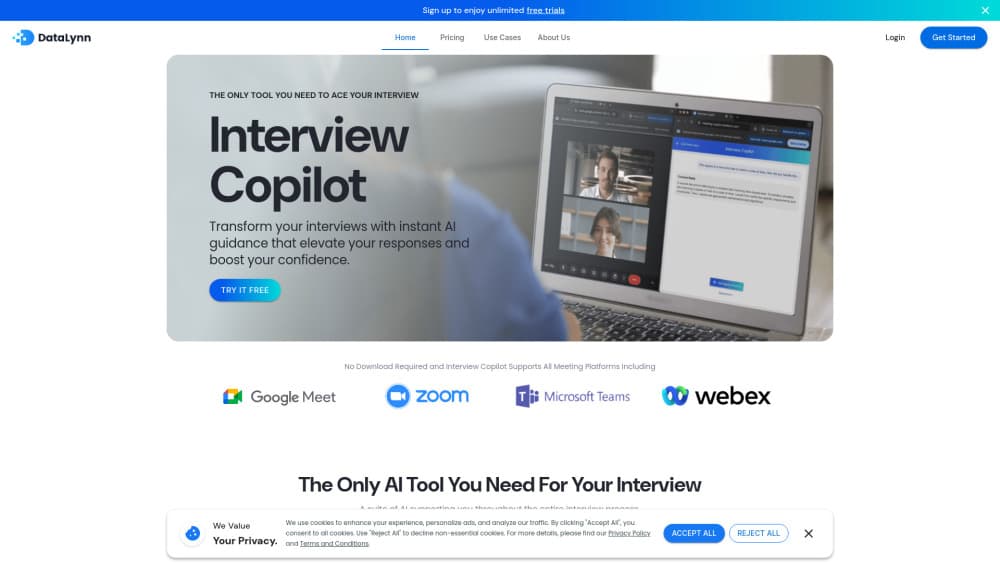
DataLynn AI Interview Copilot is a real-time AI assistant that suggests answers during job interviews on any meeting platform.
About DataLynn AI Interview Copilot
What Is DataLynn AI Interview Copilot
DataLynn AI Interview Copilot is an AI agent built by DataLynn, a company that develops large language models and AI agents for healthcare, finance, gaming, and recruiting. This particular agent targets one narrow job: real-time interview help. It sits beside a candidate during a live interview and feeds them answer ideas as questions come in.
The problem it solves is familiar to anyone who's blanked under pressure. Prep happens. Then everything leaves. The copilot listens to the conversation, reads the question, and drafts a structured response you can glance at and adapt in your own words, which is faster than trying to assemble a perfect answer from scratch while a stranger watches you think. It supports behavioral questions, technical topics, and standard "tell me about yourself" openers.
The main limitation is that it's a support tool, not a substitute for real skill. Answers still sound better when they come from your own experience, and reading a scripted reply on camera is obvious to any interviewer paying attention. It's live interview assistance, not a magic trick.
Getting Started
- Request access through DataLynn's contact form or product page, since the copilot runs on the company's platform rather than a public download.
- Set up your interview context: paste your resume, the job description, and any notes about the role.
- Connect the copilot to your meeting. It works alongside common video call platforms instead of replacing them.
- Run a practice session to see how suggestions appear and adjust the pace to your speaking style.
- Keep the suggestion window off to the side and use the prompts as talking points.
Product Information
A quick look at DataLynn AI Interview Copilot's pricing, supported platforms, and performance.
Best for
The users, tasks, and scenarios where this tool fits best.
Users
- Job seekers who freeze at unexpected questions
- Non-native English speakers
- Career changers returning to interviews
Tasks
- Answering behavioral questions
- Preparing for technical screens
- Drafting responses to salary and negotiation questions
Scenarios
- A first-round phone screen where you want help staying on track
- A remote interview on Zoom, Google Meet, or Teams
- A last-minute interview with little prep time
Key features
Real-Time Answer Generation
The copilot listens to interview audio and produces suggested answers within seconds of each question. Suggestions arrive as bullet points or short paragraphs, so you can grab a key phrase instead of reading a whole script. This is the feature that separates it from simple practice tools, which only work outside a live call. So how fast is fast? Fast enough to stay in the conversation.
Works Across Meeting Platforms
It's built to sit beside whatever platform hosts your interview rather than forcing you onto a proprietary call. Zoom, Google Meet, and Microsoft Teams all work, and the design keeps the suggestion panel separate from the video window so the interviewer never sees anything but your face.
Context-Aware Responses
You feed it your resume and the job description, and it shapes answers around that material. A marketing candidate and a data analyst get different framing for the same "greatest weakness" question. The output reflects the role, which makes suggestions more usable than generic interview templates.
Structured Answer Frameworks
Instead of rambling, the copilot favors formats interviewers expect, like situation-action-result for behavioral questions. That structure helps candidates who know their material but lose the thread when nervous. It won't write a story you never lived. The details still have to come from you.
Practice Mode
You can rehearse before the real thing and watch how suggestions appear in real time. As an interview preparation tool, practice mode helps you build the habit of glancing, not staring, which is what keeps the tool invisible to interviewers. It's a useful warm-up for anyone returning to interviews after a long gap.
Conversation Support, Not Just Answers
The copilot covers more than single questions. It flags follow-up angles and points worth expanding, so you're not stuck on one thread. It's closer to an AI copilot for interviews than a teleprompter reading lines. That distinction matters in conversations that branch in unexpected directions.
Pros and cons
Pros
- Generates answer suggestions in real time during the actual interview, not just during prep.
- Runs alongside Zoom, Google Meet, and Teams without requiring a platform switch.
- Personalizes suggestions using your resume and the job description.
- Practice mode lets you rehearse the glancing workflow before it counts, which is the habit that keeps the tool invisible during a live interview.
- Useful for non-native speakers who need help with phrasing under pressure.
Cons
- There's no free tier, so you pay before you know whether the format suits you, which makes an expensive bet for anyone still deciding.
- Reliance on live suggestions can make answers sound generic if you read them verbatim, which interviewers notice.
- It's tied to DataLynn's platform access rather than a simple standalone download, and there's no Google Play app.
- Pricing isn't published openly, so you confirm cost through a sales conversation.
Frequently asked questions
It listens to a live interview and generates answer suggestions in real time. You use those suggestions as talking points while speaking in your own words, rather than reading them out. Simple idea. Hard to pull off well.
Related content
Explore related tools, skills, and articles for DataLynn AI Interview Copilot.
DataLynn AI Interview Copilot Alternatives

Base Code
Base44 (Wix) · Coding · ProductivityBase Code is a shared cloud development environment from Base44. Teammates describe changes to an existing GitHub codebase in chat, preview them live and send them back as pull requests.

Knocket
Knocket (Tencent RTC team) · Productivity · Business · ChatbotKnocket is a free live chat and contact page tool that lets visitors message you from your website, app, or a shareable link, with every reply handled from Telegram or one inbox.

FloorGen
Vinit Kumar (FloorGen) · Productivity · China AIFloorGen is a browser-based floor plan maker that turns a sentence or a sketch into an editable 2D plan and a 3D walkthrough. Export to PDF, DXF or video, and draw without an account.