

Deep Personality
Deep Personality Inc. · Leaning
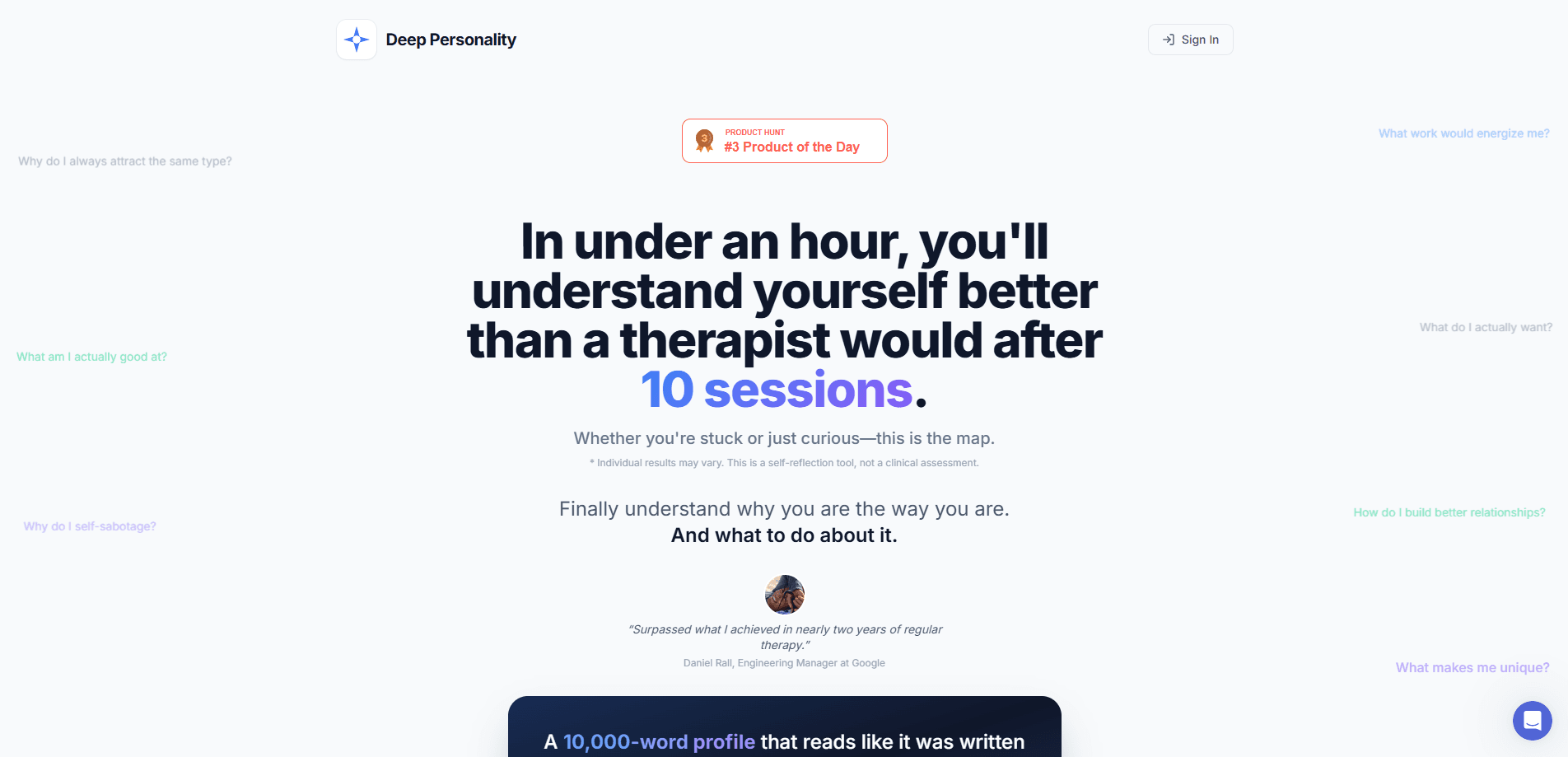
Deep Personality is an AI-powered personality assessment platform that turns a single long questionnaire into a 10,000-word written report about how you think, love, work, and cope. It runs 28 validated psychological instruments, including the Big Five test and attachment style measure, then cross-reads the results so patterns only get named when several instruments agree. You start free with a snapshot of your top patterns, and the deeper written report opens up for $9.99/mo.
About Deep Personality
What Is Deep Personality
Deep Personality is a science-backed personality assessment built by Deep Personality Inc. out of British Columbia, Canada. Instead of handing you five scores and walking away, it takes your answers across 28 research instruments and reads them together. That includes the Big Five (IPIP-50), attachment style (ECR-R), anxiety (GAD-7), mood (PHQ-9), career fit (RIASEC), and the ASRS, OCI-R, and AQ-10 screeners for ADHD, OCD, and autism traits.
The pitch is that a single test rarely tells the whole story. Your attachment pattern and your stress response and your work motivation all pull on each other. So why does every quiz treat them as separate? This tool is designed to surface those overlaps in plain language rather than a chart dump. The output is a report written to read like someone who knows you, not a stack of bar graphs.
There are real limits worth knowing upfront. The clinical screeners are screening tools, not diagnoses, and the platform says so plainly. The full written report sits behind a $9.99/mo subscription, and side-by-side partner comparison costs $14.99/mo. It's a web product, so you take it in a browser. And it isn't a quick 16 personality types quiz, so don't come in expecting a label in five minutes.
Getting Started
- Open deeppersonality.app and start the free assessment. No account or card is needed at this stage.
- Answer honestly across the full instrument set, which runs roughly 35 to 50 minutes. You can pause and resume, and your progress saves automatically.
- Opt in to the optional mental health screeners if you want them read; they stay off until you give an explicit yes.
- Review the free snapshot, which names your top patterns, your five-dimension profile, and your screening results.
- Open the full 10,000-word report for $9.99/mo, or add the Comparison plan at $14.99/mo to read your profile against a partner's.
Product Information
A quick look at Deep Personality's pricing, supported platforms, and performance.
Best for
The users, tasks, and scenarios where this tool fits best.
Users
- Pattern repeaters who keep living the same relationship or career story with a new cast
- High-achievers who want an honest read on their edge and their blind spots
- Therapy-curious adults who want structured self-knowledge before committing to a professional, or alongside it.
Tasks
- Mapping your attachment style and the specific conflict loop it triggers
- Screening for ADHD, OCD, and autism traits in the same pass as your personality
- Checking compatibility with a partner
Scenarios
- Deciding whether a relationship is worth the long haul, and wanting data before the ring.
- Preparing for a first therapist session with a written picture of your patterns instead of a vague sense of being stuck.
- Re-taking the assessment every few months to see how your patterns shift as you work on them.
Key features
28 Instruments Cross-Read Into One Report
The core of Deep Personality is aggregation, not any single test. Your answers to the Big Five, attachment style, mood, stress, and career measures get read together, and a pattern is only named when several instruments point the same way. The result is a 10,000-word report that reads as one coherent story rather than a score dump. That's what separates it from the free Big Five quiz most people have already taken. Big difference.
Built-In Mental Health Screeners
The same assessment quietly runs validated screeners for ADHD (ASRS), OCD (OCI-R), and autism traits (AQ-10), plus anxiety and mood measures. You can read those scores against your personality instead of getting them in isolation. Deep Personality is clear that these are screening tools, not diagnoses, so the useful part is knowing which patterns are worth raising with a professional.
A Free Snapshot Before You Pay
You don't hit a paywall to see anything at all. The free tier names your top three patterns in plain English, shows your five-dimension profile, gives you your ADHD, OCD, and autism screening scores, and points to the relationship pattern most likely running your life right now. No account and no card are required just to start. That's rare. Most tools make you register before they tell you anything.
The Written Report That Tells You What To Do
The paid report takes everything the free snapshot names and turns it into action: what your screeners actually mean and what to do about each one, the exact conflict loop your attachment style creates and how to break it, and concrete moves for love, work, stress, and self-sabotage. It spans 12 sections built from all 28 instruments.
A Report That Updates As You Change
The subscription is monthly on purpose. You can re-take the assessment over time and track how your patterns and symptoms shift as you work on them, and Deep Personality adds new instruments to the roster as they're released. That tracking is the reason a one-off test can't match it. It has to keep up with you.
Partner and Relationship Comparison
On the Comparison plan, both people take the assessment and the tool reads the two profiles side by side. It scores attachment fit, values and money, and intimacy across emotional, intellectual, recreational, and sexual dimensions separately, then gives a plain-language read on green and red flags. That's specific. It's a structured way to see where you click and where you'll clash before those things become surprises.
Pros and cons
Pros
- Cross-reads 28 validated instruments instead of reporting isolated scores, so patterns get named only when the measures agree.
- The free tier is genuinely useful and skips the account-and-card friction at the start.
- Progress saves automatically, so a 35 to 50 minute assessment fits around a normal schedule.
- Optional clinical screeners stay off until you explicitly opt in, which puts sensitive data in your hands.
- Data is encrypted in transit and at rest and deletable anytime, with a stated no-sale policy.
Cons
- The full 10,000-word report is paywalled, so the free snapshot is a preview rather than the deliverable.
- It's browser-only, so there's no app for people who prefer taking long assessments on their phone offline.
- Partner comparison costs extra, which adds up if you only want a one-time compatibility read.
Frequently asked questions
A free Big Five test hands you around five scores and stops there. Deep Personality reads 28 validated instruments together, names a pattern only when several agree, and writes the result as one long report. So you get an interpretation rather than a set of numbers to decode yourself.
Related content
Explore related tools, skills, and articles for Deep Personality.
Deep Personality Alternatives

HireKey
HireKey · Voice & Language · Productivity · LeaningHireKey is an AI job search copilot built by a former tech recruiter. It checks role fit, tailors resumes, runs interview practice and tracks every application.
Lune
Retrograde Labs · Productivity · LeaningLune is a research search engine for scientific AI agents. It runs as an MCP server that lets Claude, ChatGPT and Cursor search peer-reviewed computer science papers and cite them.
Coddy
Coddy · Coding · LeaningCoddy is a gamified platform to learn to code through short interactive lessons in 20+ languages, with a browser editor, an AI tutor and free certificates.