

DeltaMemory
DeltaMemory · Chatbot
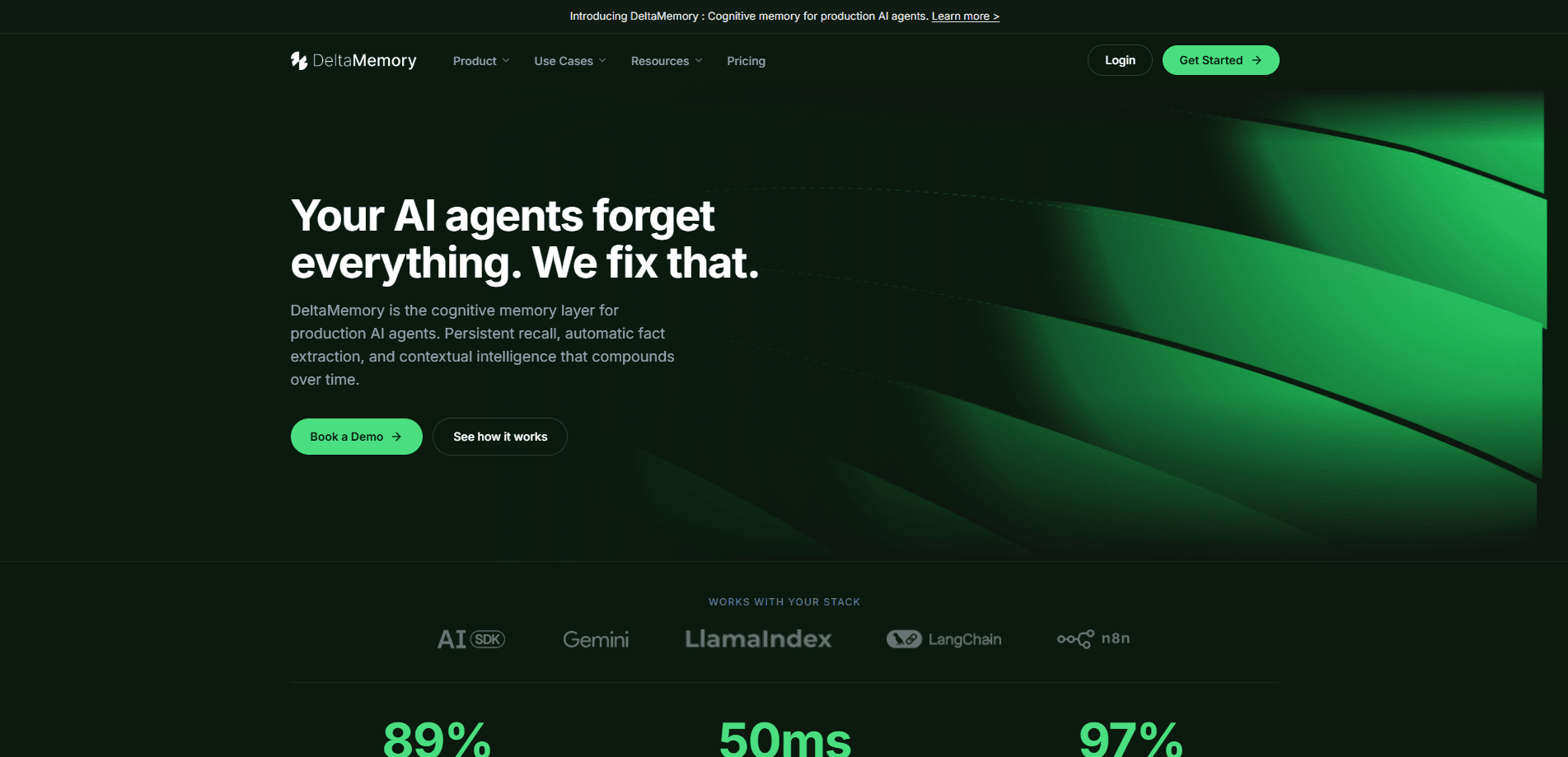
DeltaMemory is a persistent recall layer that helps AI agents and implementation teams remember what actually happened on a project. It captures commitments, decisions, and changes from meetings, chat, email, and tickets, then turns them into a source-backed record you can query anytime. Instead of losing context when a deal escalates or an owner changes, you get a current brief that leads with open commitments, recent shifts, and unresolved blockers. It's memory for AI agents and the people who run complex software implementations, built for teams that can't afford to reconstruct the truth under pressure.
About DeltaMemory
What Is DeltaMemory
DeltaMemory is an AI memory layer that keeps a living, source-backed record of a project. Every captured item stays linked to where it came from, so you can trace a promise, a decision, or a scope change back to the meeting or thread that produced it. The product handles the messy reality that enterprise implementations fail on. The real state of a project is scattered across systems and people.
The pitch is simple. Your project plan shows what should happen, but your team still has to remember why. DeltaMemory closes that gap with automatic fact extraction: it pulls requirements, commitments, decisions, blockers, and risks out of your tools, then ranks what needs attention before it turns into an escalation. That goes beyond search. The memory layer acts, pushing briefs and nudges into Slack or Teams where the work already happens.
The main limitation right now is timing. DeltaMemory is in early beta and launches soon, so pricing, connector depth, and support terms are still being finalized. If you need a production-ready enterprise memory platform today with a published price list, you'll want to wait for general availability.
Getting Started
- Request early beta access from the official site and wait for your workspace to be provisioned.
- Connect the systems you already run, such as Slack, Jira, Notion, or Salesforce, keeping your source permissions intact.
- Scope any custom sources with the team during memory design if your data lives somewhere unusual.
- Let DeltaMemory ingest your meetings, chat, email, and tickets as they happen.
- Review the ranked brief in Slack or Teams and act on the commitments and blockers it flags.
Product Information
A quick look at DeltaMemory's pricing, supported platforms, and performance.
Best for
The users, tasks, and scenarios where this tool fits best.
Users
- Implementation and professional services teams
- Solutions architects
- Customer success managers
Tasks
- Catching slipping commitments
- Tracking scope changes
- Handing off a project
Scenarios
- Walking into a customer meeting
- A deal escalates
- A project owner leaves
Key features
Source-Backed Project Memory
Every requirement, commitment, decision, and risk stays tied to its source. When a customer disputes what was promised, you can pull up the exact call or thread instead of relying on memory. That traceability is the difference between a record people trust and a dashboard nobody checks.
Persistent Recall Across Owners
AI agent memory usually dies with the session. DeltaMemory keeps persistent recall alive across owners, handovers, and escalations, so context survives when people move on. People leave. Projects don't have to reset. The new owner picks up the same project model rather than rebuilding it from scraps.
Cross-System Ingestion
DeltaMemory ingests meetings, chat, email, tickets, CRM records, and documents as they happen. It connects systems you already run, including Slack, Jira, Zoom, Notion, Zendesk, and Salesforce, with source permissions preserved or made stricter, never weakened. New connectors ship regularly, and custom sources can be scoped during memory design. Setup is the real work here.
Temporal Reasoning
The platform keeps a time-aware record of decisions and changes rather than overwriting history. You can see what was decided, who decided it, what was rejected, and whether a later decision superseded it. For teams juggling moving requirements, that timeline answers a common question: when did this change? No hunt through old docs needed.
Ranked Attention and Nudges
A record nobody acts on is just an archive. DeltaMemory prioritizes overdue commitments, unanswered asks, new blockers, and off-plan changes, then pushes the brief, the nudge, and the alert to the right person in Slack or Teams. Catch it early. That's the goal, stopping a problem before it becomes an escalation rather than after.
Complete Handoff
When a project changes hands, DeltaMemory transfers the full project model: current state, stakeholder map, decisions, risks, blockers, and open questions. Each item still links back to its source, so the new owner inherits context rather than a compressed task list. No more guessing. Just the record.
Pros and cons
Pros
- Keeps every captured item linked to its source, so decisions are auditable.
- Ingests from many systems at once, including Slack, Jira, Notion, and Salesforce.
- Preserves permissions from connected sources instead of loosening them.
- Ranks what needs attention and delivers it inside Slack or Teams.
- Tracks commitments from both sides of a project, not just your own.
Cons
- Still in early beta, so pricing and support terms aren't published yet.
- Custom sources require a scoping step, which slows setup for unusual data setups.
- Value depends on connecting your systems, so a partial rollout limits what it can surface.
Frequently asked questions
It's a memory layer that captures commitments, decisions, and changes from across your tools and turns them into a source-backed project record. It then ranks what needs attention and delivers it to your team in Slack or Teams.
Related content
Explore related tools, skills, and articles for DeltaMemory.
DeltaMemory Alternatives
Griffin by Tavus
Tavus · Voice & Language · Video · ChatbotGriffin by Tavus is the first Human Interaction Model: a full-duplex, video-to-video system that watches, listens, and answers during a live video call in real time.

Claude Haiku 5.5
Anthropic · Writing · Coding · ChatbotClaude Haiku 5.5 is Anthropic's fastest and cheapest small model, built for high volume tasks at $0.10 per million input tokens with a 1M token context window.

Wabi
Wabi, Inc. · Productivity · AI Assistant · ChatbotWabi is a messenger-style AI assistant for iOS, Android and Mac. It sorts your life into shared threads, builds small apps inside each one, and handles email, calendar and errands after you approve.