

Dex
Dex · Business
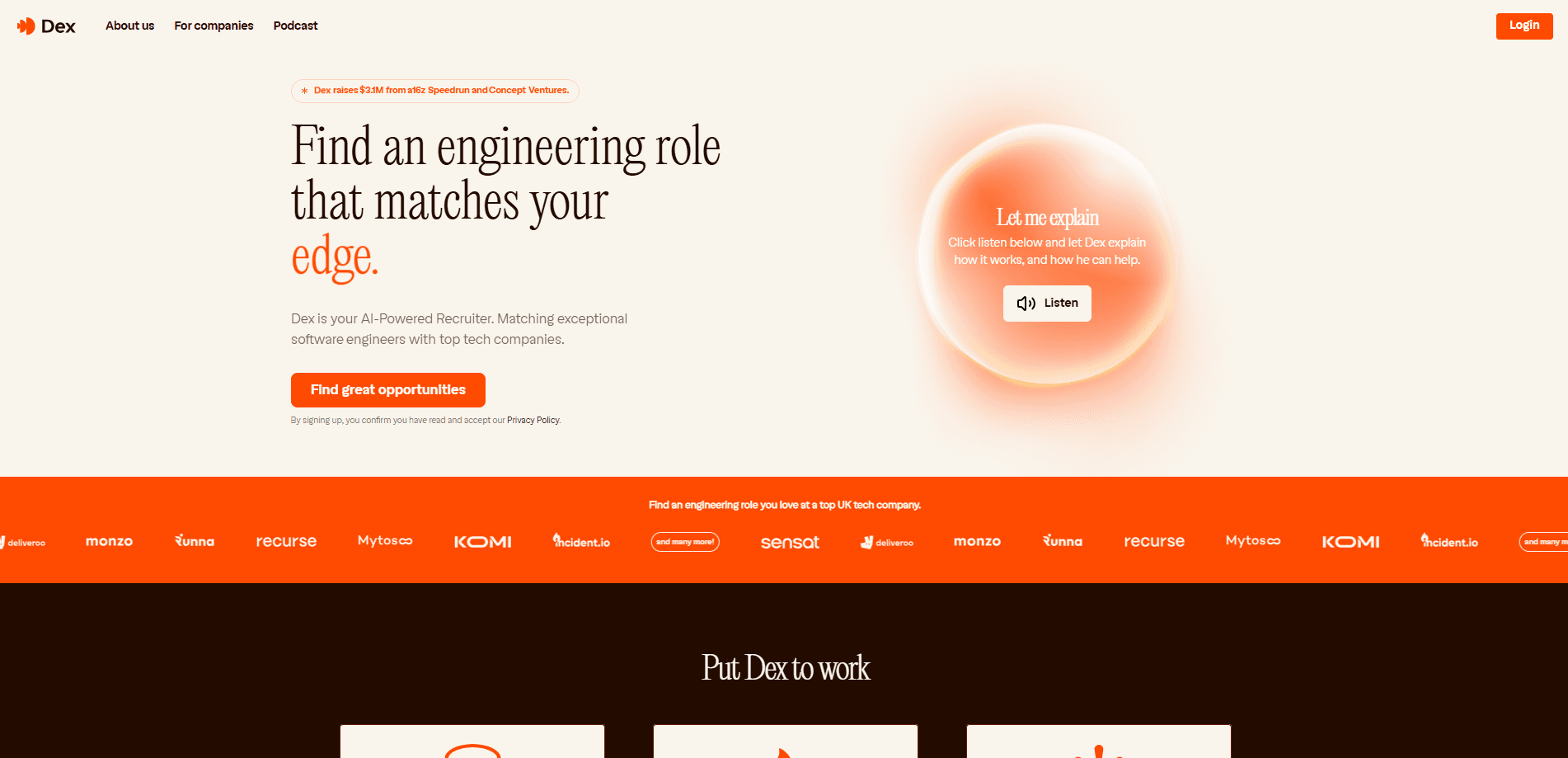
Dex is an AI recruiting agent built for software engineers and the companies that hire them. Engineers brief it once with their stack, seniority, and dealbreakers, then get a shortlist of vetted roles with salary shown upfront instead of a feed to scroll. Companies use the same matching engine to get a small shortlist of pre-qualified candidates they can introduce directly to a hiring manager. One conversation, both sides.
About Dex
What Is Dex
Dex is an AI talent agent, not a job board. It runs a conversation with each engineer, learns what they actually want to build and what they won't accept, and then searches for roles that clear that bar. Every opening on the platform is reviewed by humans and only comes from tech companies that pay at least £100K, with a median salary above £150K according to Dex. That's the core idea. High bar in, high bar out.
The pitch is aimed at the hidden job market. Dex says most engineering roles are never publicly posted, and that its direct introductions are far more likely to land an offer than a job board application. For companies, the appeal is the opposite of a pipeline. Fewer candidates, each one already qualified and interested. The company behind Dex is based in London and is backed by Notion Capital and a16z Speedrun.
The main limit is scope. Dex only works with AI engineers, software developers, machine learning engineers, and quant engineers, so it's not a general-purpose job search tool for designers, marketers, or other functions. It's also web-only, with no mobile app for either engineers or hiring teams.
Getting Started
- Go to the Dex site and sign up with a work email or LinkedIn profile.
- Brief the agent once by voice or text: your stack, seniority, motivations, red flags, and what you want to build next.
- Review the matches Dex sends as new roles clear your brief, and check the salary and package before committing.
- Choose who to be put forward to, and let Dex make the direct introduction to the hiring team.
Product Information
A quick look at Dex's pricing, supported platforms, and performance.
Best for
The users, tasks, and scenarios where this tool fits best.
Users
- Software engineers
- Machine learning and quant engineers
- Hiring managers at tech companies
Tasks
- Running a quiet job search
- Screening candidates
- Comparing offers
Scenarios
- A senior engineer who is open to the right move but not any move.
- A funded startup that needs to fill a hard-to-reach engineering role fast.
- A developer who is tired of recruiter spam and wants confidential matching.
Key features
Conversational Briefing
You tell Dex what you want in plain language, by voice or text. The agent captures your stack, seniority, dealbreakers, and the kind of work that motivates you, then builds a profile around what you have actually built and shipped. That profile drives every match. Get the brief wrong and the matches will be wrong too.
Salary Shown Upfront
Every role on the platform displays compensation before you talk to anyone. Dex says all openings pay at least £100K, with a median above £150K. The practical effect is that you can filter out roles that don't fit your number without sitting through three interview rounds first. Three rounds. That's the norm elsewhere.
Human-Vetted Roles
A person reviews each opportunity before it goes live, checking for quality, stability, and culture. Dex says it turns down twice as many companies as it accepts. That cuts down on the low-effort listings you get on open job boards. It also means the pool is smaller.
Direct Introductions
When a match is right, Dex introduces you straight to the hiring team and skips the recruiter screen. The company claims its engineers are around 10 times more likely to get a role through a direct intro than through a job board application. It also puts the average referral-to-offer time at 29 days. That's roughly half the 55 days Dex cites for a job board.
Candidate Matching for Employers
Companies brief Dex on the role and the team, not just the spec. The agent speaks with engineers regularly and sends a small number of genuinely interested, already-qualified candidates. Hiring teams get fewer names to review and more time with people who are already excited about the product. Less screening. More hiring.
Confidential by Default
Dex states it doesn't share your information with anyone else and won't bombard you with messages. Your search stays private until you choose to be put forward, which matters if you're employed and don't want your current employer to know you're looking.
Pros and cons
Pros
- Salary and package transparency before any conversation with a company.
- Roles are vetted by humans, so the shortlist avoids low-effort listings.
- Direct introductions to hiring managers skip the usual recruiter screen.
- Free for engineers, and the search stays confidential until you opt in.
Cons
- Only covers AI and software engineering roles, so other job seekers get nothing from it.
- Web-only, with no mobile app for engineers or hiring teams.
- Pricing for companies isn't published, so employers have to talk to the team first.
Frequently asked questions
Dex is an AI recruiter and AI job matching platform that connects software and AI engineers with vetted roles. Engineers use it to run a private job search, and employers use it to get a short, pre-qualified shortlist.
Related content
Explore related tools, skills, and articles for Dex.
Dex Alternatives
Liveplan
Palo Alto Software · BusinessLivePlan is business plan software that helps founders and small business owners turn an idea into a funder-ready plan. It combines AI-assisted writing, market research with cited sources, and connected financial forecasting so your income statement, cash flow, and balance sheet move together when you change one number. Over 1.5 million businesses have used it to plan, forecast, and track performance against real accounting data. That's a lot of founders. It's also a signal the tooling survived contact with real lenders.

Swms
Swms AI · Writing · Productivity · BusinessSwms is an AI safety compliance tool that turns a plain description of a job into ready-to-use safety documents. Describe your project, trade, and known hazards, and it writes a safe work method statement, job hazard analysis, safe work procedure, RAMS, or safety data sheet in seconds. It also ships with Oscar, a chat assistant that answers workplace safety questions in any language. Teams in construction, mining, transport, and warehousing use it to cut the paperwork that usually eats into a workday.

Rows
Rows (Superhuman) · Productivity · BusinessRows is an AI spreadsheet and data analysis tool that imports live data from more than 50 sources, then lets you work with it using plain language instead of SQL queries or nested formulas. You can pull numbers out of PDFs, connect ad platforms, databases, and bank accounts, and ask the AI to build reports, merge datasets, or set up models that recalculate themselves. It runs in the browser, works like a spreadsheet, and now sits under the Superhuman umbrella.