

Document Parser by Contextual AI
Contextual AI · Productivity · Business
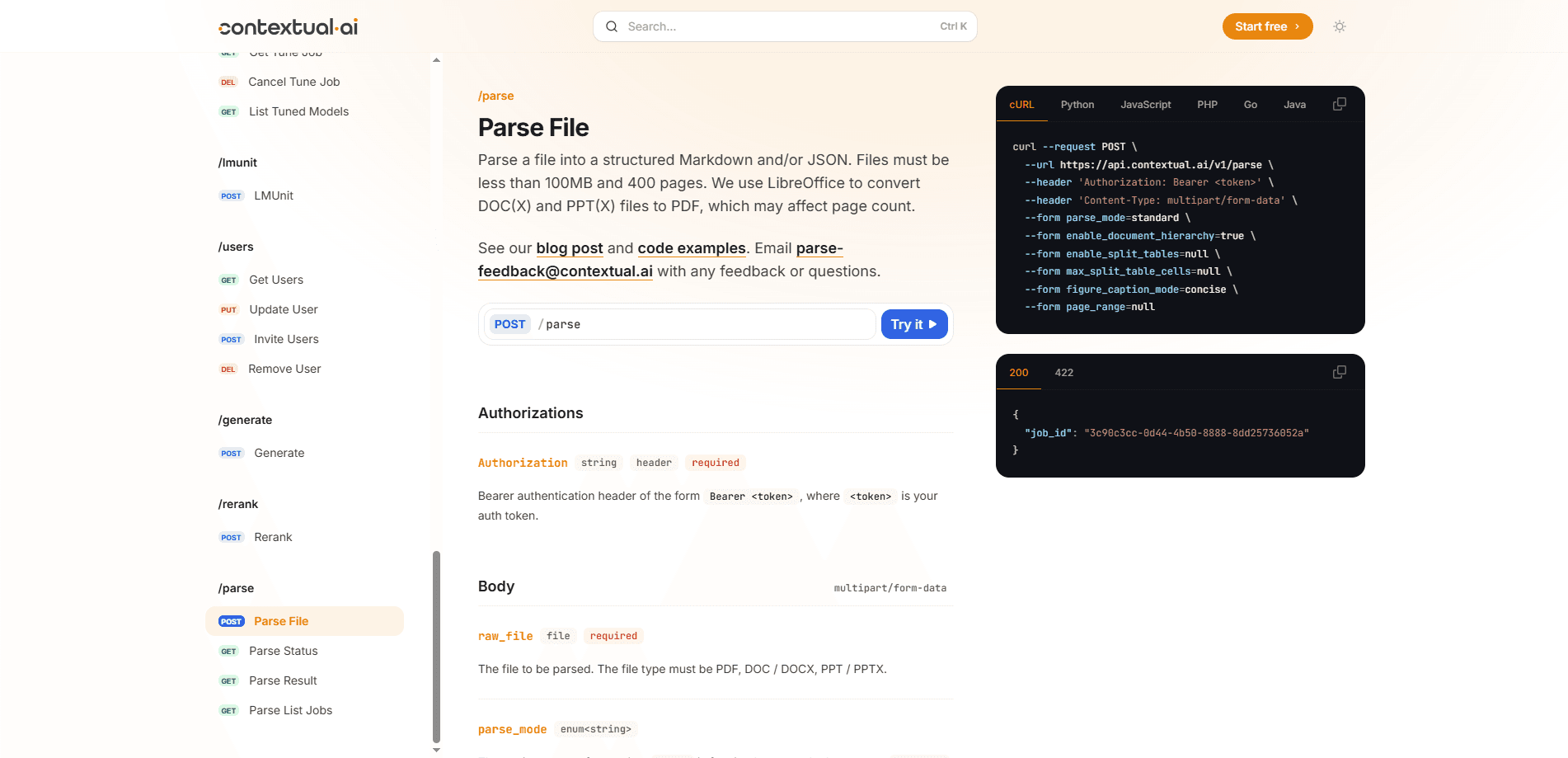
Document Parser by Contextual AI is the parsing engine inside Contextual AI's context layer. It turns messy PDFs and scans into clean, structured data that AI agents can search and cite.
About Document Parser by Contextual AI
What Is Document Parser by Contextual AI
Document Parser by Contextual AI is the document processing component of Contextual AI's context engineering platform. The company builds the context layer that powers expert AI agents for enterprises, and parsing is the first step in that pipeline. Before an agent can answer a question about a technical datasheet or a compliance filing, something has to read the file and turn it into usable text.
That something is the parser. It handles the documents that trip up ordinary extraction tools: multi-column PDFs, scanned pages, embedded tables, charts and mixed HTML. The parser preserves the original structure and attaches metadata to what it reads, so models get better inputs and produce fewer wrong answers.
Contextual AI sells this as part of a broader platform, not as a standalone app. The company says its parsing and agentic extraction tools beat standard OCR on dense documents, and the wider stack pairs parsing with reranking, grounded generation and evaluation. The catch is the same one that applies to the whole product: it targets companies with real budgets. There's no self-serve free plan, and you start by requesting a demo rather than signing up alone.
Getting Started
- Request a demo through the Contextual AI site to get platform access for your organization.
- Connect your document sources, either through managed connectors, the API, MCP, or a direct file upload in the interface.
- Point the parser at your knowledge base and let it extract text, tables and metadata while preserving document structure.
- Configure an agent or workflow in Agent Composer and select the parsed content as its retrieval source.
- Test answers against your own documents and check the sentence-level citations before rolling out to your team.
Product Information
A quick look at Document Parser by Contextual AI's pricing, supported platforms, and performance.
Best for
The users, tasks, and scenarios where this tool fits best.
Users
- Enterprise AI and platform teams
- Data and knowledge engineers
- Compliance and IP research teams
Tasks
- Parse complex PDFs and specifications
- Extracting data from messy data room documents
- Diagnosing errors in large device log files
Scenarios
- Enterprise knowledge management
- Qualification report generation
- Customer engineering support
Key features
State of the Art Parsing
The parser handles complex documents while keeping their structure in place. It reads multi-column layouts, embedded tables, charts and mixed-format HTML, then creates metadata automatically. That structured output is what raises accuracy for whatever model reads it next.
Agentic Extraction
Dense reports often defeat standard OCR, which mangles tables and loses relationships between fields. Contextual AI's agentic extraction goes further, converting multi-format files into structured data you can act on. It's aimed at documents that are too complex for basic text scraping.
Multimodal Data Support
The tool ingests both unstructured files such as PDFs, scanned pages and image-heavy HTML, and structured sources like databases, spreadsheets and CSVs. Mixing both in one pipeline means an agent can reason over a financial model and a scanned contract in the same answer.
Intelligent Model Selection
Rather than forcing one parser on every file, the platform picks a model per document based on what it contains. That automatic selection is meant to keep accuracy up when your corpus spans everything from clean text to scanned forms.
Continuous Ingestion
Scheduled ingestion and real-time updates keep parsed content current as source systems change. Agents therefore answer from the latest version of a document instead of a stale snapshot, which matters when policies or specs get revised often.
Part of the Wider Context Platform
Parsing is one module in a stack that also covers reranking, grounded generation and evaluation. Teams that want more control can call the individual parsing models through the API to upgrade an existing RAG document parser pipeline they already run.
Pros and cons
Pros
- Purpose-built for hard documents, including multi-column PDFs, scans and tables that break simpler extractors.
- Preserves document structure and adds metadata, which lifts the accuracy of downstream retrieval and generation.
- The individual parsing models are available through the API, so you can slot them into an existing RAG setup.
- Multimodal support mixes unstructured files and structured sources in a single pipeline.
- Backed by Contextual AI, the team behind much of the early work on retrieval augmented generation.
Cons
- There's no self-serve tier or published price list, so you can't test it alone without talking to sales.
- Custom enterprise pricing puts it out of reach for individual developers and small projects.
- It's a platform component, not a standalone consumer app, so casual users have little reason to look here.
- Best results depend on connecting your own systems, which takes setup work and technical staff.
Frequently asked questions
It reads complex documents and turns them into structured, retrievable text along with metadata. That cleaned output becomes the knowledge base that AI agents search, so parsing quality sets the ceiling on answer quality.
Related content
Explore related tools, skills, and articles for Document Parser by Contextual AI.
Document Parser by Contextual AI Alternatives

Base Code
Base44 (Wix) · Coding · ProductivityBase Code is a shared cloud development environment from Base44. Teammates describe changes to an existing GitHub codebase in chat, preview them live and send them back as pull requests.

Knocket
Knocket (Tencent RTC team) · Productivity · Business · ChatbotKnocket is a free live chat and contact page tool that lets visitors message you from your website, app, or a shareable link, with every reply handled from Telegram or one inbox.

FloorGen
Vinit Kumar (FloorGen) · Productivity · China AIFloorGen is a browser-based floor plan maker that turns a sentence or a sketch into an editable 2D plan and a 3D walkthrough. Export to PDF, DXF or video, and draw without an account.