

Docus - AI-Powered Health Platform
Docus, Inc. · AI Assistant
Docus is an AI health platform that explains lab results, answers health questions through an AI doctor, and connects patients with 350+ specialists for second opinions.
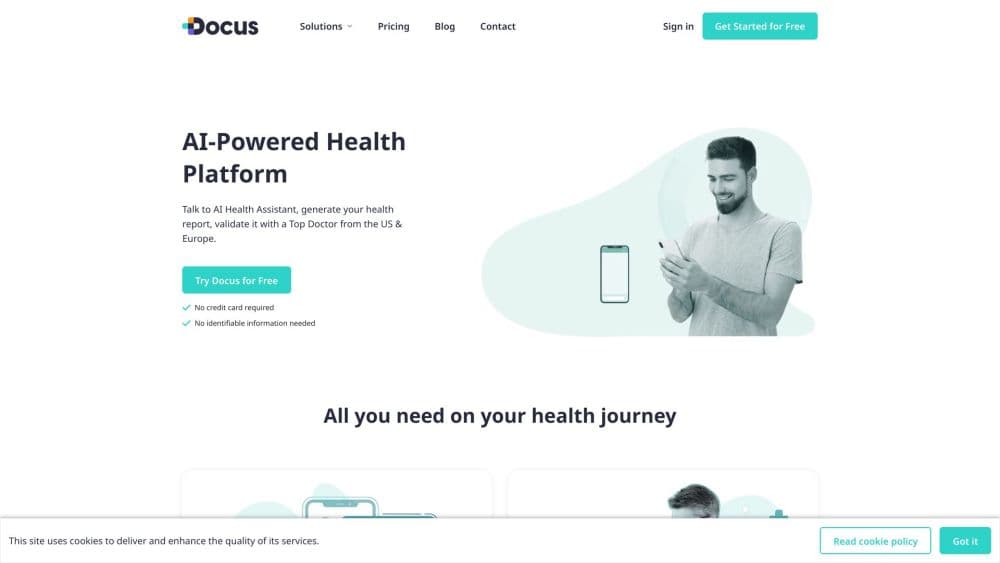
About Docus - AI-Powered Health Platform
What Is Docus
Docus is an AI health assistant built around one idea: a lab report or a strange symptom shouldn't leave you guessing. You upload a blood test, describe a symptom, or ask the AI doctor a question, and the platform explains what the numbers or symptoms likely mean in plain language. It also sells consultations with human specialists, so the AI output can be checked by a doctor when it matters.
The company started in 2021 after a friend of the founders fell seriously ill in Armenia and local doctors couldn't name his condition. A German specialist reviewed the case remotely and the treatment worked. That story explains the split personality of the product: part self-serve health tool, part bridge to distant experts.
The limits matter more here than with most apps. Docus doesn't diagnose, prescribe, or treat, and the site says so on nearly every page. The AI health assistant is an explainer and a starting point for a conversation with your own doctor. Anyone looking for a diagnosis from a chatbot will be disappointed, and anyone in an emergency should call local services instead.
Getting Started
- Create an account at docus.ai. No payment details are needed for the free plan, and the platform says personally identifiable information isn't required for core features.
- Fill in your health profile. Age, sex, existing conditions, and medications go into a memory the AI doctor uses later, so answers stay tied to your history.
- Ask a question or upload results. The AI doctor takes typed questions, and the lab tool accepts PDFs, screenshots, or a phone photo of the report.
- Read the output. You get a biomarker table with normal ranges, out-of-range flags with explanations, and a report you can download and bring to your physician.
- Move up if needed. On Docus pricing, paid plans raise the monthly message and test limits, and a separate second opinion session with a top doctor can be booked for a flat fee.
Product Information
A quick look at Docus - AI-Powered Health Platform's pricing, supported platforms, and performance.
Best for
The users, tasks, and scenarios where this tool fits best.
Users
- People holding a lab report they can't read
- Anyone weighing a serious diagnosis
- Doctors in small practices
- Diagnostic labs
Tasks
- Making sense of blood work after a checkup
- Checking whether a symptom needs attention
- Preparing for a specialist visit
- Getting a second read on a treatment plan
Scenarios
- A routine annual test comes back with two flagged values
- A relative abroad receives a diagnosis that sounds uncertain
- A clinic wants to cut documentation time
Key features
Lab Test Interpretation
This is the feature people come for. You upload a PDF, a screenshot, or a photo of a blood, urine, or other lab report, and Docus returns a table of biomarkers with your measured value, the normal range, and a status flag. Out-of-range values get a short explanation of what they can indicate. A second view charts the same marker across several tests, which is where trends show up that a single report hides.
Personal AI Doctor
The AI doctor is a chat interface with memory. It keeps your conditions, medications, and earlier conversations in context, so you don't re-explain your history with every question. Answers come with a reasoned list of possible conditions rather than a single verdict, and you can ask follow-ups about any term in a report.
AI Symptom Checker
Describe what you feel in everyday words, then answer a round of targeted questions. The checker returns a list of conditions that fit, with an indication of how likely each one is, plus guidance on whether to wait, see a doctor, or seek urgent care. It's free to use and needs no account on the public page, which makes it an easy first stop before booking anything.
Medical Second Opinions
Docus works with more than 350 doctors across 100+ subspecialties in 15+ countries. You pick a specialist, choose a written or video consultation, and share records through the platform. The result is a documented opinion you can take to your own physician. Each consultation is billed at $490 and sits outside every subscription plan.
Doctor Platform
The clinician side packs a patient-specific medical assistant, a research assistant that pulls from guidelines and literature, lab interpretation with differential diagnosis and follow-up suggestions, and AI-drafted SOAP notes. Each patient gets a separate memory, which keeps context from bleeding between cases. Plans run from free for a single patient to $100 per month for 2,000 patients.
Lab Software and API
Diagnostic labs can plug Docus in through API or HL7 and get structured interpretation reports back inside their LIS, CRM, or EHR. There's also an AI compliance agent that checks test orders against diagnosis codes before a payer denies the claim, and digital requisitions with AI-generated medical necessity notes. Pricing is quoted per lab based on test volume and region.
Privacy and Validation
Docus is built to HIPAA, GDPR, and SOC 2 requirements, with encryption at every step and a design that doesn't require names or other direct identifiers for core flows. AI answers pass through a multi-step pipeline that includes text recognition, medical knowledge checks, and reasoning before output. Human specialists review and test the system, and the company publishes a safety page describing the process.
Pros and cons
Pros
- Lab reports come back in a format a non-clinician can actually read, with ranges and explanations next to each number.
- The AI doctor remembers your history, so a follow-up question doesn't require restating everything.
- Second opinions from 350+ specialists are bookable online at a fixed $490, with no travel involved.
- The free plan is real: three AI doctor messages a week and one free test interpretation, no card required.
- The same account covers personal use, a doctor workflow, and lab tooling, which is unusual for one vendor.
Cons
- Message and test limits on Lite and Pro are tight. 50 messages and 5 interpretations a month run out fast during a health scare.
- Second opinions sit outside the subscription. A patient on the $8 Pro plan still pays $490 for a consultation.
- The AI can't diagnose or prescribe, so every serious finding still needs a licensed doctor, which adds a step rather than replacing one.
- Coverage leans on US and European specialists, and availability in other regions isn't spelled out on the site.
Frequently asked questions
Docus explains health information. You upload a lab report, describe symptoms, or ask the AI doctor a question, and it returns an explanation in plain language with possible causes and suggested next steps. It also arranges paid consultations with human specialists.
Related content
Explore related tools, skills, and articles for Docus - AI-Powered Health Platform.
Docus - AI-Powered Health Platform Alternatives
Agibot
Agibot · Productivity · AI Assistant · ChatbotAgibot is a personal AI agent for Mac that keeps running after you close the window, runs routines on a schedule, and works from Telegram or Slack with your own API keys.

Foley
Hanamori Labs, LLC · Voice & Language · Productivity · AI AssistantFoley is a voice to-do list that turns a spoken sentence into a filed task, complete with project, date and time, then helps you plan the day around what is already there.

Ghost Core
Ghost · Productivity · AI AssistantGhost Core is a $3,499 screenless personal AI computer that runs local AI models on its own hardware, builds context from your apps and devices, and acts without waiting for a prompt.