

Ghost Core
Ghost · Productivity · AI Assistant
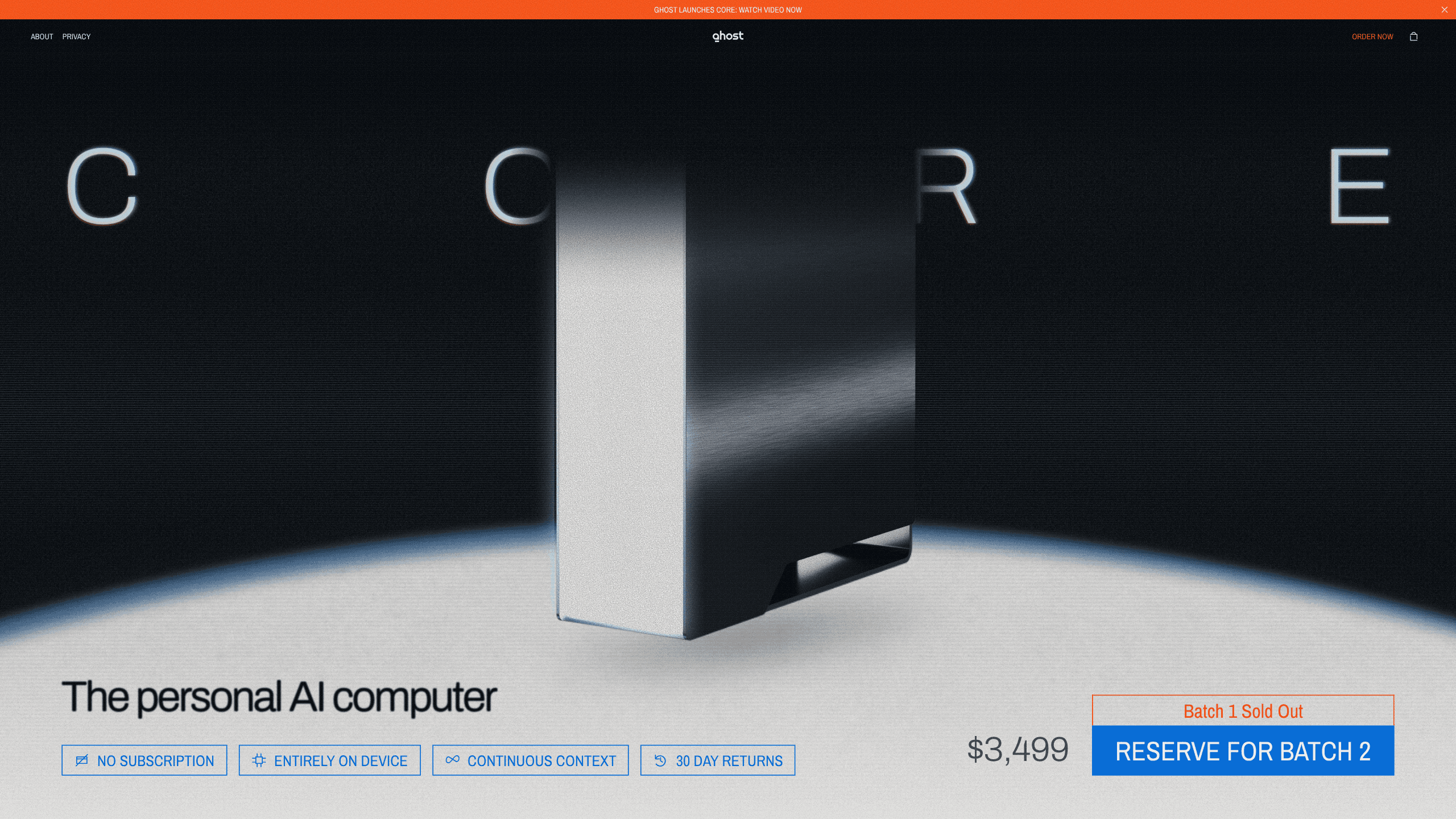
Ghost Core is a $3,499 screenless personal AI computer that runs local AI models on its own hardware, builds context from your apps and devices, and acts without waiting for a prompt.
About Ghost Core
What Is Ghost Core
Ghost Core is a small desktop machine built by Ghost, a San Francisco startup that came out of stealth on October 5, 2026 with an $11 million seed round led by Andreessen Horowitz. The company calls Core the personal AI computer. It has no screen and no keyboard. You reach it through a phone app, and you can talk to it in voice mode through that app.
The pitch is ownership, and on-device AI is the mechanism. Models, memory, and the files Core collects all stay on the 1 TB drive inside the box. Ghost says nothing leaves your home, and that the source code, logic, and model weights live on the device rather than in a service the company operates. Core keeps working if Ghost disappears.
The hardware is one answer to a familiar complaint: running a capable model on a laptop is slow, hot, and awkward to keep online. Core ships with an NVIDIA RTX PRO 4000 Blackwell GPU, 64 GB of DDR5 memory, and an AMD Ryzen 5 9600X. That is enough to hold several open models in memory at once and keep an agent running around the clock.
Two limits shape the decision. At $3,499 it costs more than a Mac mini plus a year of cloud subscriptions, and the first batch sold out. It also asks you to hand a single device access to your mail, calendar, files, wearables, and smart home, which is a bigger commitment than installing an app.
Getting Started
- Join the interest list at ghost.ai. The first batch is sold out, and Ghost says new batches open in waves.
- When your slot opens, pay $3,499. There is no subscription and no per-token bill.
- Put Core on a shelf or desk near your router. It connects over Wi-Fi and Bluetooth and stays on.
- Install the companion app, sign in, and choose which accounts and devices to connect, such as email, calendar, files, Whoop, Oura, or smart home gear.
- Set how much autonomy the agent gets. Core starts building context, and you can review or revoke access at any time.
Product Information
A quick look at Ghost Core's pricing, supported platforms, and performance.
Best for
The users, tasks, and scenarios where this tool fits best.
Users
- Privacy-first professionals
- Founders and operators with crowded calendars
- Quantified-self users
- Households that want one always-on assistant
Tasks
- Morning briefings
- Cross-app follow-ups
- Document and screen history search
- Personal health tracking
Scenarios
- Working from home with a locked-down laptop
- Living with a chronic condition or a training block
- Replacing a pile of AI subscriptions
Key features
A $3,499 box built for local inference
Core is not a general-purpose PC with an AI sticker. This is AI agent hardware, picked for memory bandwidth and sustained load: an NVIDIA RTX PRO 4000 Blackwell SFF Edition with 24 GB of GDDR7 ECC memory and 432 GB/s of bandwidth, 64 GB of DDR5, a 1 TB NVMe SSD, and a six-core Ryzen 5 9600X. That combination is what lets several models sit in memory and answer without a network round trip.
Four models preinstalled, more from Hugging Face
The machine ships with Qwen 3.8-Next, Qwen 3.8-27B, Gemma 4-31B, and Muse-Glimmer-30B. You can add other local AI models from Hugging Face or load one you trained yourself. Ghost pushes over-the-air updates in the style of a car maker and asks before switching you to a new generation, which matters when a model change alters how the agent behaves.
Context that accumulates across apps and devices
Core runs all day and keeps taking in what you allow: email, calendar, finances, files, recordings, browser and screen history, health records, lights, cameras, a fridge, a speaker, Whoop, Oura, and Eight Sleep. The point is not a bigger chat log. It is an assistant that knows you were up late and that your resting heart rate is up, then joins those facts into one useful message.
An agent that acts before you ask
Ghost designed Core to work without a prompt. It can spot that you are low on groceries, that rain will change your commute, or that a refill fits between two appointments, and send a notification through the app. You decide how much it can do on its own, and the settings can be tightened at any time.
An agent firewall for credentials
An assistant with your logins is a security problem, and Ghost says it is building the control for it. The firewall watches every outgoing request from the machine. If the agent tries an action you did not sanction, or tries to send data out, the request is rejected and flagged for review. This is the feature that turns a powerful local agent into something you can leave running.
Ownership that survives the company
Ghost states that all personal data is encrypted on the device and that neither a cloud provider nor Ghost itself can read it. Because the logic and weights sit on the SSD, the machine is meant to keep working if the company shuts down. A 30-day return window covers the case where the reality does not match the demo.
Pros and cons
Pros
- The whole stack runs locally, so no usage meter and no token bill after the $3,499 purchase.
- Real hardware for the job: 24 GB of VRAM and 64 GB of RAM let several capable models stay loaded.
- Context across wearables, files, and smart home devices is broader than most chat assistants manage.
- The agent firewall and autonomy settings address the obvious risk of giving an AI your logins.
- Ghost says the device keeps working without its cloud, which is rare in this category.
Cons
- $3,499 buys a lot of Mac mini and cloud credit, and the first batch is already sold out.
- No screen means every interaction goes through the phone app or voice, which is awkward for long documents.
- You are trusting a young startup with access to mail, calendar, health records, and home devices.
- Only four models ship preinstalled, and the 24 GB of VRAM caps how large a model you can run.
Frequently asked questions
It is a screenless desktop computer built to run AI agents locally. Ghost sells it as a personal AI computer: models, memory, and data stay on the device, and you control it through a phone app or voice.
Related content
Explore related tools, skills, and articles for Ghost Core.
Ghost Core Alternatives

Base Code
Base44 (Wix) · Coding · ProductivityBase Code is a shared cloud development environment from Base44. Teammates describe changes to an existing GitHub codebase in chat, preview them live and send them back as pull requests.

Knocket
Knocket (Tencent RTC team) · Productivity · Business · ChatbotKnocket is a free live chat and contact page tool that lets visitors message you from your website, app, or a shareable link, with every reply handled from Telegram or one inbox.

FloorGen
Vinit Kumar (FloorGen) · Productivity · China AIFloorGen is a browser-based floor plan maker that turns a sentence or a sketch into an editable 2D plan and a 3D walkthrough. Export to PDF, DXF or video, and draw without an account.