

Dreavie
Noah (independent developer) · AI Assistant
Dreavie is an AI dream interpreter that reads your dream against your current life, asks follow-up questions and returns a personal analysis with concrete next steps.
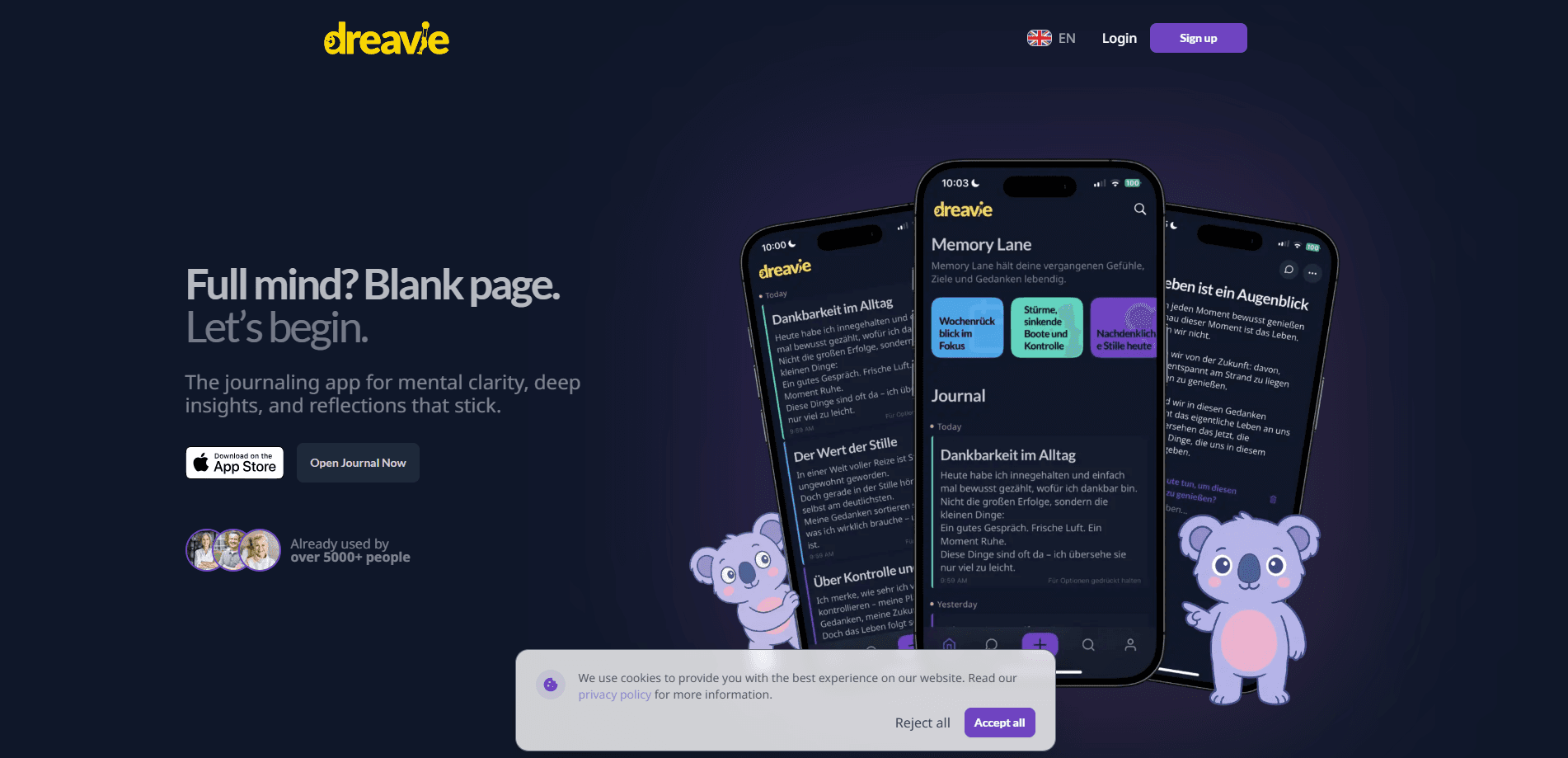
About Dreavie
What Is Dreavie
Dreavie is an online dream analysis tool, and it treats a dream as a message about your present state of mind rather than a fixed symbol to look up. Noah, a solo developer, built it in 2023 after hearing the same line over and over: "I had the weirdest dream last night." The idea is simple. Dreams are personal, so a dictionary entry that says water stands for emotion tells you almost nothing about why water showed up in your basement last Tuesday.
If you're trying to work out what a dream meaning app should actually do, the answer here is ask questions first. Dreavie asks what happened, how you felt and what is going on in your life right now, then reads the symbols in that context and explains its reasoning in plain language. The output is structured: a core theme, an interpretation you can follow, a few concrete steps for the week ahead and reflection questions so the analysis keeps working after you close the tab.
The honest limit is scope. Dreavie is a self-reflection tool, not a therapist, and the site says so directly. It won't diagnose anything, and if a dream or a feeling weighs on you, it points you to a doctor or a therapist. There's also a practical ceiling: one free interpretation a month, so heavy users end up paying per dream or subscribing.
Getting Started
- Open Dreavie in a browser and write down the dream the way you remember it. Fragments are fine and spelling doesn't matter.
- Answer a few short questions about your feelings, the people in the dream and what's on your mind right now.
- Read the analysis, which opens with the core theme and then connects the symbols to your situation.
- Work through the concrete steps and reflection questions it suggests, and revisit the entry later if the dream comes back.
Product Information
A quick look at Dreavie's pricing, supported platforms, and performance.
Best for
The users, tasks, and scenarios where this tool fits best.
Users
- People with a recurring dream
- Anyone curious about their own patterns
- Therapy-adjacent self-reflectors
Tasks
- Making sense of a single vivid dream
- Tracking a dream over time
- Turning a vague feeling into concrete steps
Scenarios
- A dream you can't shake
- A recurring dream that keeps nagging
- A weekly self-reflection habit
Key features
Context-Driven Interpretation
Dreavie reads each symbol against what's going on in your life right now, not against a static dream dictionary. You answer questions about your feelings and current situation, and the analysis uses those answers to explain why a particular reading might fit you. That's the core difference from a generic symbol lookup.
Structured Analysis Output
Every analysis opens with a core theme, then builds an interpretation and ends with something you can act on. Instead of a vague "this could mean many things" answer, you get reasoning plus concrete steps and reflection questions for the days after. The structure is what makes it usable as a self-reflection habit rather than a one-off curiosity.
Guided Question Flow
Before any interpretation, Dreavie asks a short set of follow-up questions about your emotions, the people in the dream and your current situation. This is deliberate: without that context, the site argues, any AI dream reading is just a guess. The questions take about a minute to answer.
Psychology-Based, Not Fortune-Telling
Dreavie says plainly that it uses psychological approaches and avoids stars, fate and "secret messages." It points to sleep research showing that dreams pick up what occupies you during the day, especially emotional experiences, as the basis for psychology dream analysis. That framing sets expectations for what the tool is and isn't.
Privacy Controls
Dreams are stored on servers in the EU, aren't used to train AI models, and you can delete a single dream or your whole account in settings. Since dreams can be personal or embarrassing, those controls are the reason some people will share details they'd keep off a general-purpose chatbot.
Simple Pay-As-You-Go Pricing
One interpretation a month is free and complete. Beyond that you can pay €2.90 for a single dream with no subscription, or €4.90 a month for unlimited readings. The single-analysis option keeps the cost of trying it low for people who just want one dream explained.
Pros and cons
Pros
- Reads dreams in the context of your life instead of returning a generic symbol list.
- Free tier gives one complete interpretation a month, no strings attached.
- Pay-per-dream option (€2.90) means no subscription just to try one.
- Clear action steps and reflection questions beyond the interpretation itself.
- EU data storage, no AI training on your dreams and easy deletion.
Cons
- One free interpretation a month is thin if you dream often.
- It's a web tool only, with no mobile app for jotting a dream the moment you wake.
- It won't replace therapy, and it says as much, so heavy emotional needs aren't covered.
- No public API, so you can't wire it into a personal journaling workflow.
Frequently asked questions
Dreavie is an AI dream interpretation tool. You write down a dream, answer a few questions about your feelings and current situation, and get a personal analysis that connects the dream to what's on your mind, plus concrete next steps.
Related content
Explore related tools, skills, and articles for Dreavie.
Dreavie Alternatives
Agibot
Agibot · Productivity · AI Assistant · ChatbotAgibot is a personal AI agent for Mac that keeps running after you close the window, runs routines on a schedule, and works from Telegram or Slack with your own API keys.

Foley
Hanamori Labs, LLC · Voice & Language · Productivity · AI AssistantFoley is a voice to-do list that turns a spoken sentence into a filed task, complete with project, date and time, then helps you plan the day around what is already there.

Ghost Core
Ghost · Productivity · AI AssistantGhost Core is a $3,499 screenless personal AI computer that runs local AI models on its own hardware, builds context from your apps and devices, and acts without waiting for a prompt.