

EarlyAI
EarlyAI · Coding
EarlyAI is an AI regression testing tool. As a regression guard, it compares each release candidate to production and flags risky changes early.
About EarlyAI
What Is EarlyAI
EarlyAI is an AI-powered testing tool for development teams. Its current focus is release safety: it takes a release candidate, compares its behavior against what users already rely on in production, and points out what changed. That comparison matters. Most bugs that reach customers aren't brand-new defects. They're regressions, quiet side effects of a change nobody expected to be risky.
The tool doesn't stop at "something changed." It classifies each difference as Expected or as a Regression, then traces impact across the components and business flows you've configured. If a change in one service quietly breaks a feature in another, EarlyAI surfaces that link instead of leaving you to find it in production. Each result stays tied to its pull request, commit, author, and run, so the finding is provable rather than a hunch.
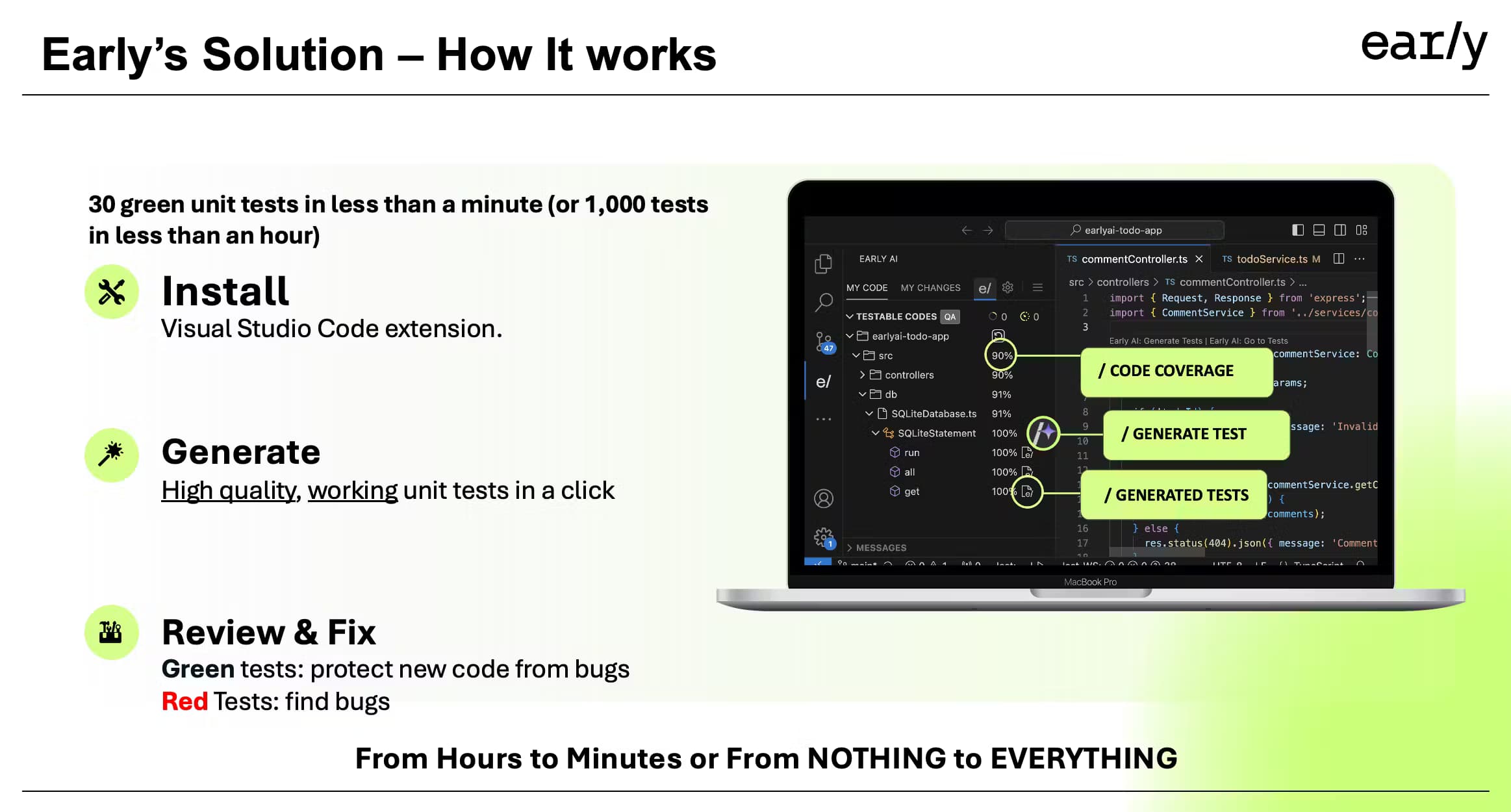
EarlyAI also grew out of an earlier product, an IDE extension built around automated unit test generation. That extension, Early for IDE, still exists in a legacy branch and supports JavaScript, TypeScript, and Python with frameworks like Jest, Mocha, Vitest, and Pytest. The bigger limitation is scope. The release guard works best once you've connected your repositories and mapped how your components depend on each other. Skip that setup and you get a much shallower picture.
Getting Started
- Create a team in EarlyAI and invite the developers who ship code, since findings and reports are shared at the team level.
- Connect GitHub and select the repositories you want the tool to watch.
- Map dependencies between your components so EarlyAI can trace cross-service impact, not just single-repo changes.
- Point EarlyAI at a release candidate, then run the analysis and wait for the run to finish.
- Review the results and regression findings, grouped by project, and use the ready-made fix prompt when something needs a decision.
Product Information
A quick look at EarlyAI's pricing, supported platforms, and performance.
Best for
The users, tasks, and scenarios where this tool fits best.
Users
- Software developers
- QA and release engineers
- Engineering teams on JavaScript, TypeScript, or Python
Tasks
- Catching regressions before a release
- Tracing cross-component impact
- Reviewing release risk
- Generating unit tests
Scenarios
- A backend change that could quietly break a downstream service your team rarely touches.
- A fast release cycle where manual regression testing can't keep pace with the number of changes.
- An onboarding moment where a new developer needs to see how components relate before editing them.
Key features
Release candidate comparison
EarlyAI takes your release candidate and compares its behavior with production, the version users already depend on. Instead of guessing whether a change is safe, you get a direct before-and-after view. That's the core of the whole product. It's also what makes the other findings meaningful.
Regression classification
Every difference gets sorted as Expected or as a Regression. The distinction saves your team from arguing over whether a behavior change was intended. Findings carry a status badge. You can tell at a glance which ones still need a decision and which are already closed.
Business-flow impact
The tool shows which customer and operational flows a change reaches, not just which lines of code moved. That reframing helps you prioritize. A broken internal script matters far less than a checkout flow. EarlyAI tries to make that difference visible before release.
Cross-component reach
When components depend on each other, a change in one can break another. EarlyAI traces impact across those relationships and lists a regression under the project that actually changed, tagged as a dependency finding. Connecting your repos and mapping dependencies is what makes this work.
Traceable evidence
Results stay linked to the pull request, commit, author, and run that produced them. When you need to justify a hold on a release, or explain a fix after the fact, the paper trail is already there. It turns "I think this broke something" into something you can show. No guessing.
Ready-made fix prompts
Each regression comes with an investigation view: why it happened, which change broke the previously stable behavior, a root-cause analysis, and a fix written out as a prompt for an AI coding tool. You still make the call. The diagnosis is half done.
AI unit test generation (legacy IDE extension)
The original EarlyAI product lives on as Early for IDE, a VS Code extension that scans your code and generates unit tests automatically, covering happy paths and edge cases. It works with Jest, Mocha, Vitest, and Pytest across JavaScript, TypeScript, and Python, and can add function documentation too.
Pros and cons
Pros
- Compares release candidates to production behavior directly, so regressions are judged against reality rather than a test suite you wrote.
- Classifies changes as Expected or Regression, which cuts down on triage debate.
- Traces impact across components and business flows, catching dependency breakage that single-repo checks miss.
- Ties every finding back to its PR, commit, and author for a clean audit trail.
- Ships ready-made fix prompts that speed up the investigation stage.
Cons
- The use cases center on business flows and release risk, so it suits engineering and QA teams more than individual hobbyist coders.
- You need to connect GitHub and map dependencies before the deeper impact tracing works; skip that and the picture stays shallow.
- Pricing isn't published, so you'll have to talk to the vendor to know whether it fits your budget.
- The unit test generation that made EarlyAI's name now sits in a legacy extension rather than the main product.
Frequently asked questions
It guards software releases. EarlyAI compares a release candidate against production behavior, then tells you which business flows a change puts at risk. It classifies each difference as Expected or as a regression, so you catch unintended behavior change before it ships.
Related content
Explore related tools, skills, and articles for EarlyAI.
EarlyAI Alternatives

Udon
Udon · Coding · ProductivityUdon turns an Apple Silicon Mac into a home server you run from a browser, with container controls, file shares, and an optional AI sysadmin.

offstage
offstage cloud · Coding · Productivityoffstage gives AI coding agents and CI jobs a real Mac: a fresh macOS account on Apple silicon, driven over an API and billed by the second.

BotBus
Chengdu Tuyang Tusen Technology Co., Ltd. · Coding · ProductivityBotBus lets you control AI coding agents from your phone and watch: approve commands, start tasks and read results while the code stays on your desktop.