

EcomStat
EcomStat · Productivity · Marketing · Business
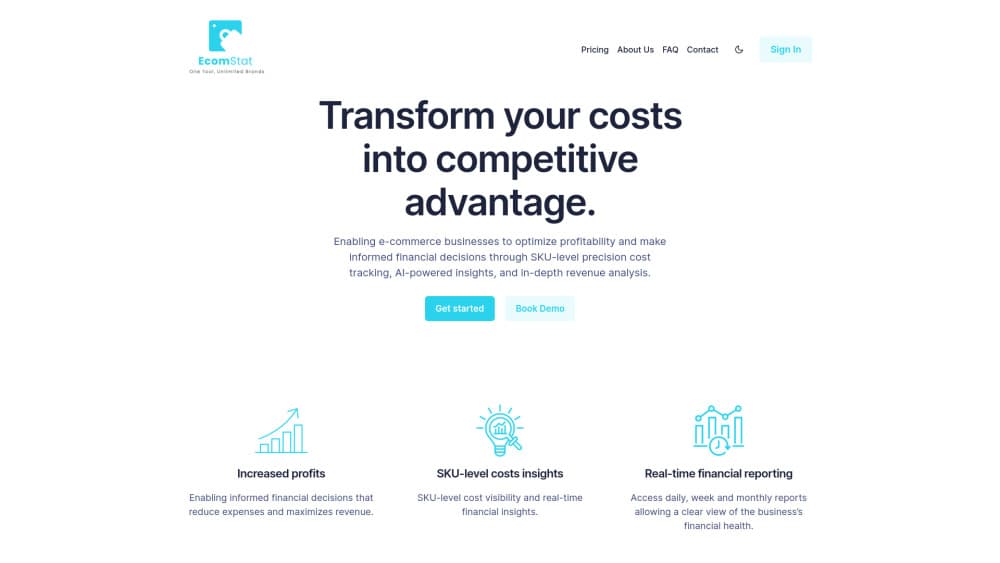
EcomStat is a real-time e-commerce analytics platform that tracks SKU costs, margins and customer behavior for online sellers.
About EcomStat
What Is EcomStat
EcomStat is a data-driven analytics platform built for online store owners who want to know exactly where their money goes. It pulls sales, expenses and marketing data into one live dashboard, so you can see storewide profit without stitching together spreadsheets by hand. It was made by e-commerce owners for e-commerce owners, which shows in how blunt the reporting is.
Treat it as profit tracking software, not just another traffic tool. The core of the tool is SKU-level cost visibility. Instead of guessing at blended margins, you enter what each product actually costs you and EcomStat returns the true margin per item, updated as sales come in. The vendor advertises that sellers who act on this picture can multiply profits by trimming the wrong expenses and doubling down on what works. Treat that number as a pitch, not a promise.
Two limits are worth knowing before you commit. EcomStat leans on Shopify to sync store data, so it's aimed at Shopify sellers rather than a universal tool for every cart. And any cost-based report is only as good as the numbers you feed it. If your purchase costs are stale, your margins will be too.
So keep them fresh.
Getting Started
- Connect your Shopify store so EcomStat can sync sales, expenses and channel data in real time.
- Import your product costs and categorize business expenses into the predefined buckets.
- Link your sales and marketing channels to pull ad spend and performance into the same view.
- Open the profit dashboard to check product-level margins, customer trends and overall performance.
- Adjust pricing and spending based on what the reports show, then re-check weekly.
Product Information
A quick look at EcomStat's pricing, supported platforms, and performance.
Best for
The users, tasks, and scenarios where this tool fits best.
Users
- Shopify store owners
- Small e-commerce teams
- Dropshippers and DTC sellers
Tasks
- Tracking SKU costs and margins
- Categorizing business expenses
- Measuring marketing impact
- Reading customer behavior
Scenarios
- Monthly profit review
- Pricing decisions
- Ad spend triage
- Scaling a product line
Key features
SKU-Level Cost and Margin Tracking
EcomStat lets you store what each product costs you and then reports the real margin per SKU, not a blended average. That matters because two products with the same price can have wildly different profit once shipping, fees and ad spend are counted. Product margin reporting at this level is rare in cheap tools. If you've ever been surprised by a slow-selling item that turned out to be your best earner, this is the view that fixes it.
Real-Time Sales and Expense Reporting
Sales and expenses sync in real time, so the dashboard reflects what's happening now rather than last week. You connect your sales and marketing channels once and EcomStat keeps them updated, which means you stop waiting on month-end reports and can react to a bad week while there's still time to fix it. The catch? Bad cost data flows straight into bad reports.
Expense Categorization
The platform sorts business costs into predefined categories, turning a messy pile of transactions into something you can actually reason about. You can see at a glance where the money goes: too much on ads, not enough on shipping, or a stack of overlapping tools nobody uses. It's a small feature. It still saves real time if you've been doing this by hand in a spreadsheet with color-coded tabs and a formula you're scared to touch.
Customer Behavior Insights
EcomStat reports on customer behavior, including repeat customer rate and order rate, so you can tell whether buyers come back or vanish after one purchase. That feeds directly into decisions about retention versus acquisition spend. Sellers who only watch revenue miss this. Watching repeat rate tells you if the business is actually healthy.
Multi-Channel Integration
You can connect your sales and marketing channels for a unified view of store performance. Instead of logging into Shopify, your ad platforms and a spreadsheet, you see one picture. The value here is less about any single number and more about seeing how marketing spend and sales interact in the same place.
Profit-Focused Dashboard
The whole product is organized around profit, not vanity metrics. It groups costs, sales and margins into one real-time view built for owners who care about the bottom line. Want a marketing dashboard full of traffic charts? Look elsewhere. Want to know if the business actually made money? This answers that question faster than any spreadsheet.
Pros and cons
Pros
- Reports true product-level margins instead of blended revenue figures, so a low-volume item that quietly carries the store stops hiding behind a headline sales number.
- Syncs store and channel data in real time, cutting manual spreadsheet work.
- Categorizes expenses automatically, so cost leaks are easier to spot.
- Surfaces customer behavior like repeat customer rate and order rate.
- Rated 5/5 on Shopify, which suggests a small but satisfied user base.
Cons
- Tied to Shopify for store sync, so it's a poor fit for sellers on other carts.
- Margin reports depend entirely on you keeping purchase costs accurate.
- Pricing sits in the paid range, with no advertised free tier for testing first.
- Public detail on its API and integrations is thin, so verify your channels before committing.
Frequently asked questions
It tracks SKU-level costs, margins and customer behavior for online stores and shows them in a real-time profit dashboard. Think of it as a finance layer on top of your store, not another traffic analytics tool.
Related content
Explore related tools, skills, and articles for EcomStat.
EcomStat Alternatives

Base Code
Base44 (Wix) · Coding · ProductivityBase Code is a shared cloud development environment from Base44. Teammates describe changes to an existing GitHub codebase in chat, preview them live and send them back as pull requests.

Knocket
Knocket (Tencent RTC team) · Productivity · Business · ChatbotKnocket is a free live chat and contact page tool that lets visitors message you from your website, app, or a shareable link, with every reply handled from Telegram or one inbox.

FloorGen
Vinit Kumar (FloorGen) · Productivity · China AIFloorGen is a browser-based floor plan maker that turns a sentence or a sketch into an editable 2D plan and a 3D walkthrough. Export to PDF, DXF or video, and draw without an account.