

ego: AI-native 3D simulation engine
ego (Ego AI, Y Combinator W24) · Image · Coding
ego is an AI-native 3D simulation engine that turns plain language into animated characters, living worlds, and scripted games. The engine is no longer open to new users.
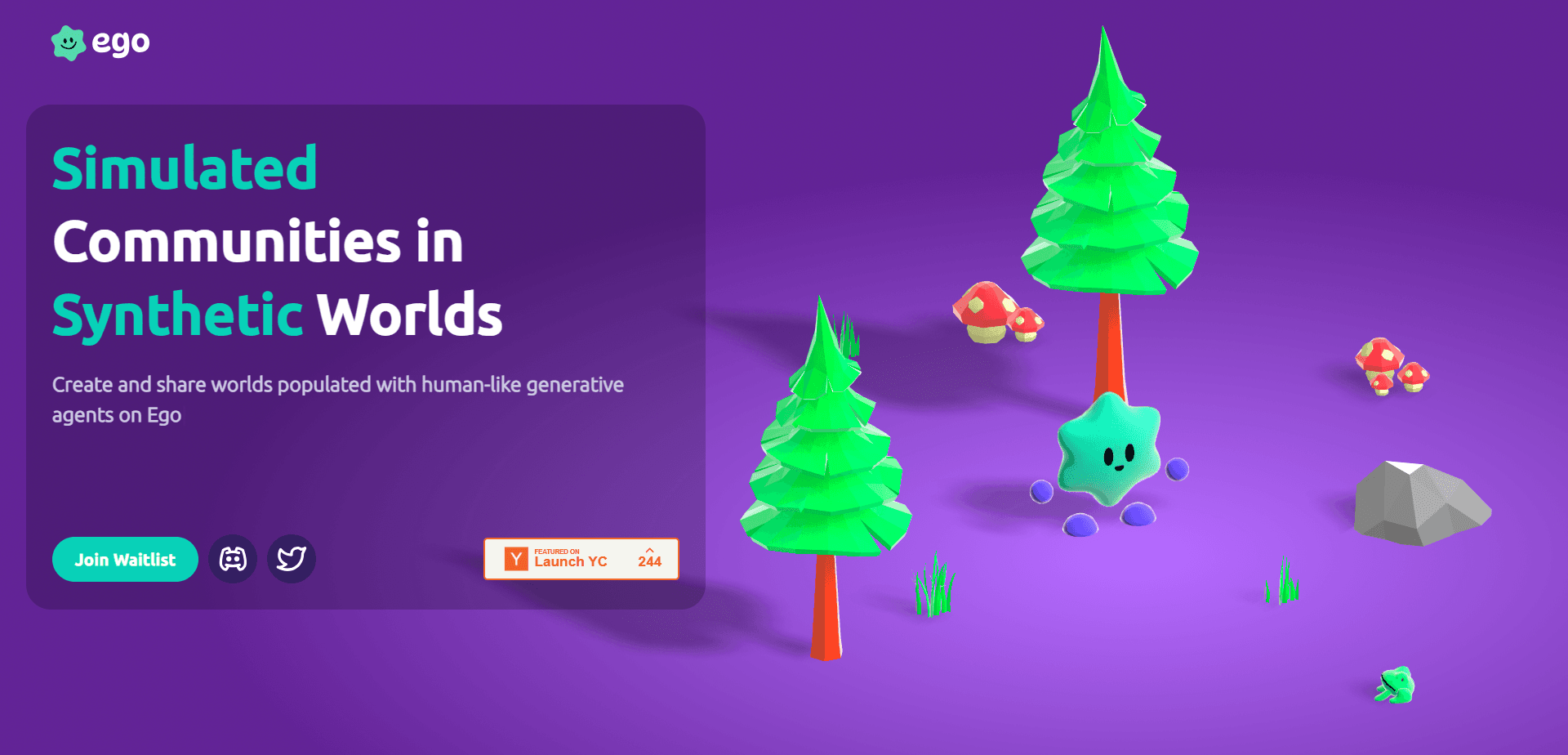
About ego: AI-native 3D simulation engine
What Is ego
ego is a simulation engine and hosting platform built by a small San Francisco team in the Y Combinator W24 batch. You describe a character, a place, or an interaction in ordinary words, and the engine builds it as a running 3D scene you can walk into and share. The people behind it came from Meta's AI applied research and Horizon scripting teams, so the pitch leaned on real engine work rather than a chat window with a 3D filter on top.
The problem it went after is an old one for game makers. Scripting interactions between characters, assets, and an environment takes code, and convincing NPC behavior takes even more. Large language models and diffusion models changed both halves, so the team set out to build a natural language game engine where prompting a scene replaces writing Lua or modeling props by hand.
Now the limits. The company has moved on. ego.live redirects to egoai.com, a voice agent research lab, and the team's current project is a voice agent called yōkai. There's no public pricing page, no API documentation, and no signup form for the 3D engine. What follows describes what ego was built to do, plus what's still verifiable today.
Getting Started
- Signing up used to mean joining the waitlist at ego.live and the company Discord, since the platform never opened general registration.
- Once you had access, you described a scene in a prompt: a town square, a shop, a group of characters with names and habits.
- The engine generated the world, the character bodies, and the behavior layer, including personalities, conversations, memories, and routines.
- You ran the scene in the browser, watched what the characters did on their own, then shared a link so other people could drop in.
- Sharing and remixing was the point of the platform, which is why the two demo games, TownWorld and CharacterIdol, were published as playable links rather than downloads.
Product Information
A quick look at ego: AI-native 3D simulation engine's pricing, supported platforms, and performance.
Best for
The users, tasks, and scenarios where this tool fits best.
Users
- Writers and worldbuilders who have a setting in their head and no 3D skills
- Hobbyist game designers curious about AI NPCs
- Researchers and students studying generative agents
Tasks
- Turning a written scene into a walkable space
- Testing how AI characters behave over time
- Prototyping an interaction before committing to an engine
Scenarios
- Pitching a game idea to someone who can't read a design doc
- Classroom demos of agent behavior
- Late-night experiments with a premise you'd never build in a real engine
Key features
Prompt To Playable World
The core loop starts with text. You describe a location, a mood, and who lives there, and the engine returns a 3D scene you can move around in. No asset library browsing, no terrain sculpting, no placement pass. For a first draft of an idea, that removes the slowest part of the work.
Characters With Memory And Routine
These aren't dialogue trees with canned lines. Each character gets a personality, a set of memories, and a daily pattern, and those keep shaping what they say and where they go. The team described personalities, conversations, memories, and routines as fully generated by AI in both demo games. The result is behavior that drifts in believable ways instead of resetting every time you look away.
Scripted Interactions Without Code
Interactions between characters and the environment were authoring targets, not just window dressing. You could describe a sequence of events and let the engine hold the logic, which is the part that normally means writing Lua or wiring a visual scripting graph. This is where a natural language game engine earns the name.
Shareable, Browser-Based Scenes
Everything ran in the browser and lived behind a link. That choice matters more than it sounds: a scene you can send to a friend gets played, and a build you have to download usually doesn't. Sharing was treated as a first-class feature rather than an export button.
Built On Language And Diffusion Models
ego combined LLMs for behavior and conversation with diffusion models for imagery. That pairing is what made a text to 3D world pipeline possible in 2024: language models handle intent and character logic, diffusion handles what things look like. The team framed the engine as the base layer for a much larger set of generated experiences.
Shipped Proof: TownWorld And CharacterIdol
Two experimental games ran on the engine during the accelerator. TownWorld recreated the Stanford generative agents setup as a 3D town. CharacterIdol put user-prompted agents in a talent contest judged by AI. Both were public and both used the same simulation layer, which is the strongest evidence the engine did more than produce pretty stills.
Pros and cons
Pros
- Authoring in plain language skips modeling, rigging, and scripting, which is the barrier that keeps most ideas off a 3D engine.
- Generative agents with memory and routines produce behavior that holds up over a session, not just in a demo clip.
- Browser delivery and link sharing made finished scenes easy to hand to other people.
- Two public games proved the engine worked end to end, including the character layer.
Cons
- Signups are closed and ego.live now redirects to egoai.com, so you can't test the 3D product today. That means any evaluation stays secondhand.
- No pricing was ever published, so there's no way to budget for it or compare it against Unity, Roblox, or a hosted agent platform.
- No public API and no live documentation, which rules out building on top of the ego AI platform even if access reopened.
- Worlds lived inside ego. No export path to Unity or Unreal was offered, so the work stayed with the platform and left when the platform did.
Frequently asked questions
ego is an AI-native 3D simulation engine from a YC-backed San Francisco team. You describe characters, worlds, and interactions in natural language, and the engine generates a playable 3D scene with AI-driven characters inside it.
Related content
Explore related tools, skills, and articles for ego: AI-native 3D simulation engine.
ego: AI-native 3D simulation engine Alternatives

Google EmbeddingGemma 2
Google DeepMind · Writing · Image · CodingGoogle EmbeddingGemma 2 is a 740M-parameter open model that turns text, code, images, audio, and video frames into vectors in one 768-dimension space, running on phones and laptops.

Tractionwave
TractionWave · Image · MarketingTractionWave is an AI attention heatmap tool for static ads. Upload a PNG or JPG and it returns predicted attention, ranked hotspots, and fixes before you spend budget.

Imejis.io
Imejis.io · Image · MarketingImejis.io is an AI design studio for agents and marketing teams. Describe an image in plain words, and it writes the copy, builds the layout, reflows it to every size, then exports a finished file.