

Elements of AI
MinnaLearn and the University of Helsinki · Leaning
Elements of AI is a free online course from the University of Helsinki and MinnaLearn. Six text-based chapters explain what AI is, how it works, and where it fails, with no math required.
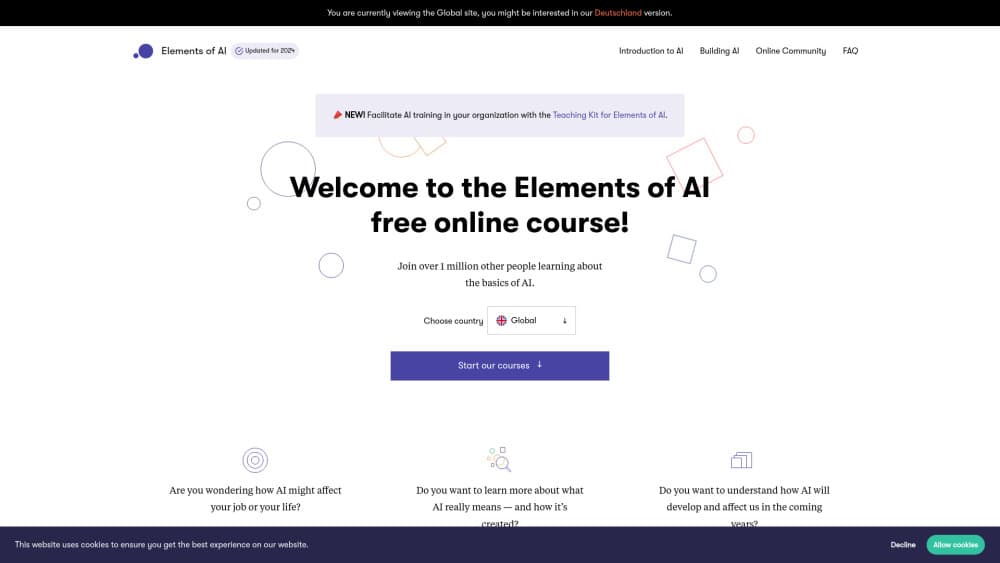
About Elements of AI
What Is Elements of AI
Elements of AI is a free online course that teaches the basics of artificial intelligence to people who don't plan to become engineers. MinnaLearn and the University of Helsinki built it in 2018, after Finland set a goal of training one percent of its population in AI fundamentals. More than 2 million people from over 170 countries have signed up since.
The course answers a narrow set of questions well. What counts as AI, how search and probability drive it, where machine learning fits, and what should worry you when it shows up in hiring or health care. Each chapter closes with exercises, and most of them ask you to apply a concept instead of recalling a definition.
Know the limits before you start. This is an introduction, not a route into an AI job. Part 1 has no coding projects, no tutor feedback, and nothing about training large models. It works as an AI literacy course for people who need context, not a career switch. The follow-up course, Building AI, covers the algorithms, but it assumes you can already write basic Python.
Getting Started
- Go to elementsofai.com and pick your country and language from the list.
- Create an account with an email address. You need it to save progress and claim the certificate.
- Work through the six chapters in order. Most people spend around 5 hours on each one.
- Finish the exercises, download your certificate, and if you want academic credits, enroll through the University of Helsinki Open University.
Product Information
A quick look at Elements of AI's pricing, supported platforms, and performance.
Best for
The users, tasks, and scenarios where this tool fits best.
Users
- Career changers who want an AI course for beginners and want a straight answer on what it actually does
- Students picking a major or a first job
- Managers, HR staff, and policy people who need the vocabulary to read an AI vendor proposal without nodding along
- Teachers and trainers building a unit on AI
Tasks
- Getting a shared vocabulary across a team before an AI rollout
- Preparing for a data or computer science course
- Checking the claims in news stories and product pitches
Scenarios
- A company wants baseline AI training without a per-seat license
- You're between jobs and have a few evenings a week
- A school or library runs an adult education evening
Key features
Six Text-Based Chapters
The Introduction to AI course is split into six chapters: what AI is, solving problems with AI, real world AI, machine learning, neural networks, and the implications of AI. Every chapter is written in plain prose with short examples, not video lectures, so you can read at your own speed and go back to a paragraph that didn't land the first time. There's no complicated math and no programming.
Exercises With Instant Feedback
Each chapter ends with a set of exercises, and the course checks your answers as you go. Most questions are applied: you're asked which search strategy fits a problem, or why a neural network gets one case right and another wrong. Model answers appear after you submit, which is where a lot of the learning happens.
A Certificate You Can Share
Complete the exercises and you get a certificate of completion that you can add to a LinkedIn profile or attach to a job application. It states that you finished the course, nothing more. For a free course, that's a fair trade: it proves you put in the hours, and it won't be mistaken for a degree.
2 ECTS Credits Through the Open University
Learners who want academic recognition can enroll through the University of Helsinki Open University and have 2 ECTS credits recorded in the university's student register. Studying stays free. The catch is administrative: you enroll separately after finishing the assignments, and the credits are processed in a few days.
Building AI for the Algorithm Side
Building AI is the second course in the series and picks up where the introduction stops. It walks through the algorithms behind search, probabilistic models, and machine learning, and asks you to write small programs. Basic Python skills are recommended before you start. If you only want to understand AI as a user, Part 1 is enough.
Dozens of Languages, One Curriculum
The course has been translated into all official EU languages and several others, including German, French, Spanish, Portuguese, Japanese, and Korean. The chapters, exercises, and certificate follow the same structure in each language, so a team spread across countries can take the same course. A country selector on the homepage routes you to the right version.
Pros and cons
Pros
- Free from start to finish, with no upsell inside the lessons and no credit card at signup.
- No math or programming required for the introduction, which is rare among AI courses aimed at beginners.
- Text-based chapters load fast on a phone or a slow connection, and you can reread a section without scrubbing a video.
- Backed by a major university and a learning company with a public track record, so the content isn't anonymous blog material.
- Clear stopping point: six chapters and you're done, which makes it easy to finish instead of abandoning a 40-hour program.
Cons
- The material is static, so examples lag behind the current generation of AI products. You won't find much on agents or the model releases of the past year.
- No tutor, no cohort, and no discussion forum. If you get stuck on a concept, the course itself won't help you past it.
- The certificate carries little weight with employers outside Finland. It signals interest, not competence.
- Part 1 stays conceptual. You finish with a clear picture of how machine learning works, but you can't build or fine-tune anything.
Frequently asked questions
Yes. The course, the exercises, and the certificate cost nothing, and there's no paid tier inside the course. The University of Helsinki states that study is free of charge for all participants, and that covers the 2 ECTS credit option too.
Related content
Explore related tools, skills, and articles for Elements of AI.
Elements of AI Alternatives

HireKey
HireKey · Voice & Language · Productivity · LeaningHireKey is an AI job search copilot built by a former tech recruiter. It checks role fit, tailors resumes, runs interview practice and tracks every application.

Lune
Retrograde Labs · Productivity · LeaningLune is a research search engine for scientific AI agents. It runs as an MCP server that lets Claude, ChatGPT and Cursor search peer-reviewed computer science papers and cite them.
Coddy
Coddy · Coding · LeaningCoddy is a gamified platform to learn to code through short interactive lessons in 20+ languages, with a browser editor, an AI tutor and free certificates.