
Elium
Elium · Productivity · Leaning
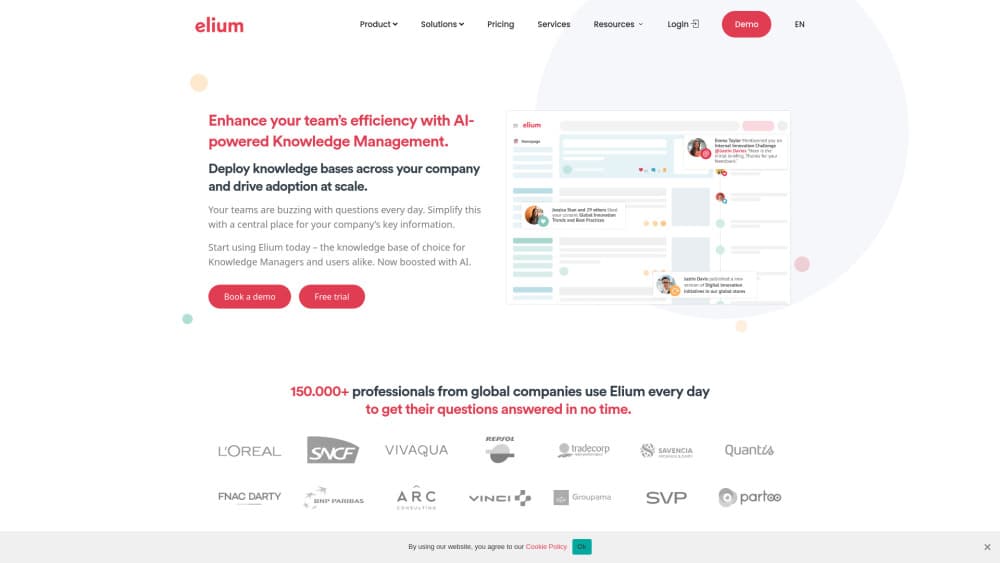
Elium is a European knowledge management platform that keeps company know-how owned and current, then serves it to teams and AI agents as cited, permission-aware answers.
About Elium
What Is Elium
Elium is knowledge management software from Belgium, built for companies that need one reliable place for procedures, policies and internal know-how. It has been independent since 2008 and now runs inside more than 1,200 teams, with L'Oréal, BNP Paribas, VINCI Energies and the Council of Europe among its customers.
The problem it targets is familiar. Documentation lives in shared drives, a wiki nobody trusts and a dozen chat threads. When a support agent or an AI assistant answers from that mess, the answer sounds confident and is often wrong. Elium puts an owner and an expiry date on every article, flags content that has gone stale, and points AI answers back to the validated source.
Its limits matter before you sign. There's no free plan, only a trial, and plans start at ten users billed per seat. Full API access sits on the Enterprise tier, and the deeper governance features such as approval workflows and duplicate detection come with Corporate. Teams of three or four will find it priced and packaged for larger organisations.
Getting Started
- Book a demo or a free trial and pick the plan that matches the size of your team.
- Connect the systems you already use, such as SharePoint, Google Drive or Confluence, or import existing pages as Markdown.
- Assign an owner and a review date to each article, then set the spaces each group can see.
- Turn on AI search and answers so people get the top result with its source attached.
- Roll out to more teams, and on Corporate or Enterprise connect ChatGPT, Claude or your own agents through MCP.
Product Information
A quick look at Elium's pricing, supported platforms, and performance.
Best for
The users, tasks, and scenarios where this tool fits best.
Users
- Knowledge and documentation managers
- Customer service leads
- IT support teams
Tasks
- Writing standard operating procedures for several sites
- Deflecting repetitive support questions
- Onboarding new staff
- Grounding an internal AI assistant
Scenarios
- A manufacturer with plants in several countries needs the same safety procedure in four languages, each version validated by a local owner.
- A regulated bank or insurer needs EU hosting, an audit trail and a record of which policy version an answer came from.
- A company rolling out AI assistants wants to stop hallucinated policy answers before the pilot reaches customers.
Key features
Governed Knowledge With Owners and Expiry Dates
Every article carries an owner and a validity date. When a page passes its date or a gap appears, Elium flags it and routes the fix to the person responsible. Nothing silently rots in a corner, which is the usual failure mode of a shared drive.
AI Answers With Citations
Elium AI reads your verified content and returns an answer with the sources it used. You can trace any claim back to the article behind it, so a wrong answer points to a wrong document rather than an unexplainable model. Answers are unlimited on every plan, with no credit system.
One Permission Model for People and Agents
Access rules are set once and apply to staff and to the AI assistants they use. An assistant can only answer from content the person asking is allowed to see, which keeps HR files and pricing sheets out of general search results. Single sign-on and SCIM provisioning arrive with Corporate and Enterprise.
Connectors, API and MCP
Native connectors pull content from SharePoint, Google Drive, Confluence and OneDrive, and Elium surfaces inside Teams, Slack and service desks. An open API and MCP support everything else, so developers can build an internal app or let their own AI agent query the knowledge base. Full API access is an Enterprise feature.
Decision Trees and Multilingual Content
Procedures can be published as decision trees, which walk a reader through branches instead of a wall of text. The editor handles multiple languages and can translate content automatically, so a policy written once in French still reaches a team in Poland.
Analytics Across Content, Search and AI
One dashboard reports on content engagement, search behaviour and AI usage, broken down by space and team. You can see which questions get answered, which ones miss, and which articles nobody opens. Reports export to your existing BI tool.
Pros and cons
Pros
- Ownership and expiry dates make stale documentation visible instead of invisible.
- AI answers cite their sources, which turns a trust problem into a review task.
- European hosting, ISO 27001 and a no-training guarantee on customer content suit compliance-heavy buyers.
- Unlimited AI answers without usage credits keeps budgeting predictable.
- Native connectors and MCP mean the platform fits around existing tools rather than replacing them.
Cons
- No free plan. A ten-user minimum and per-seat pricing put it out of reach for small teams.
- Approval workflows, gap detection and SSO all sit above the entry plan, so the cheap tier is thinner than the feature page suggests.
- Setup is sales-led, with implementation packs quoted at 8 to 16 weeks. Expect a project, not an afternoon.
- Full API access requires Enterprise, which limits custom integrations for mid-sized customers.
Frequently asked questions
It stores company procedures, policies and know-how in one governed place, keeps them verified, and lets people and AI assistants search that content for answers. The difference from a plain wiki is that every article has an owner and a review date.
Related content
Explore related tools, skills, and articles for Elium.
Elium Alternatives

Base Code
Base44 (Wix) · Coding · ProductivityBase Code is a shared cloud development environment from Base44. Teammates describe changes to an existing GitHub codebase in chat, preview them live and send them back as pull requests.

Knocket
Knocket (Tencent RTC team) · Productivity · Business · ChatbotKnocket is a free live chat and contact page tool that lets visitors message you from your website, app, or a shareable link, with every reply handled from Telegram or one inbox.

FloorGen
Vinit Kumar (FloorGen) · Productivity · China AIFloorGen is a browser-based floor plan maker that turns a sentence or a sketch into an editable 2D plan and a 3D walkthrough. Export to PDF, DXF or video, and draw without an account.