

Erayaha.AI
Erayaha · Productivity
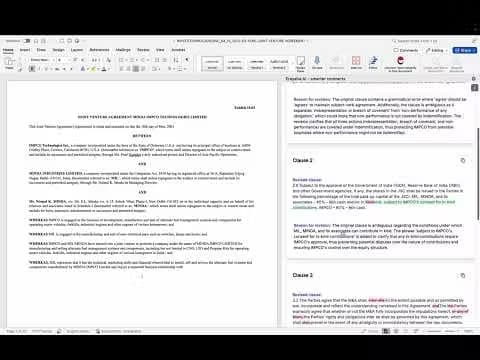
Erayaha.AI is an AI contract review tool that runs in Word and Google Docs, reading an agreement in about 90 seconds and flagging risky clauses with exact citations.
About Erayaha.AI
What Is Erayaha.AI
Erayaha.AI is a contract review tool that plugs into Microsoft Word and Google Docs. You open a draft agreement in the editor you already use, run a review, and it returns a marked-up document that calls out the clauses worth a second look. The company describes the engine as a structured reasoning compiler rather than a plain language model, meaning it maps clauses into a logic graph and tests them for structural problems instead of just predicting likely text.
The problem it targets is review time. Lawyers, in-house counsel, and fractional general counsels read the same boilerplate terms over and over, and the expensive mistakes hide in plain sight. As contract analysis software, Erayaha.AI looks for the familiar traps, like auto-renewal windows, price escalators, uncapped liability, and circular obligations, then attaches the clause it drew from so you can check the call yourself. Those clause citations are what separate a usable finding from a vague warning. The vendor cites a $300,000 contract that carried more than $43,000 a year in risk exposure as the kind of issue it's built to surface.
Limits are worth knowing before you trust it. Erayaha.AI is a review aid, not legal advice, so a qualified person still owns the final judgment. It works on text you can put into Word or Google Docs, which rules out purely scanned or image-only files unless they're converted first. The publisher also markets it toward several document types beyond contracts, so results depend on how close your document is to the formats it's tuned for.
Getting Started
- Go to erayaha.ai and create an account, then connect the add-in to Microsoft Word or Google Docs.
- Open the contract you want reviewed in that editor.
- Start a review and let the tool read the document, which the company says takes about 90 seconds.
- Read the flagged risk cards, each tied to the clause it came from, and check the suggested fallback language.
- Apply the inline replacements you agree with, or export the findings to share with your team.
Product Information
A quick look at Erayaha.AI's pricing, supported platforms, and performance.
Best for
The users, tasks, and scenarios where this tool fits best.
Users
- Law firms
- In-house legal teams
- Fractional general counsels
- Procurement and vendor management teams
Tasks
- Spotting auto-renewal traps
- Catching price escalators
- Finding hidden liability
- Getting a first-pass redline
- Checking a stack of vendor agreements
Scenarios
- A small business signs a supplier contract without full-time counsel
- An in-house team clears a backlog of standard NDAs and service agreements
- A consultant reviews a client's vendor paper on short notice
- A sales operations lead checks whether a template protects the company
Key features
In-Editor Contract Review
Erayaha.AI runs inside Microsoft Word and Google Docs, so review happens where the document already lives. You don't export to a separate platform or paste text into a web form. That keeps the workflow familiar and lowers the training cost for teams that live in those editors.
Fast Document Reading
The company says a review takes about 90 seconds per contract. That speed is the pitch: instead of booking a review slot, you get flagged issues while you're still working on the draft. It's the difference between a review that fits into a task and one that becomes its own project.
Clause-Linked Risk Flags
Every flagged issue comes with a citation to the exact clause it came from. You can jump to the wording and judge the call yourself instead of trusting a black box. Reliable clause citations and a steady grip on contract risk detection are what make an AI review usable in a legal setting, where the reasoning matters as much as the answer.
Structured Reasoning Engine
The vendor describes its engine as a reasoning compiler that maps clauses, dependencies, and thresholds into a logic graph and tests them for structural faults. The aim is to catch problems like circular obligations, indemnification loops, and missing caps that a simple text model can miss. Treat the claim as the company's, and check it against your own documents.
Redline and Fallback Suggestions
The playbook analysis tool evaluates clauses against a company's risk policies and proposes fallback language and redlines. You get a starting point for the markup rather than a blank page. Reviewers still decide what to accept, but the first draft is faster to produce.
Connected-Storage Security
The company says it ties into OneDrive, Google Drive, and SharePoint and keeps zero data retention on its own servers. For legal teams, where client confidentiality is the main blocker, that claim is the one to verify during a trial. Ask for the details in writing before uploading sensitive agreements.
Built for Legal Teams
Erayaha.AI sits in the legal tech category, aimed at the people who read contracts for a living rather than general knowledge workers. That focus shows in the output: risk cards, fallback language, and citations written for a reviewer, not a chatbot transcript. It's the difference between a general writing assistant and a tool built around contract risk detection.
API and MCP Access
Erayaha.AI publishes a REST API with endpoints for scanning contracts, analyzing clause playbooks, calculating ROI, and batch scanning, plus a Streamable HTTP MCP server for agent clients. That opens the review engine to automation and internal tools, not just manual editing. A sandbox key lets developers test before committing.
Pros and cons
Pros
- Runs in Word and Google Docs, so review happens in the editor teams already use.
- About 90 seconds per contract makes a first pass cheap enough to do routinely.
- Every flag cites the clause it came from, so findings are checkable rather than a black box.
- Batch scanning handles several contracts in one pass, which suits vendor agreement stacks.
- A published REST API and MCP server let teams automate review inside their own tools.
Cons
- It's a review aid, not legal advice, so a qualified person still has to own the final call.
- It needs text that goes into Word or Google Docs, so image-only or scanned agreements must be converted first.
- The vendor's performance figures come from the vendor, so teams should test them against their own contracts.
- Pricing is quoted by review sessions per month, which can be harder to budget than a flat seat fee.
- The engine is tuned for specific document types, so results vary with how close your paper is to those formats.
Frequently asked questions
Erayaha.AI is an AI contract review tool that runs inside Microsoft Word and Google Docs. It reads an agreement in about 90 seconds and flags risky clauses, each tied to the clause it came from.
Related content
Explore related tools, skills, and articles for Erayaha.AI.
Erayaha.AI Alternatives

Base Code
Base44 (Wix) · Coding · ProductivityBase Code is a shared cloud development environment from Base44. Teammates describe changes to an existing GitHub codebase in chat, preview them live and send them back as pull requests.
Knocket
Knocket (Tencent RTC team) · Productivity · Business · ChatbotKnocket is a free live chat and contact page tool that lets visitors message you from your website, app, or a shareable link, with every reply handled from Telegram or one inbox.

FloorGen
Vinit Kumar (FloorGen) · Productivity · China AIFloorGen is a browser-based floor plan maker that turns a sentence or a sketch into an editable 2D plan and a 3D walkthrough. Export to PDF, DXF or video, and draw without an account.