

Extruct AI
Extruct AI · Business
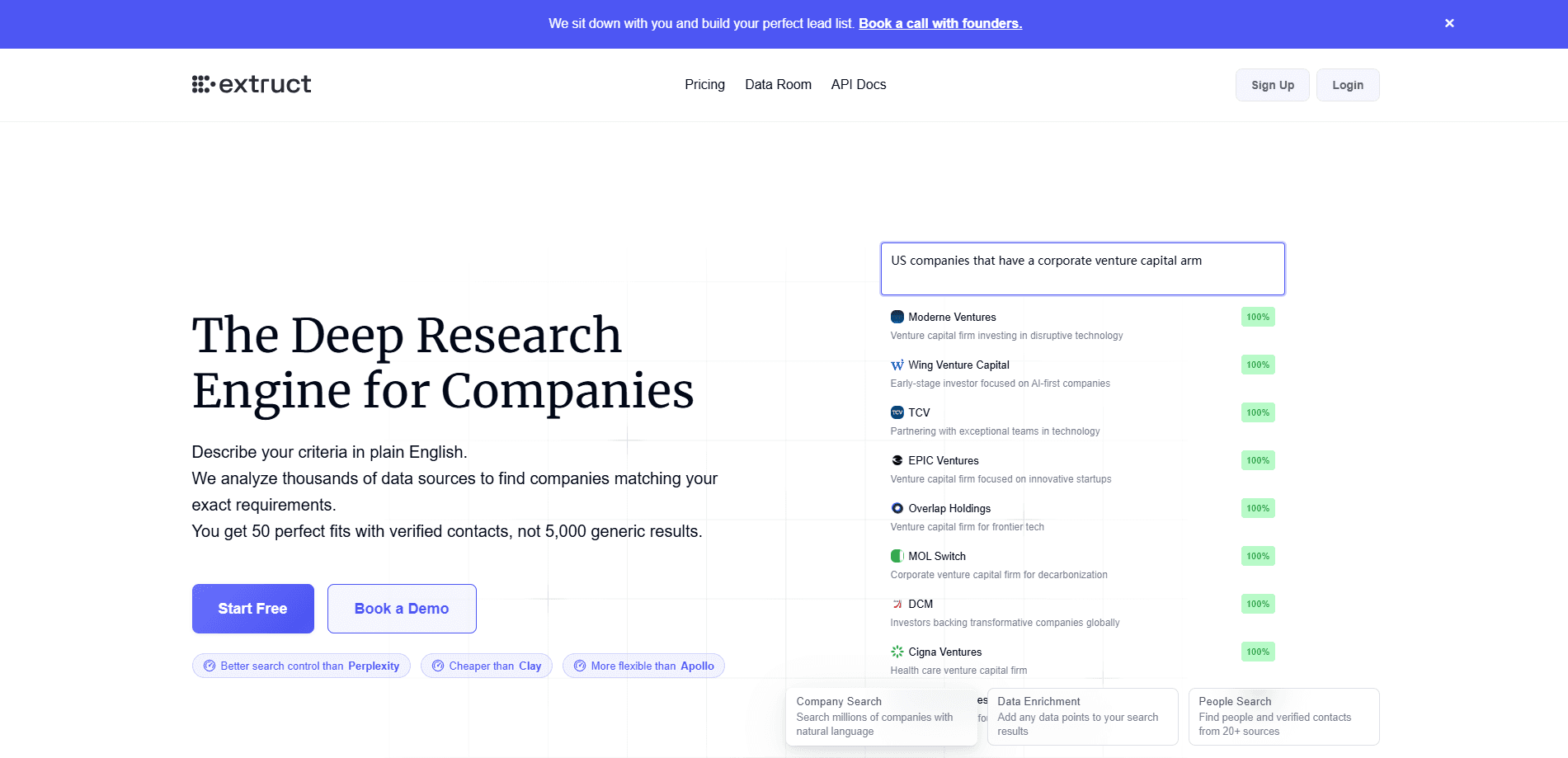
Extruct AI is a company research platform built for teams that need to find and vet companies at scale. It searches a curated index of roughly 10 million companies, or the live web when you need it, and returns each result with its source attached. Sales, market research, and investment teams use it to turn a plain-English brief into a researched list of matching companies. That last part matters. Sourced answers mean you can check a fact before you bet a quarter on it. No guessing.
About Extruct AI
What Is Extruct AI
Extruct AI is a company research API and search tool that answers questions about companies instead of just returning links. You describe what you want in normal language, and it builds a candidate list, researches each company against your criteria, and shows where every fact came from. The core idea is that companies beat URLs as a unit of search: results are structured firms with products, audience, use cases, and traffic already indexed, not raw pages you have to read yourself.
The platform runs on a shared credit pool across three retrieval paths. Semantic search finds companies from a plain-English prompt, lookalike search finds firms similar to a target company, and deep search checks multiple criteria and returns fewer but higher-fit matches. A Chrome extension and API access ship on every plan, including the free one.
The main limitation is scope. Extruct is a research and sourcing tool, not a CRM or a full sales engagement suite. It doesn't send outreach, manage deals, or replace your pipeline; the results are meant to be pushed into the tools your team already runs day to day. The free and paid tiers both support that handoff, and neither automates it end to end. Pricing scales by monthly credits, so heavy users on the free plan hit the 25-credit ceiling fast.
Getting Started
- Create a free account at app.extruct.ai to get 25 monthly credits and API access.
- Write your search in plain English, for example commercial HVAC contractors in Florida with 50+ employees and BIM capability.
- Run a semantic, lookalike, or deep search and review the sourced results.
- Add the Chrome extension or connect through the API if you want to pull results into your own workflow.
- Export or share your tables, and upgrade to Starter or Pro when you need more volume or features like email lookups.
Product Information
A quick look at Extruct AI's pricing, supported platforms, and performance.
Best for
The users, tasks, and scenarios where this tool fits best.
Users
- Sales teams
- Market researchers
- Investors
Tasks
- Building a prospect list
- Finding lookalikes
- Checking company facts
Scenarios
- Early-stage market mapping
- CRM enrichment
- Thesis and report prep
Key features
Semantic Company Search
You type a brief in normal language and Extruct returns companies, not pages. It reads your prompt as criteria and matches them against the structured index, which is built from what each firm does rather than from keyword overlap on a landing page. That means a sentence like "hospitals and schools, 50+ employees, recent $5M project" becomes a working query without query syntax. No operators to learn. Good news for anyone who hates query syntax.
Lookalike Search
Point the tool at one company and it finds others that are similar across products, audience, and use cases. It's the fastest way to expand a shortlist when you already have one good example and want a dozen more like it. Feed it a firm you'd love to close and see who else fits. That's the classic use case.
Deep Search
Deep search checks several criteria at once and returns fewer, higher-fit matches. On the Pro plan it handles up to 1,000 matches per run. If your first pass returns hundreds of loose results, this is the filter that tightens them into a working list. Not ideal for a quick glance, but great when precision beats volume.
The 10M Company Index
Search draws on a curated index of around 10 million companies, each indexed by what it does rather than just its URL. Products, audience, use cases, social presence, and traffic are part of the record, so results arrive pre-described instead of blank. The index is the reason a natural-language prompt works at all. No index, no magic.
Live Web Research
When a company isn't in the index, Extruct can research the live web against your criteria. This matters for newer or niche firms that bigger databases miss. Every answer comes back with its source so you can judge how much to trust it. That's the whole point of sourced research: you decide, not the tool.
API and Chrome Extension
API access and a Chrome extension are included on every plan, free included. That lets you run searches from your own stack or pull results while browsing, rather than staying inside the web app. Most teams start in the browser and graduate to the API once a workflow sticks.
Exports, Sharing, and AI Tables
Starter unlocks exports and shared tables and searches. Pro adds AI research tables that fill up to 2,000 cells and contact lookups for email and phone. These are the features that turn a search into something a team can actually use.
Pros and cons
Pros
- Sourced answers make it easy to verify a fact before you act on it.
- Free tier includes API access and the Chrome extension, so you can test the workflow before paying.
- Three search modes cover different jobs, from broad prompts to tight multi-criteria filters.
- The 10M-company index returns already-described firms, which cuts the manual reading.
- Credit pricing is published and shared across features, so costs are easy to predict.
Cons
- Credits reset monthly and don't roll over, so unused volume is lost.
- The free plan's 25 credits run out quickly, which limits real testing.
- It's a research tool, not a CRM, so you still need another system to run outreach.
- Contact lookups are locked to Pro and cost 4 to 20 credits each, which adds up fast if you're pulling phone numbers across a large batch of accounts.
Frequently asked questions
Extruct AI finds and researches companies from a curated 10 million-company index or the live web. You search in plain English, and it returns matched companies with the source behind each answer. Simple as that.
Related content
Explore related tools, skills, and articles for Extruct AI.
Extruct AI Alternatives
Liveplan
Palo Alto Software · BusinessLivePlan is business plan software that helps founders and small business owners turn an idea into a funder-ready plan. It combines AI-assisted writing, market research with cited sources, and connected financial forecasting so your income statement, cash flow, and balance sheet move together when you change one number. Over 1.5 million businesses have used it to plan, forecast, and track performance against real accounting data. That's a lot of founders. It's also a signal the tooling survived contact with real lenders.

Swms
Swms AI · Writing · Productivity · BusinessSwms is an AI safety compliance tool that turns a plain description of a job into ready-to-use safety documents. Describe your project, trade, and known hazards, and it writes a safe work method statement, job hazard analysis, safe work procedure, RAMS, or safety data sheet in seconds. It also ships with Oscar, a chat assistant that answers workplace safety questions in any language. Teams in construction, mining, transport, and warehousing use it to cut the paperwork that usually eats into a workday.

Rows
Rows (Superhuman) · Productivity · BusinessRows is an AI spreadsheet and data analysis tool that imports live data from more than 50 sources, then lets you work with it using plain language instead of SQL queries or nested formulas. You can pull numbers out of PDFs, connect ad platforms, databases, and bank accounts, and ask the AI to build reports, merge datasets, or set up models that recalculate themselves. It runs in the browser, works like a spreadsheet, and now sits under the Superhuman umbrella.