

Fewsats
Fewsats · Business
Fewsats gives AI agents a wallet and payment rails, so they can pay for APIs, data, and files through L402 paywalls under budgets and approval rules you control.
About Fewsats
What Is Fewsats
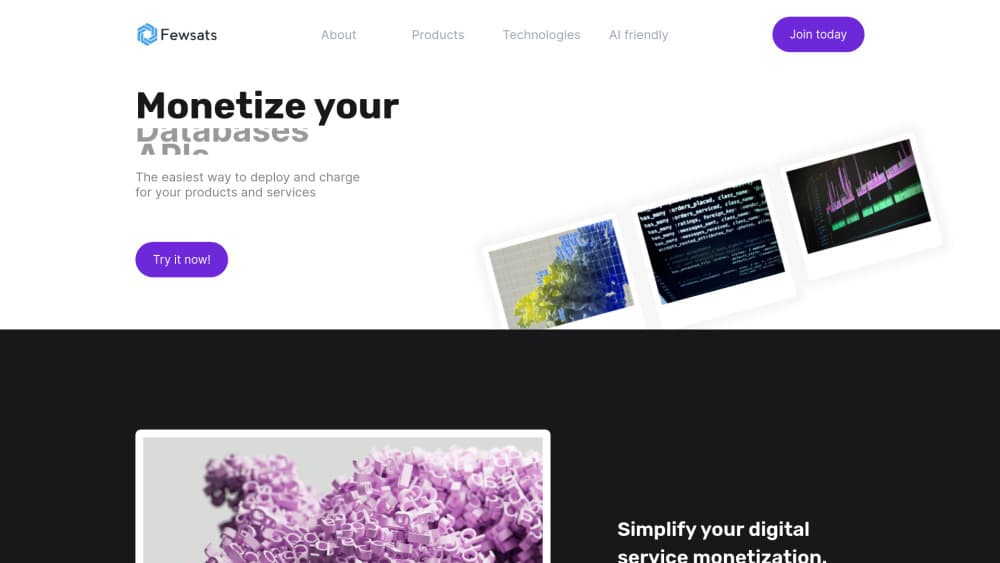
Fewsats is payment infrastructure for AI agents. The AI agent wallet gives an autonomous program a balance, a set of payment methods, and a way to settle HTTP 402 responses without a human opening a browser. The company started with the L402 protocol, which turns a paywall into a machine-readable offer, and built a hosted service around it. Its pitch sits at the point where agentic payments stop being a demo.
The problem it targets is simple. Agents can already find a paid API, read its terms, and decide the data is worth buying. What they can't do is hand over a card number safely. Fewsats sits between the agent and the money, so the model never touches raw card details and the account owner keeps a record of every purchase.
The limits matter too. Fewsats works where a seller has adopted L402 or where you use its own offers and storage endpoints. It is not a general checkout bot for arbitrary shopping sites. Pricing is not published on the site, and the balance sits with the provider, so teams that need a self-custody wallet should look elsewhere.
Getting Started
- Create an account at app.fewsats.com with an email and password.
- Generate an API key in the dashboard. Keys expire after 28 days by default, so plan for rotation.
- Add a payment method or fund the wallet balance, then set a budget and per-transaction limit for the agent.
- Install the Python SDK with
pip install fewsats, or connect the MCP server to a compatible client. - Let the agent call a paid endpoint. It reads the 402 offer, picks a payment method, pays, and retries the request with the returned credential.
Product Information
A quick look at Fewsats's pricing, supported platforms, and performance.
Best for
The users, tasks, and scenarios where this tool fits best.
Users
- Developers building autonomous agents
- API and dataset sellers
- Small product teams without a payments engineer
Tasks
- Paying for pay-per-use APIs
- Buying files and datasets behind a paywall
- Charging for your own endpoint
Scenarios
- A research agent that needs a paid corpus for one query
- A coding assistant topping up inference credits
- A marketplace selling per-call access
Key features
L402 Payments Without a Browser
Fewsats handles the full HTTP 402 exchange. When a server answers with a payment offer, the service reads the terms, pays through a supported rail, and retries the request with the credential the server expects. The agent sees a normal API call, not a checkout page. That is the core of the product, and everything else supports it.
Budgets and Transaction Limits
You set a spending ceiling for an agent, plus a cap on any single purchase. A loop that keeps hitting a paid endpoint stops at the limit instead of running up a bill overnight. Limits are the difference between a demo and something you leave running, and Fewsats treats them as a first-class control rather than a dashboard afterthought.
Approval Workflows and a Policy Engine
Not every purchase should be automatic. The policy engine lets you write rules for what an agent may buy, from whom, and up to what amount, and route anything outside those rules to a human for approval. Small, routine buys clear on their own. The expensive or unusual ones wait for a click.
Multiple Payment Rails
The wallet can pay with cards, stablecoins, Lightning, and low-fee ACH or wire transfers, depending on what the seller accepts. Stablecoins cover cross-border payments without a currency conversion step, and Lightning handles very small amounts where card fees would eat the whole transaction. One account, several rails.
Python SDK and CLI
The fewsats package exposes account details, balances, payment methods, offers, and direct Lightning payments. The CLI adds signup, API key management, and file upload with a price attached. Both wrap the same REST API, so a script and a production agent use the same primitives.
MCP Payments for Agent Clients
Fewsats ships an MCP integration, which lets a compatible assistant or IDE pay for a tool call inside the conversation. This is the shortest path from a chat client to a paid resource, and it avoids the usual dance of copying an invoice into a separate wallet app.
Selling Access, Not Just Buying It
The same platform works in reverse. You can upload a file with a price, create an offer for a service, and let Fewsats collect payment and hand out credentials. For small sellers, that removes the need to stand up subscriptions and a billing portal before the first sale.
Pros and cons
Pros
- Solves a narrow, real problem: an agent can pay for a paid API without ever holding card details, and the owner keeps a ledger.
- Budget caps and approval rules make autonomous spending tolerable, which is the blocker most teams hit first.
- The Python SDK, CLI, and MCP server cover scripts, backends, and chat clients with the same account.
- Support for cards, stablecoins, Lightning, and bank transfers means you are not locked into one payment rail.
- The seller side is included, so a team can meter its own endpoint without building billing from zero.
Cons
- Fewsats only helps where the other side speaks L402 or uses its offers. It can't pay a random checkout form that expects a human.
- There is no public price list, so you have to talk to the company before you can model costs.
- The balance is held by the provider, which adds counterparty risk for teams that prefer self-custody.
- Documentation is thin outside the SDK readme, and the docs site still shows placeholder pages.
Frequently asked questions
Fewsats is a payment service for AI agents. It gives an agent a wallet, enforces spending rules, and settles L402 paywalls so the agent can buy access to an API, file, or dataset on its own.
Related content
Explore related tools, skills, and articles for Fewsats.
Fewsats Alternatives
Liveplan
Palo Alto Software · BusinessLivePlan is business plan software that helps founders and small business owners turn an idea into a funder-ready plan. It combines AI-assisted writing, market research with cited sources, and connected financial forecasting so your income statement, cash flow, and balance sheet move together when you change one number. Over 1.5 million businesses have used it to plan, forecast, and track performance against real accounting data. That's a lot of founders. It's also a signal the tooling survived contact with real lenders.

Swms
Swms AI · Writing · Productivity · BusinessSwms is an AI safety compliance tool that turns a plain description of a job into ready-to-use safety documents. Describe your project, trade, and known hazards, and it writes a safe work method statement, job hazard analysis, safe work procedure, RAMS, or safety data sheet in seconds. It also ships with Oscar, a chat assistant that answers workplace safety questions in any language. Teams in construction, mining, transport, and warehousing use it to cut the paperwork that usually eats into a workday.

Rows
Rows (Superhuman) · Productivity · BusinessRows is an AI spreadsheet and data analysis tool that imports live data from more than 50 sources, then lets you work with it using plain language instead of SQL queries or nested formulas. You can pull numbers out of PDFs, connect ad platforms, databases, and bank accounts, and ask the AI to build reports, merge datasets, or set up models that recalculate themselves. It runs in the browser, works like a spreadsheet, and now sits under the Superhuman umbrella.