

Finbar
CEL Technologies Ltd · Productivity · Business
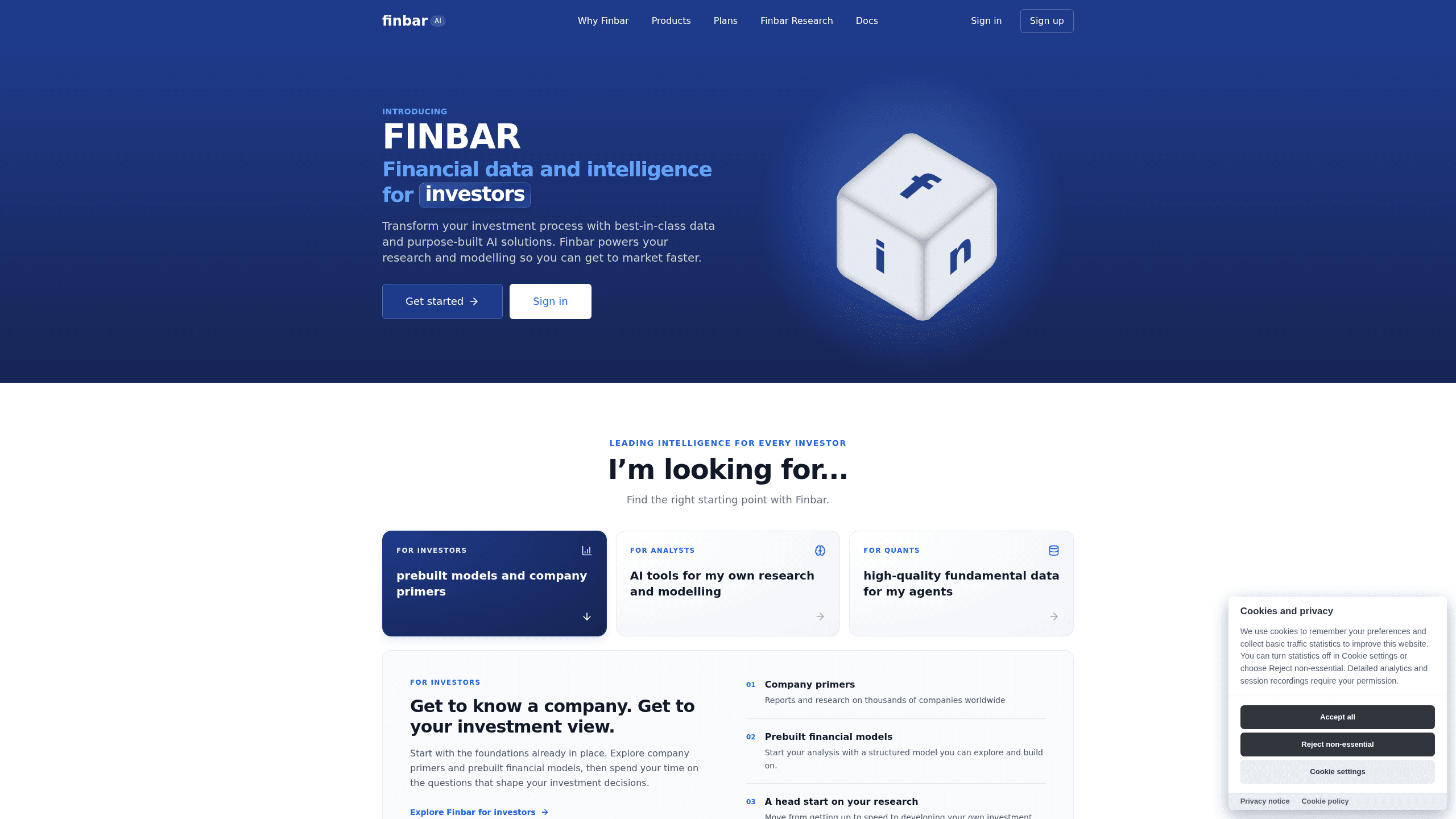
Finbar is an AI research platform for investors, pairing worldwide company fundamentals with prebuilt models and agent access through API and MCP.
About Finbar
What Is Finbar
Finbar is a financial research workspace from CEL Technologies, a London company that went through Y Combinator's Winter 2025 batch. It collects fundamental data from annual reports, investor presentations and earnings call transcripts, then puts AI tools on top so analysts spend their hours on interpretation instead of copying numbers into spreadsheets.
The coverage runs across thousands of public and private companies. You get company primers, downloadable models you can rebuild, and a research assistant that answers with citations back to the paragraph or table it used. Finbar says customers with more than $250bn in combined assets under management rely on it, which is the kind of claim worth testing on your own coverage universe before you commit a team to it.
The limits are price and scope. The individual plan costs $200 a month, and most AI work draws on a credit balance, so a heavy earnings season uses credits faster than a quiet quarter. Finbar handles research and modelling, not trade execution, portfolio accounting or personal financial planning.
Getting Started
- Sign up at app.finbar.com. The Free plan includes $5 of monthly AI credits, which is enough to test the data quality on a handful of companies.
- Search a company by name or ticker and open its primer to see the saved overview, segments and product lines.
- Ask the assistant a question about that company, or open a prebuilt model and change the assumptions yourself.
- Connect the Excel add-in, the REST API or the MCP server when you want the same data inside your own workflow.
Product Information
A quick look at Finbar's pricing, supported platforms, and performance.
Best for
The users, tasks, and scenarios where this tool fits best.
Users
- Equity research analysts
- Private equity and venture associates
- Individual investors who already build their own models
Tasks
- Building a first three-statement model for a new name
- Screening across markets
- Digging figures out of filings
- Updating a model after earnings
Scenarios
- Earnings season, when several portfolio companies report in the same week and the model refresh has to happen between calls.
- Early diligence on an unfamiliar company, where the primer gives you the business description and segment map before you open the filings.
- Research that lives in Excel, where the add-in keeps the data next to the formulas your team already trusts.
Key features
Company primers
Each covered company gets a written primer with an overview, products, geography, segments and history. The sections carry inline citations where the source allows it, so you can check a claim without leaving the page. It is the fastest way to get oriented on a company you have never modelled.
Prebuilt financial models
Finbar ships structured models you can download, open and rebuild around your own assumptions. The Free plan allows one download a month, while paid plans remove the cap. Starting from a working model saves the mechanical setup and lets you spend the time on the forecast that matters.
Worldwide fundamental data
The dataset covers company reports, presentations and transcripts from markets around the world, with new filings processed within minutes of release. Finbar puts the figure count above one billion datapoints. For a global mandate, that reach matters more than any single feature.
Cited AI research
The research assistant turns AI investment research into something you can check: it answers questions about a company and points back to the paragraph or table behind each answer. You can search across documents, read the source passage, then keep the document and item IDs if you need an audit trail. Answers you can trace are worth more than answers that merely sound confident.
Excel add-in
The add-in pulls Finbar data into a workbook and lets you build or refresh a custom model without leaving Excel. Teams that already run their process in spreadsheets keep their templates and add the data layer underneath. Updates that used to take an afternoon finish in seconds.
API and MCP server
A financial data API at api.finbar.com/v1 covers companies, documents, document search and dataset runs, and an MCP server at mcp.finbar.com/mcp exposes the same tools to assistants such as ChatGPT or Claude. The agentic investment research workflow becomes possible when your assistant can resolve a company, list its reports and read the relevant paragraphs on its own.
Pros and cons
Pros
- Data, models and AI tools sit in one subscription instead of three separate vendors.
- Every AI answer can be traced back to a source document and item, which matters when someone asks how you got a number.
- The Excel add-in keeps existing spreadsheet workflows intact.
- API and MCP access mean the same data reaches your own code and your AI assistant.
- Free plan with $5 of credits lets you judge data quality before paying.
Cons
- $200 a month for the individual plan puts it out of reach for casual investors.
- AI credits run out during heavy research periods, and the top-up model is not published on the pricing page, so budgeting takes a support ticket.
- Private company coverage is listed as early access on Enterprise, which leaves VC and PE teams on the tier they can least afford to test.
- There is no public pricing for API usage beyond the plan allowances, so developers cannot estimate cost per request in advance.
Frequently asked questions
Finbar collects fundamental financial data from company filings and presentations, then gives you tools to research, model and export it. In practice you use it to build or update a financial model without copying figures out of PDFs by hand.
Related content
Explore related tools, skills, and articles for Finbar.
Finbar Alternatives

Base Code
Base44 (Wix) · Coding · ProductivityBase Code is a shared cloud development environment from Base44. Teammates describe changes to an existing GitHub codebase in chat, preview them live and send them back as pull requests.

Knocket
Knocket (Tencent RTC team) · Productivity · Business · ChatbotKnocket is a free live chat and contact page tool that lets visitors message you from your website, app, or a shareable link, with every reply handled from Telegram or one inbox.

FloorGen
Vinit Kumar (FloorGen) · Productivity · China AIFloorGen is a browser-based floor plan maker that turns a sentence or a sketch into an editable 2D plan and a 3D walkthrough. Export to PDF, DXF or video, and draw without an account.