

FindYourTriggers
FindYourTriggers · Leaning · AI Assistant · Chatbot
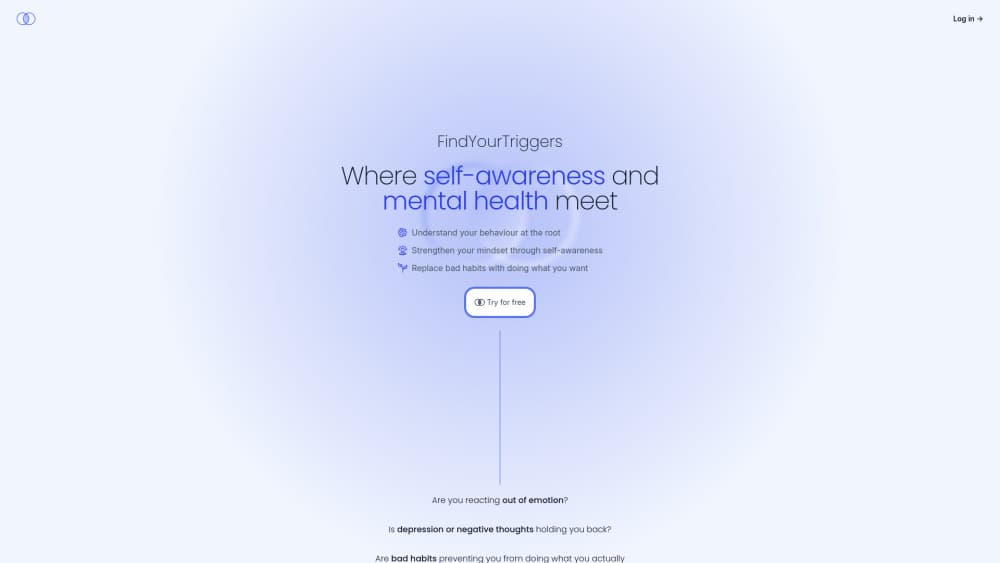
FindYourTriggers is an AI journaling app that helps you spot hidden emotional triggers and track your mood over time.
About FindYourTriggers
What Is FindYourTriggers
FindYourTriggers is a self-awareness app built around one idea: you can't change a reaction you don't understand. It pairs a digital journal with AI analysis, so the emotions you write down get sorted, tagged, and turned into patterns you can actually see instead of a pile of entries you never read again. The founder, Tristan, built it out of his own struggle to understand his reactions, and that origin still shapes the tone. This isn't a clinical tool.
Where it differs from a plain notes app is the trigger focus. Most journals just store text. FindYourTriggers looks for the moments, people, and situations that set you off, then groups them so recurring themes surface on their own without you having to hunt for them entry by entry. Users often describe the moment their own mindmap appears as the first time they saw their behavior laid out in one view.
The limits matter too. It's a web app, not a replacement for therapy, and it won't diagnose anything. If you're in crisis, this isn't the tool for that. What it does well is day-to-day reflection and habit building, not emergency support. The roadmap shows active development, with features like long-term triggers and weekly statistics already shipped and more on the way.
Getting Started
- Create a free account on the FindYourTriggers website using your email.
- Start your first journal entry and describe how your day went and what stirred up a reaction.
- Let the app tag the feelings and triggers it finds in your writing.
- Check your mindmap and weekly statistics to see which triggers keep showing up.
- Make check-ins a daily habit and watch the patterns build over time.
The goal isn't to journal perfectly. It's to give the AI enough material to work with.
Product Information
A quick look at FindYourTriggers's pricing, supported platforms, and performance.
Best for
The users, tasks, and scenarios where this tool fits best.
Users
- Anyone noticing repeated emotional reactions
- People in therapy or coaching
- Habit changers
Tasks
- Trigger tracking
- Journaling with structure
- Mood logging
- Spotting behavior patterns
Scenarios
- After a rough argument or a stressful day
- Weekly review
- Preparing for a therapy session
Key features
AI Journaling With Prompt Support
The core of the app is a digital journal that reacts to what you write. Instead of a blank page, you get prompts generated from your own input, which helps when you don't know where to start or when the day felt too ordinary to bother writing about. As you write, the AI picks out triggers and feelings and tags them for you. That tagging is what makes entries searchable later. It sounds small. It changes everything about how you review your own writing.
Trigger Mindmap
The mindmap is a graph of every trigger, feeling, and the causal link between them, and seeing it rendered as a network rather than a list is the part users tend to remember. It sounds abstract until you use it, then it's the clearest picture of your behavior the app offers. Long-term triggers, the ones that run through your whole journal history rather than just today, are included, which means a pattern you've carried for a decade can finally sit next to one that started last week. You get your entire behavioral map in a single view. Not a summary. The whole thing.
Weekly Statistics
Each week the app pulls together the trigger tags and moods that came up most often across everything you logged. This is where patterns that feel random day to day turn into something obvious. If the same situation keeps triggering you, the weekly view will show it. It's the simplest reason to keep checking in. Miss a week and you lose the thread. Simple.
Mood and Streak Tracking
Daily check-ins build a streak, and the app keeps a mood history alongside your entries. The streak is meant to make journaling a habit rather than a one-time effort. Keep it going and you get a timeline of how your mood has moved over weeks and months, which is far more useful than any single snapshot of how you felt on one bad Tuesday when everything went sideways at once.
Import Your Own Journals
You can bring existing journals into the app. It supports importing your own files and even uploading a physical journal through the entry flow. For anyone with years of written entries sitting elsewhere in notebooks, old apps, or scattered files, this means the analysis doesn't start from zero. Your back catalog becomes searchable and taggable like any new entry. That's rare. Most journaling tools make you choose between your history and their analysis.
Privacy by Design
The app's stance is that your data can only be viewed by you, is encrypted, and will never be sold. That's a meaningful promise for a tool holding your most personal writing. Still, should you take any company at its word? It's the kind of claim you should verify against the privacy policy before committing, which the team links directly on the site, because a promise about encryption is only as strong as the document behind it.
Pros and cons
Pros
- The trigger focus is specific, so it does one job well instead of being a generic notes app.
- AI tagging and prompts lower the barrier for people who find blank-page journaling hard.
- The mindmap turns scattered entries into a visual pattern you can act on. No spreadsheets required.
- Journal import lets long-time writers bring their existing history into the analysis.
- Actively developed, with shipped features and a public roadmap you can check.
Cons
- Web only, so there's no native mobile app for quick phone check-ins.
- No API. That rules out connecting it to other tools or automations.
- Prices aren't shown publicly, so you have to sign up to learn the paid tier details.
- It's a reflection aid, not a substitute for professional mental health care.
Frequently asked questions
It's an AI journaling app for understanding your emotional triggers. You write entries, the app tags the triggers and feelings it finds, and you use the resulting patterns to change how you react.
Related content
Explore related tools, skills, and articles for FindYourTriggers.
FindYourTriggers Alternatives

HireKey
HireKey · Voice & Language · Productivity · LeaningHireKey is an AI job search copilot built by a former tech recruiter. It checks role fit, tailors resumes, runs interview practice and tracks every application.

Lune
Retrograde Labs · Productivity · LeaningLune is a research search engine for scientific AI agents. It runs as an MCP server that lets Claude, ChatGPT and Cursor search peer-reviewed computer science papers and cite them.
Coddy
Coddy · Coding · LeaningCoddy is a gamified platform to learn to code through short interactive lessons in 20+ languages, with a browser editor, an AI tutor and free certificates.