

Flora Incognita
Technische Universität Ilmenau & Max Planck Institute for Biogeochemistry · Image
Flora Incognita is a free AI plant identification app from German researchers. Snap a flower or leaf, and it names the species from more than 30,000 plants.
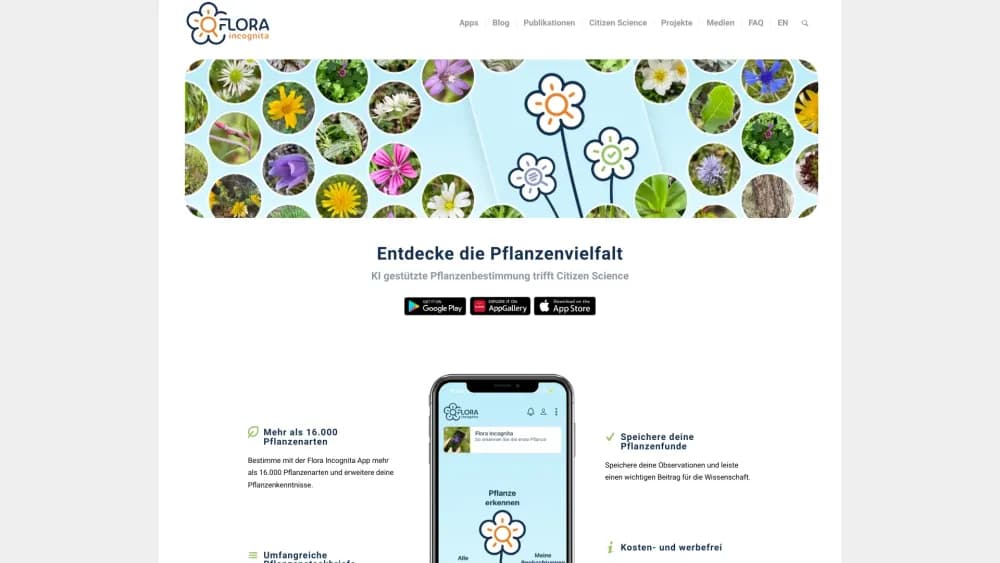
About Flora Incognita
What Is Flora Incognita
Flora Incognita is a plant identification app built by scientists at the Technical University of Ilmenau and the Max Planck Institute for Biogeochemistry in Jena. You point your phone at a plant, take a close photo, and the app suggests a species within seconds. It covers wild herbs, trees, grasses, ferns, cacti, palms, and some cultivated plants.
The project is part of a citizen science effort. Every observation you save feeds biodiversity research, which is why the app asks for your location and stays free. Sightings have been used to track how climate change shifts when plants flower, and a 2024 study on the same image set put its accuracy at 98.8 percent.
Two things shape how it fits. First, it works best on wild plants outdoors, not on houseplants or garden varieties you can't photograph clearly. Second, accurate results depend on sharp, close-up photos of the right plant parts, usually the flower, then the leaf. Treated as a field tool for curious people rather than a botanical key, it holds up well.
Getting Started
- Install Flora Incognita from the App Store or Google Play, then open it. You can skip the profile and tap "Without profile" if you just want wild plant identification without an account.
- Allow camera and location access when prompted. Location sharpens the identification and unlocks the parts of the fact sheet tied to your region.
- Snap the plant. Take a clear photo of the flower first, then the leaf when the app asks. A photo straight from your gallery works too.
- Review the suggested species and add more photos if the match looks uncertain. Tap the green check to save the observation.
- Read the fact sheet for traits, protected status, and distribution, then find the record later under "My observations."
Product Information
A quick look at Flora Incognita's pricing, supported platforms, and performance.
Best for
The users, tasks, and scenarios where this tool fits best.
Users
- Hikers and nature walkers
- Students and teachers
- Budding botanists and gardeners
Tasks
- Identifying a wild plant on a walk
- Recording what grows in an area
- Learning a species in detail
- Contributing to research
Scenarios
- A hike with no mobile signal
- A school field project
- Documenting a garden or allotment over a season
Key features
AI Plant Identification from Photos
The core of the app is a deep learning model that matches your photo against a library of more than 30,000 vascular plants. You shoot the flower first, and the app prompts you for the leaf next to firm up the match. Since 2025 it also covers around 3,000 lichen and fungus species, plus roughly 500 common mosses.
Offline Mode for Remote Places
When your phone loses signal, Flora Incognita switches to offline mode. You can still take three photos per plant, save the observation, and run the identification once you have a connection again. That matters on a mountain trail or anywhere coverage drops.
Detailed Species Fact Sheets
Every result comes with a fact sheet covering traits, protection status, and distribution. Much of the local detail, such as whether a species is common or rare near you, is shown in relation to your location, so the same plant reads differently depending on where you are.
Observation List and Map
Confirmed sightings are saved automatically to your profile and shown in a list and on a map. You can revisit them any time, filter and sort your records, and share individual finds to social media.
Export to CSV and GPX
Your observation list can be exported with images, species names, and coordinates as a CSV table or a GPX file. Guides from the project show how to load those files into Google Maps, QGIS, or R for your own mapping projects.
Flora Routines and Citizen Science Projects
For power users, Flora Routines automatically attach tags to observations within a set time, at certain locations, or for target species. That makes it easy to join research projects inside the app, where tagged observations feed published studies.
Pros and cons
Pros
- Completely free with no ads, no premium tier, and no subscription, so there's nothing to unlock behind a paywall.
- Handles more than 30,000 vascular plants plus mosses, lichens, and fungi, a range that covers most plants you'll meet outdoors.
- Works offline, so a lost signal on a hike doesn't stop you from recording a plant.
- Comes from a genuine research project, so identifications are backed by published studies and independent accuracy checks.
- Can run without an account, which lowers the barrier for a one-off use.
Cons
- Accuracy depends on your photos, so blurry or far-away shots can return a wrong or uncertain match, which means you should retake the picture rather than trust the first guess.
- It's tuned for wild plants, so houseplants and many garden cultivars may not be in the library, and you'll need a different tool for those.
- Sharing your location adds the most value, so the app is less useful for private or indoor plant logging if you'd rather not share coordinates.
- There's no public API, which rules out building your own tools on top of the identification model.
Frequently asked questions
Yes. The app is free of charge and advertising, with no premium version or subscription. It's funded as a research project rather than sold as a product.
Related content
Explore related tools, skills, and articles for Flora Incognita.
Flora Incognita Alternatives

Google EmbeddingGemma 2
Google DeepMind · Writing · Image · CodingGoogle EmbeddingGemma 2 is a 740M-parameter open model that turns text, code, images, audio, and video frames into vectors in one 768-dimension space, running on phones and laptops.

Tractionwave
TractionWave · Image · MarketingTractionWave is an AI attention heatmap tool for static ads. Upload a PNG or JPG and it returns predicted attention, ranked hotspots, and fixes before you spend budget.

Imejis.io
Imejis.io · Image · MarketingImejis.io is an AI design studio for agents and marketing teams. Describe an image in plain words, and it writes the copy, builds the layout, reflows it to every size, then exports a finished file.