

Gymglish: Learn a language
Gymglish · Leaning
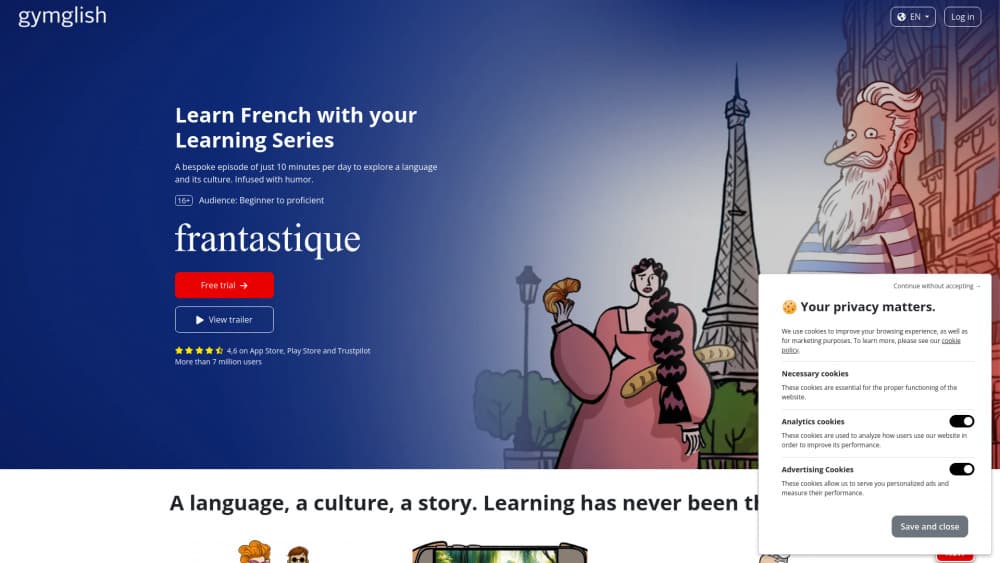
Frantastique is Gymglish's French course, built around one short daily episode with exercises, a personal correction, and a cultural clip. A lesson takes about 10 to 15 minutes.
About Gymglish: Learn a language
What Is Frantastique
Frantastique is the online French course from Gymglish, a French company that has published adaptive language courses since 2004. A lesson isn't a grammar unit with a page of drills. It's an episode in a running story about a cast of characters, followed by questions, a correction written for your answers, and a clip from a French film, series, or song. Gymglish says 8 million learners have used its courses, and that more than 6,000 companies, universities, and public bodies run them.
The gap it fills sits between a free gamified app and a private tutor, which is the space most AI language learning tools aim at. Apps keep you tapping but stall at intermediate level, and a tutor costs far more per hour than most people who want to learn French are ready to spend. Frantastique asks for 10 to 15 minutes a day and adjusts the next episode to what you got wrong, which is the part a fixed textbook can't do.
The limits matter before you sign up. There's no free tier, only a 7-day trial, so long-term use means a subscription that starts at €14 per month. Corrections are text, not a live teacher, and most of the work is reading, writing, and listening. Speaking practice exists through a chat with the story's hero, but it doesn't replace conversation with a person. Ask about levels above C1 if you're already fluent, because the top of the course is thinner than the middle.
Getting Started
- Take the free French level test on the Frantastique site. It places you between A1 and C2 and sets the starting difficulty.
- Start the 7-day trial without a card. The first episode of your series arrives straight away, on the web or in the app.
- Answer the day's questions, then read the correction. It shows your score, explains each mistake, and lists the vocabulary you asked about.
- Pick a subscription length in the shop, and choose whether lessons arrive by email or only in the app. Monthly plans renew until you switch off auto-renewal.
Product Information
A quick look at Gymglish: Learn a language's pricing, supported platforms, and performance.
Best for
The users, tasks, and scenarios where this tool fits best.
Users
- Adults returning to French after years away
- Professionals who need business French
- Culture-driven learners
Tasks
- Keeping a daily habit going
- Fixing grammar gaps you can't name
- Practising listening across accents
- Preparing for work in a French-speaking country
Scenarios
- A lunch break at the office
- Reviving French before a trip
- Keeping up French after a class ends
Key features
A Daily Episode Instead of a Drill
Each lesson is a chapter in a serial story about a group of characters, written by the Gymglish team. You read or listen, answer questions about what happened, and get the next chapter tomorrow. The story is the hook, and the grammar sits inside it rather than in a separate list.
AI-Tuned Difficulty
The course tracks your answers and adjusts the next lesson to your level, your goals, and the points you keep missing. Gymglish describes the method as AI-powered, with human-written stories underneath it. In practice, a weak spot comes back a few days later instead of disappearing after one correct answer.
Corrections That Explain the Mistake
After you submit, you get a score, an explanation for each question, the vocabulary you flagged, and a transcript of the audio. The explanation is the useful part: it tells you why the subjunctive was needed, not just that you picked the wrong option. Answers can be reviewed later in your account.
Conversation Practice With the Hero
A chat mode lets you talk with the main character of your series in French. You type or speak, and the reply stays in character. It's a low-pressure way to build sentences, and it's clearly a scripted assistant rather than a teacher who corrects your accent.
Culture Built Into the Lesson
Episodes draw on French, Belgian, and Canadian life: films, songs, food, history, and the small social rules that decide whether a phrase lands. Each lesson ends with a cultural note, which is why the course suits people who want the language with the culture attached.
Level Test and Completion Certificate
A placement test sets your starting point, and the course keeps evaluating you as you go. Finish the programme and you get a certificate of completion. The test is also useful on its own if you only want to know where you stand before choosing a course.
Pros and cons
Pros
- Ten to fifteen minutes a day fits a real schedule, and the short format makes a missed day easy to recover.
- Corrections explain the reasoning, so mistakes turn into rules you can reuse instead of red crosses.
- Stories and film clips give the lessons a reason to exist beyond the exercise, which helps with the habit.
- Content covers everyday and business French, with accents from several French-speaking countries.
- The level test and the certificate give you a starting point and a finish line, both rare in subscription apps.
Cons
- There's no free tier: after 7 days you pay, and monthly billing runs from €14 to about €90 depending on the plan.
- Speaking is limited to a scripted chat, so pronunciation and real conversation still need a tutor or a language partner.
- The pace is fixed at one episode a day, which frustrates people who want to binge a level in a weekend.
- Nothing here prepares you for a specific exam paper, so DELF or DALF candidates still need separate practice.
Frequently asked questions
Frantastique is an online French course from Gymglish. You get one short episode a day, built around a continuing story, followed by exercises, a personal correction, and a cultural clip.
Related content
Explore related tools, skills, and articles for Gymglish: Learn a language.
Gymglish: Learn a language Alternatives
HireKey
HireKey · Voice & Language · Productivity · LeaningHireKey is an AI job search copilot built by a former tech recruiter. It checks role fit, tailors resumes, runs interview practice and tracks every application.
Lune
Retrograde Labs · Productivity · LeaningLune is a research search engine for scientific AI agents. It runs as an MCP server that lets Claude, ChatGPT and Cursor search peer-reviewed computer science papers and cite them.
Coddy
Coddy · Coding · LeaningCoddy is a gamified platform to learn to code through short interactive lessons in 20+ languages, with a browser editor, an AI tutor and free certificates.