

The Full Stack
The Full Stack (Full Stack Deep Learning) · Leaning · Other · Prompts
The Full Stack is a free course series from UC Berkeley PhD alumni that teaches how to build AI products, from data work and deployment to prompt engineering and LLMOps.
About The Full Stack
What Is The Full Stack
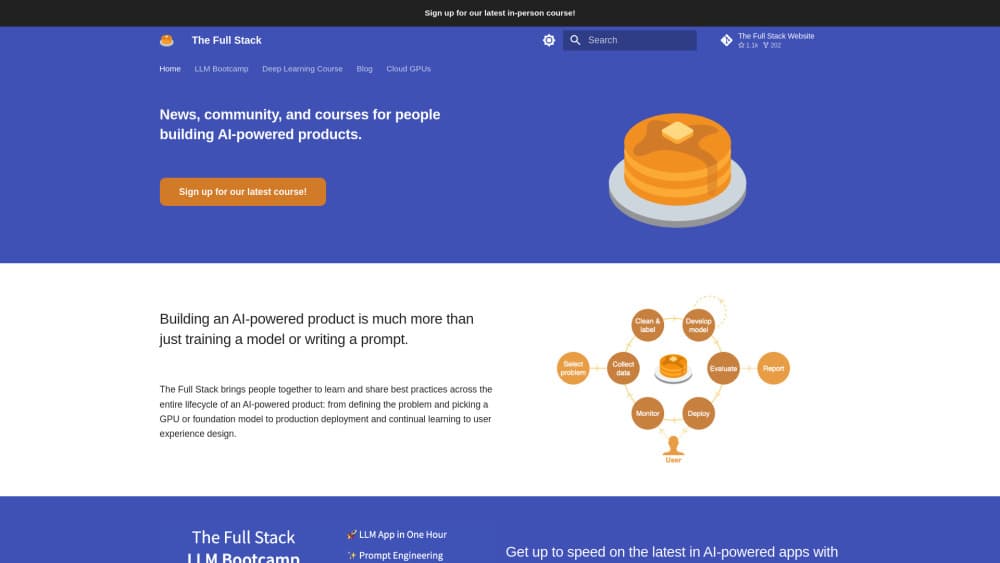
The Full Stack, also known as Full Stack Deep Learning, is a teaching project built by a small team of UC Berkeley PhD alumni who have shipped machine learning systems at OpenAI, Weights & Biases, and their own startups. Its premise is simple: getting a model to train is the easy part, and everything around it decides whether a product works.
The material covers the whole lifecycle of an AI-powered product. It starts with problem selection and moves through data and experiment management, testing of models that keep changing, deployment, and post-launch monitoring. The newer LLM track adds prompt engineering, augmented language models, and the UX questions that come with chat-style interfaces. Most AI product development advice online stops at the model, and this course starts where that advice runs out.
The main limitation is freshness. The lectures are recordings, so they describe the tools and model capabilities of the year they were taped. The team says so directly on the site, and viewers should treat specific library names as historical examples rather than current recommendations. There's also no cohort, no grading, and no instructor feedback on the free track.
Getting Started
- Open fullstackdeeplearning.com and pick a track: the 2022 deep learning course or the 2023 LLM Bootcamp.
- Skim the schedule and start with the lecture on course vision and when to use machine learning, which frames the rest of the series.
- Watch the pre-labs on CNNs, transformers, and PyTorch Lightning if your deep learning background is thin.
- Follow one lab end to end, such as experiment management or web deployment, on your own project rather than a sample dataset.
- Subscribe to the mailing list or YouTube channel if you want to hear about future iterations.
Product Information
A quick look at The Full Stack's pricing, supported platforms, and performance.
Best for
The users, tasks, and scenarios where this tool fits best.
Users
- Software engineers moving into AI work
- ML engineers with model training experience
- Product managers and founders scoping an AI feature
- Students and researchers
Tasks
- Deciding whether a problem needs machine learning at all
- Setting up experiment tracking and testing
- Moving a model from notebook to production
- Learning how LLM apps get built
Scenarios
- Self-paced study over a few weeks
- Onboarding a team onto production ML practices
- Testing the water before paying for a bootcamp or an MLOps course
Key features
Free 2022 Lecture Library
Nine recorded lectures cover course vision, development infrastructure, debugging and evaluation, data management, deployment, continual learning, foundation models, team process, and ethics. Each lecture ships with slides and a written summary, so you can read instead of watch. The whole set stays free, and the team describes it as free forever.
Full Stack LLM Bootcamp Recordings
The April 2023 LLM Bootcamp adds eight sessions built around language model applications, including prompt engineering, LLMOps, UX for language user interfaces, augmented language models, and a walkthrough that launches a working LLM app in an hour. These are recordings of an in-person event, published with the same free access as the older course material.
Hands-On Labs
Eight labs pair with the 2022 lectures and walk through experiment management, data annotation, troubleshooting, web deployment, and model monitoring. Each one uses a real tool stack rather than a toy example, so you finish with something deployable. The labs are the part that turns the lectures into skills you can reuse at work.
LLMOps Coverage
The LLMOps lecture deals with the operational side of shipping language model features: evaluating outputs that have no single correct answer, tracking cost and latency, and handling model updates that change behavior overnight. This is the material most teams lack when their first prototype meets real users. It stays at the level of first choices and pointers, not a full engineering manual.
Prompt Engineering and Interface Design
Two sessions treat prompting and interface design as product problems rather than tricks. The prompt engineering lecture covers structured prompts, few-shot examples, and failure modes, while the UX session looks at how chat interfaces hide or expose system state. Watching both together is more useful than either alone, since a good prompt in a bad interface still fails.
Project-Based Learning Path
The 2022 course includes a group project with proposals, milestones, and a final presentation, and the recorded project talks are public. You can follow the same structure alone: pick a small product idea, run it through the labs, and present it to a friend or teammate for feedback. The projects show what a realistic scope looks like for a few weeks of part-time work.
Pros and cons
Pros
- Everything is free, including slides, labs, and recordings, with no signup wall in front of the lectures.
- Instructors have shipped real systems at OpenAI, Weights & Biases, and Volition, so the advice comes from production work rather than theory.
- The scope covers the unglamorous parts that decide projects, such as data management, testing, and monitoring.
- Labs use current-at-the-time tooling end to end, which makes the workflow easy to copy into your own repo.
- The LLM track addresses interface design and evaluation, two areas most prompt engineering content skips.
Cons
- Recordings age fast. Tool names and model capabilities from 2022 and 2023 have moved on, so you'll need to check current docs for anything version specific.
- There's no cohort, deadline, or feedback, which makes finishing hard for people who need external pressure.
- The free track offers no certificate or credential, so it won't satisfy formal training requirements on its own.
- Coverage stops at first choices and pointers for many operational topics, which leaves gaps if you need deep production guidance on a specific stack.
Frequently asked questions
Yes. Every lecture, slide deck, lab, and recording on the site is free to watch, and the team states the 2022 material is free forever. There's no paid tier and no account needed to reach the videos.
Related content
Explore related tools, skills, and articles for The Full Stack.
The Full Stack Alternatives
HireKey
HireKey · Voice & Language · Productivity · LeaningHireKey is an AI job search copilot built by a former tech recruiter. It checks role fit, tailors resumes, runs interview practice and tracks every application.

Lune
Retrograde Labs · Productivity · LeaningLune is a research search engine for scientific AI agents. It runs as an MCP server that lets Claude, ChatGPT and Cursor search peer-reviewed computer science papers and cite them.
Coddy
Coddy · Coding · LeaningCoddy is a gamified platform to learn to code through short interactive lessons in 20+ languages, with a browser editor, an AI tutor and free certificates.